
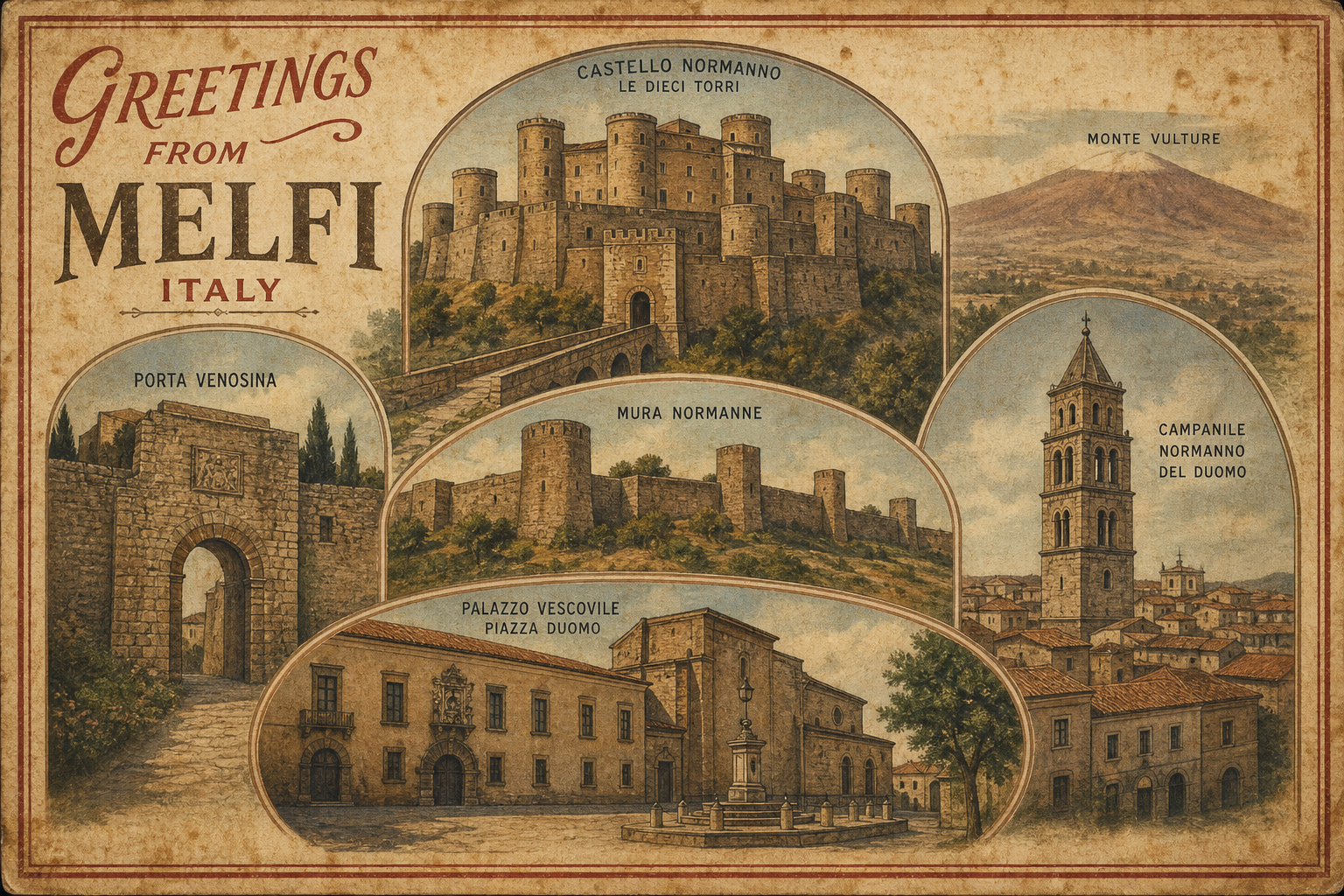
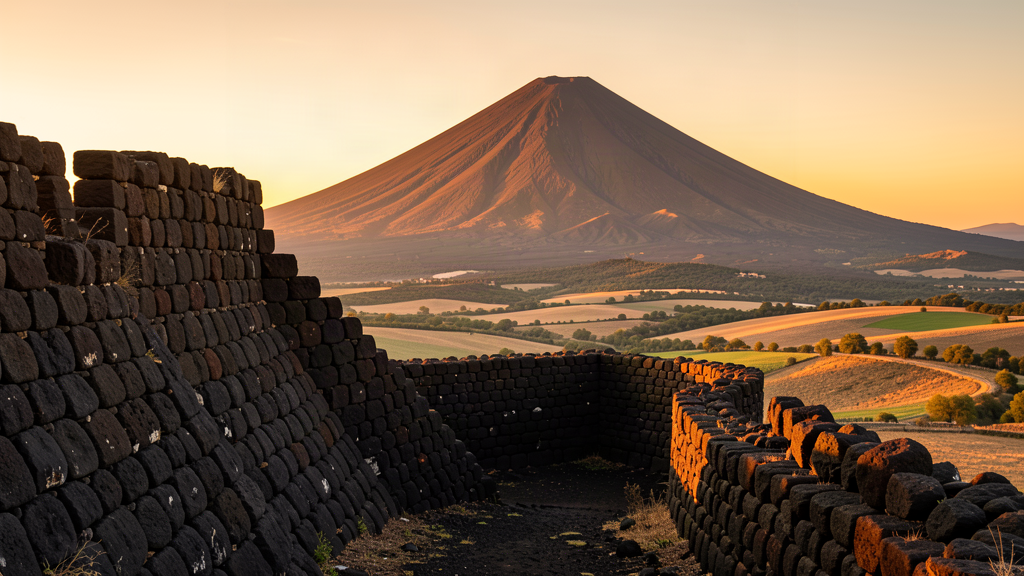
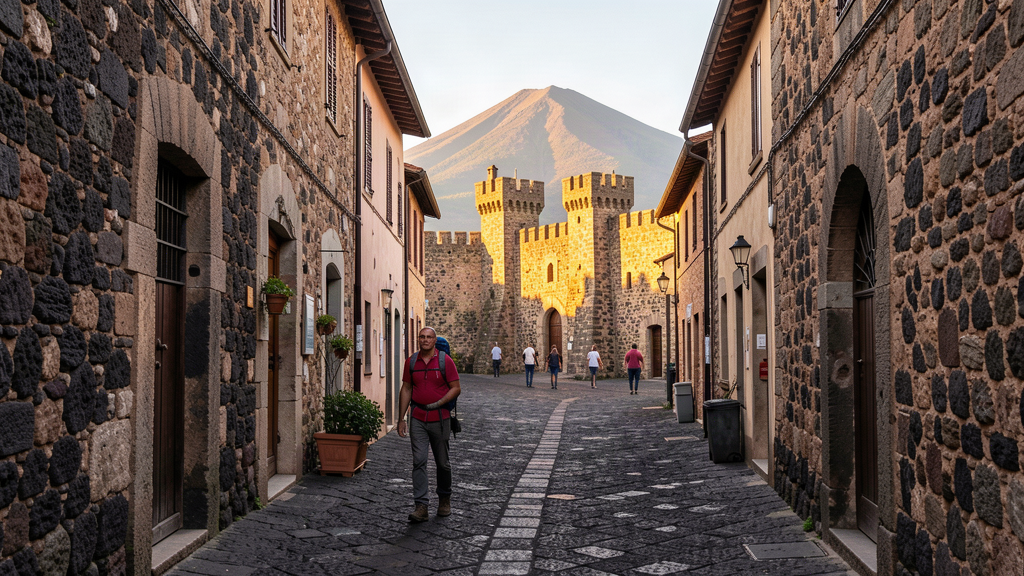
Melfi does not open with a beach or a cave city. It opens with a dark castle on a hill and an extinct volcano off to the side. Monte Vulture softens the skyline into a long green shoulder. The town sits on its lower slope in northern Basilicata, roughly between Naples and Bari if you are thinking in road distances, and the walls look built from the same stubborn volcanic rock that once came out of that mountain.
This is a working Norman town more than a costume set. People shop under the ramparts, park around ZTL edges, and treat the castle as both landmark and local museum. Come if you are driving through Vulture wine country, if Matera already filled your week, or if you want lava stone, Frederick II, and Aglianico after the walk. Start at the walls. Finish with something red.
The castle that still runs the skyline
Castello di Melfi is not a distant ruin you admire from a parking lot and leave. It sits on the high edge of town with towers, a moat line on three sides, and walls that grew from a Norman rectangle into a denser fort. The stone looks almost black in low light. Up close, it is local volcanic rock, cool to the touch, scratched by weather rather than polished.
Inside, the Museo Archeologico Nazionale del Melfese “Massimo Pallottino” holds what the countryside keeps giving up: Daunian, Samnite, Roman, and medieval layers. Go for an hour if you like context. People mention the sarcophagus of Rapolla; the quieter cases — small bronzes, pottery, everyday metal — do more to explain why this hill mattered.
Frederick II is the name you will hear most. In 1231 the Constitutions of Melfi were issued here, a legal code meant to pin an empire to paper. You do not need the clauses. Stand in the courtyard, and it is clear this was not scenery. It was government with a view.
Walk the exterior circuit when you can. From the ramparts, the Vulture plain opens in bands of fields, roads, and distant roofs. On clear days the mountain’s soft cone steadies the whole picture. Wind is part of the visit. Bring a layer even when the valley looks warm.
Porta Venosina and the lived-in core
Leave the castle and drop into the historic fabric on foot. Porta Venosina is the pointed gate that still feels like a tight passage between outside and inside — stone, shadow, then sudden street. Beyond it, lanes tighten and open without fuss: laundry, scooters, municipal notices, a bar already loud with standing locals before ten.
Piazza Duomo is home to the Cattedrale di Santa Maria Assunta. The interior has later baroque dress; the campanile keeps a more Norman memory and is the vertical marker you use when you get turned around. Step inside if the door is open, then keep walking. Melfi’s centro is best taken as a loop of short streets rather than a checklist of masterpieces.
Via Vittorio Emanuele and the nearby streets carry daily errands more than souvenirs. Piazza Abele Mancini still carries the old nickname of market square in local memory — the place outside the walls where trade once sat. You may not catch a big market day. You will catch the habit: people cross these spaces because they need bread.
Do not confuse Melfi with Craco. Craco is the abandoned landslide village further south. Melfi is inhabited and municipal. If you have a car, Santa Margherita’s crypt just outside the denser fabric rewards a slow half hour.
Vulture underfoot, Aglianico in the glass
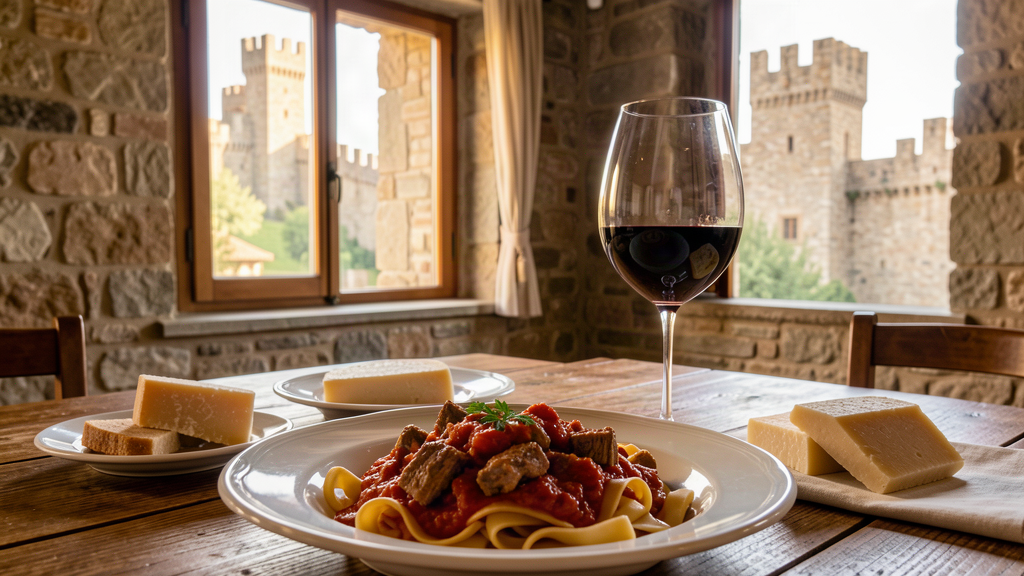
The mountain is extinct, but the soil still does a lot of work. Volcanic ground underpins the Aglianico del Vulture story that makes this corner of Basilicata worth a detour. Aglianico here runs dark, tannic when young, and patient when cellared. It is not a soft welcome wine. Pair it with grilled meats, aged cheese, and the pepper-and-herb cooking of the Lucanian interior.
Order the house Aglianico with lunch. If you want a dedicated visit, better-known cellars cluster in nearby Rionero in Vulture, Barile, and Venosa — a short drive when the castle morning is done. Book ahead; weekdays are kinder than Saturday afternoons in harvest season.
Food stays mountain-leaning: lagane e ceci, lamb or pork with herbs, wild greens, pezzente and other cured meats, bread with a real crust. Peperoni cruschi from the wider Basilicata pantry show up fried, brittle, and salty. Menus that translate every dish three ways are usually less interesting than the room where specials are written once, in Italian.
Eating without the costume
Book Friday and Saturday nights. Weeknights are easier. Portions run honest.
Trattoria Oasi Gialloverde, Via Gabriele D’Annunzio 23, 85025 Melfi PZ, is a practical Lucanian table on a real town street — regional cooking, outdoor seats when weather allows, the kind of place where Aglianico makes more sense than a random international list. Go for primi with legumes or pasta, then a simple secondo. Reservations help on weekends.
La Taverna Del Borgo Da Felice, Piazza Giuseppe D’Addezio Toga Doro 1, 85025 Melfi PZ, sits closer to the historic fabric and works when you want pizza and cucina tipica without leaving the walkable core. Good middle choice after the castle: not a shrine, not a snack counter.
Miseria e Nobiltà, Via Gabriele D’Annunzio 58, 85025 Melfi PZ, leans Italian and pasta-forward in a straightforward room. Useful when you want a sit-down meal with a clear address. Confirm opening hours; inland towns still keep honest midday closures.
For a slower evening with a car, Trame at Hotel Il Castagneto, SP ex SS 401 Km 3,100, direzione Laghi di Monticchio, 85025 Melfi PZ, pairs countryside quiet with a kitchen that can stretch beyond the daily specials.
Daytime stays simple: coffee near Piazza Duomo, a panino, fruit if a stall is out. Save the long meal for after the ramparts.
Places to stay
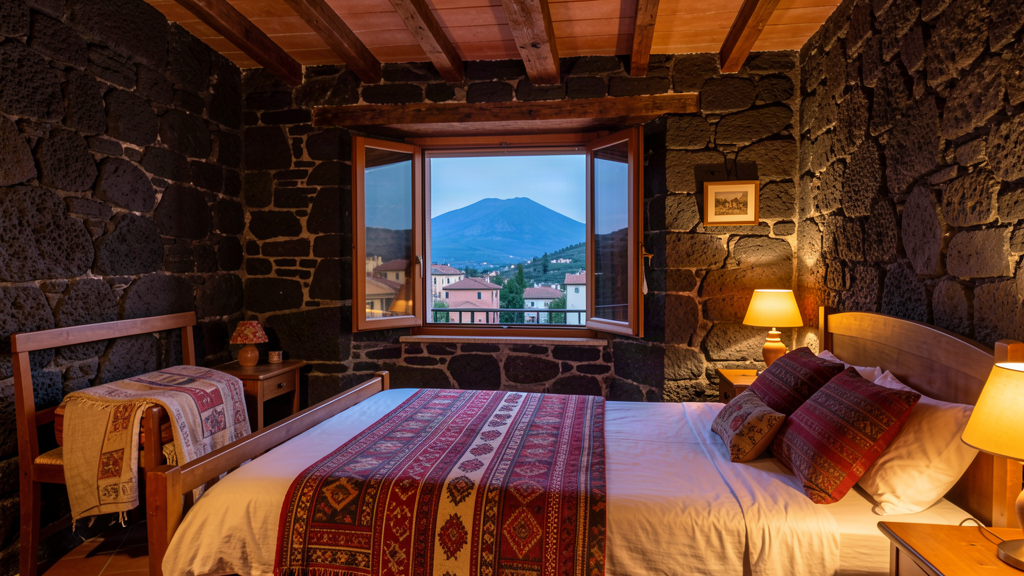
Sleep against the historic core if you want to walk out to the castle at dusk. Sleep near the station if you arrive by train. A countryside hotel toward Monticchio works if Melfi is one night in a Vulture loop.
Budget: B&B Il Melograno, Via Commenda di Malta 51, 85025 Melfi PZ. Small, clean rooms and a host who knows the short walks to the walls. You trade grand lobby theater for a fair rate and residential quiet still within an easy stroll of the centro.
Midrange: La Casa nel Borgo Antico, Via Vittorio Emanuele 27, 85025 Melfi PZ. A compact stay in the old fabric, minutes on foot from the castle approach and the cathedral square. Rooms are comfortable rather than design-magazine. The point is location: finish dinner and walk home on stone.
Splurge: Hotel Il Castagneto, Strada Provinciale ex SS 401 dell’Alto Ofanto e del Vulture, 85025 Melfi PZ. A few kilometers out toward the Monticchio lakes road, with parking and the Trame restaurant on site. Choose it when you want space, a quieter night, and a base for winery drives.
If you need a practical hinge by rail, Hotel Due Pini, Piazzale Stazione, 85025 Melfi PZ, sits near the station with parking and a no-drama base for early departures. Useful, not romantic.
Getting here and moving around
Melfi is inland. Naples and Bari are the usual air gateways, then a car or a patient train link. The station sits below the historic center, so budget the walk or a short hop up. A car is the practical tool if you combine Melfi with Rionero, Barile, Venosa, the Monticchio lakes, or a wider circuit toward Potenza or Matera.
Watch for ZTL zones. Park outside the tightest streets and finish on foot. Shoes matter on stone. Summer heat sits differently than the coast; winter can turn sharp. Shoulder seasons are kind for the ramparts.
A day that fits the walls
Morning: coffee near the cathedral, then the castle as soon as it opens. Give the museum an hour, then walk the exterior circuit while light is still clean on the lava stone. Midday: lunch at Oasi Gialloverde or the Taverna, slow enough that the Aglianico has time to open. Afternoon: Porta Venosina and a second loop of lanes, or a short drive to a Vulture cellar if you booked one. Late day: rampart views when the plain softens. Evening: dinner in town or out at Trame, then early sleep if tomorrow is wine roads.
Melfi will not compete with Matera’s cave drama or the polished white towns further east. It should not try. This is a Norman-Swabian hill town facing an extinct mountain, still lived in, still pouring a serious red when the walk is done. Walk the ramparts, watch Monte Vulture hold the horizon, and order the Aglianico while the light is still on the stone.
