
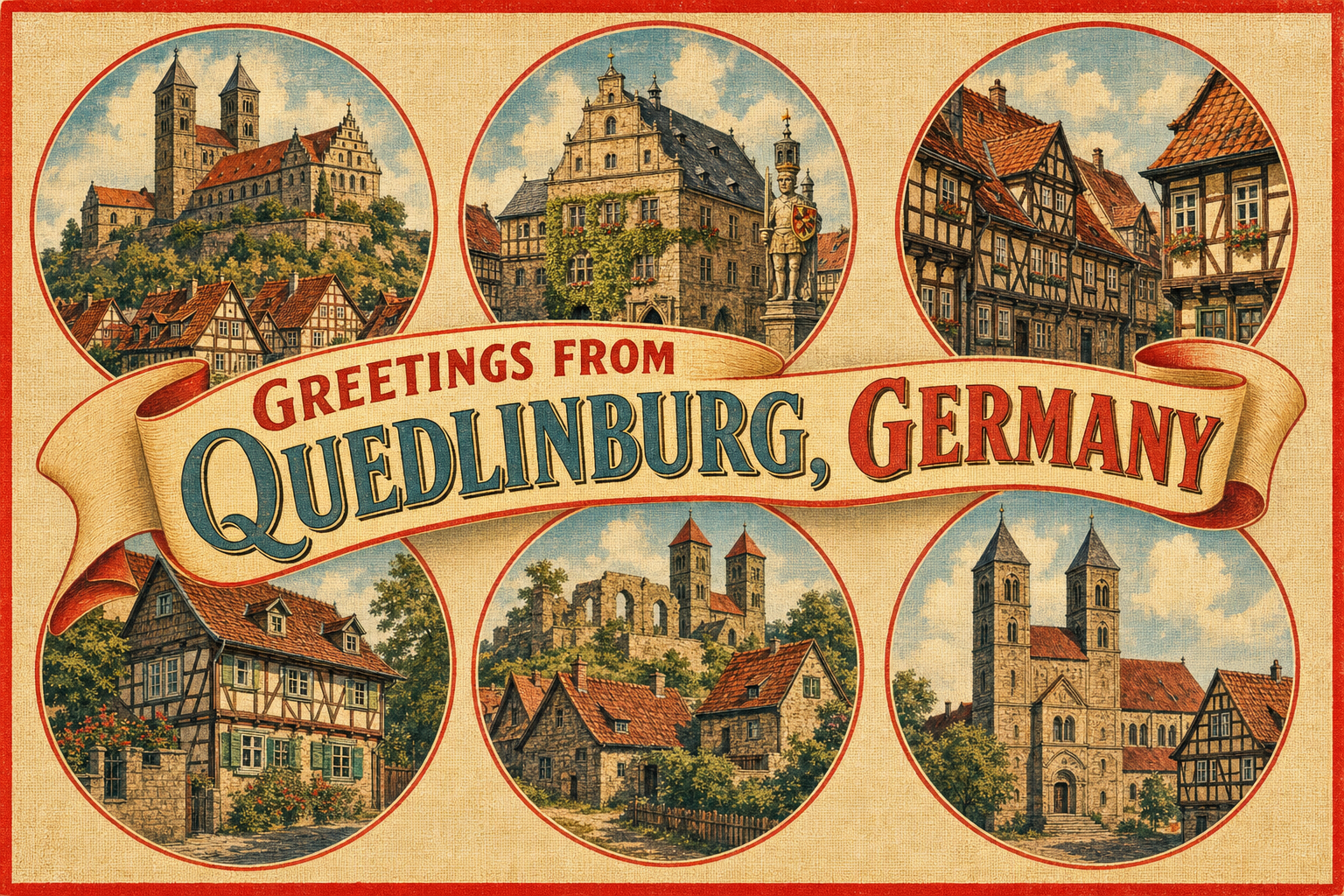
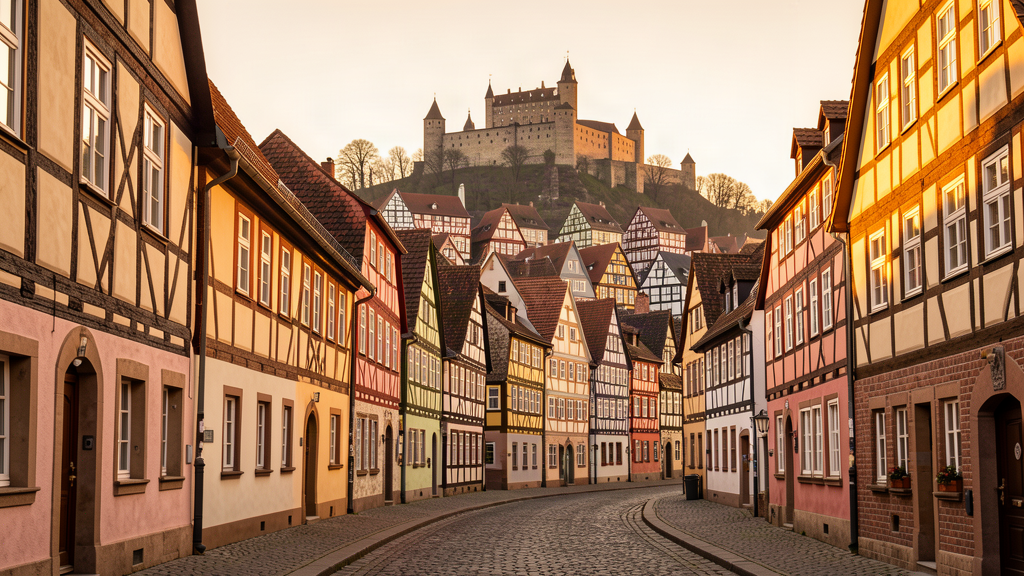
Harz day-trippers often treat Quedlinburg as a half-timber photo stop between Wernigerode and the Brocken. I do the opposite. Bags go down near the Bode, then I walk the crooked lanes until the hill pulls me up. Finkenherd comes first, a tight pocket of painted beams and leaning gables, then the climb to Schlossberg, where Stiftskirche St. Servatius sits over the town like a stone lid. Timber, crypt, Käsekuchen on the way down. That loop is why I overnight in Sachsen-Anhalt instead of racing back to Magdeburg on the same train.
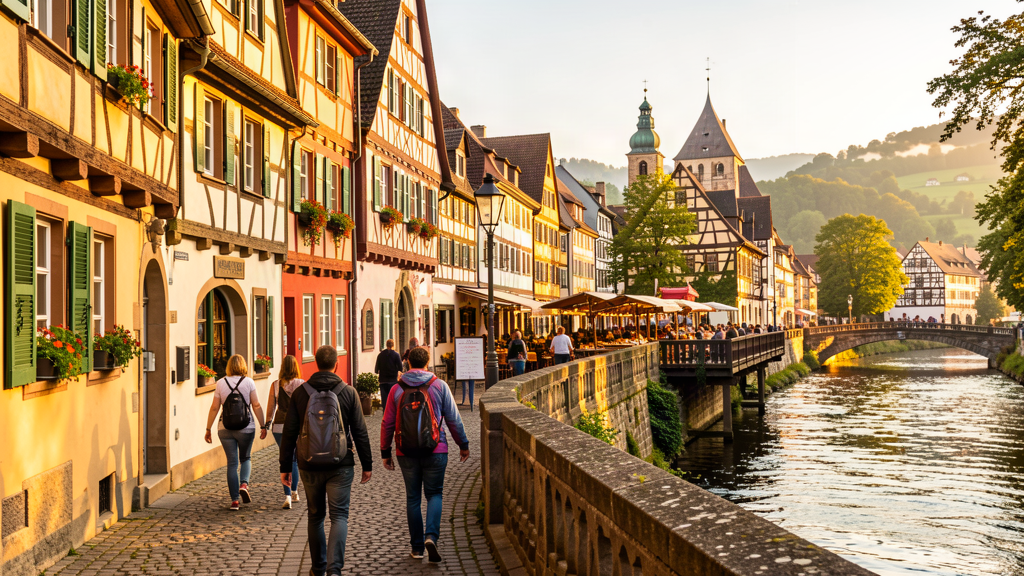
You smell wood smoke and damp cobble first. Then coffee from a ground-floor bakery, and river air when the streets open toward Brühlpark. Quedlinburg keeps roughly two thousand half-timbered houses from six centuries. On a weekday morning, those lanes still feel like they belong to the people who hang laundry in the courtyards.
Finkenherd before the hill
Start low, not at the castle ticket desk. Finkenherd sits on the west flank of Schlossberg, a small square of Fachwerk that tourists find late and locals cut through without ceremony. The houses lean. Paint peels in strips. Window boxes hold whatever survived the last frost. I give the square ten quiet minutes before I take a picture. Sit once on a step facing a carved beam. Watch how the upper stories almost touch across the lane.
From there the Altstadt opens in no particular order, which is fine. Wordgasse and Schloßstraße hold some of the oldest timber work. The Fachwerkmuseum im Ständerbau on Wordgasse 3 explains how a 14th-century frame stands up if you want the technical hour. I usually skip the museum on day one and just walk. Hölle, Judengasse, Schuhhof: short alleys that look staged until someone wheels a bike through with shopping bags. Marktkirche St. Benediktii anchors the Bürgerstadt side. The Roland on the Markt faces a Renaissance town hall that has been patched, not polished, for centuries.
The old town is a UNESCO site for density, not one postcard façade. Keep your phone pocketed for one full circuit. The place makes more sense when you stop hunting the perfect gable.
Schlossberg, St. Servatius, and the crypt
The climb is short and steep enough to slow you down. Schlossberg rises above the timber with the collegiate church of St. Servatius and the Renaissance castle museum on top. Henry the Fowler, first king of the East Frankish realm, was buried here in the 10th century. Queen Mathilde founded the women’s abbey that ran the hill for hundreds of years. Abbesses held real power. You feel that in the stone more than in any brochure line.
I buy the combined ticket and do the church before the castle rooms. The crypt is cool and low. Royal graves, carved capitals, a quiet that tourist chatter rarely fully breaks. Upstairs, the Domschatz holds ivory, goldsmith work, and manuscripts when the treasury is open. Hours shift, so check at the desk. The castle museum covers abbey life and town development. Some rooms feel more archival than theatrical, which suits me.
Outside, the terrace drops over red roofs toward the Harz fringe. One slow circuit of the wall is enough, then down the path to street level again. The hill works best as a morning climb, when the light is still flat on the timber below.
Käsekuchen, Bode water, and Brühlpark
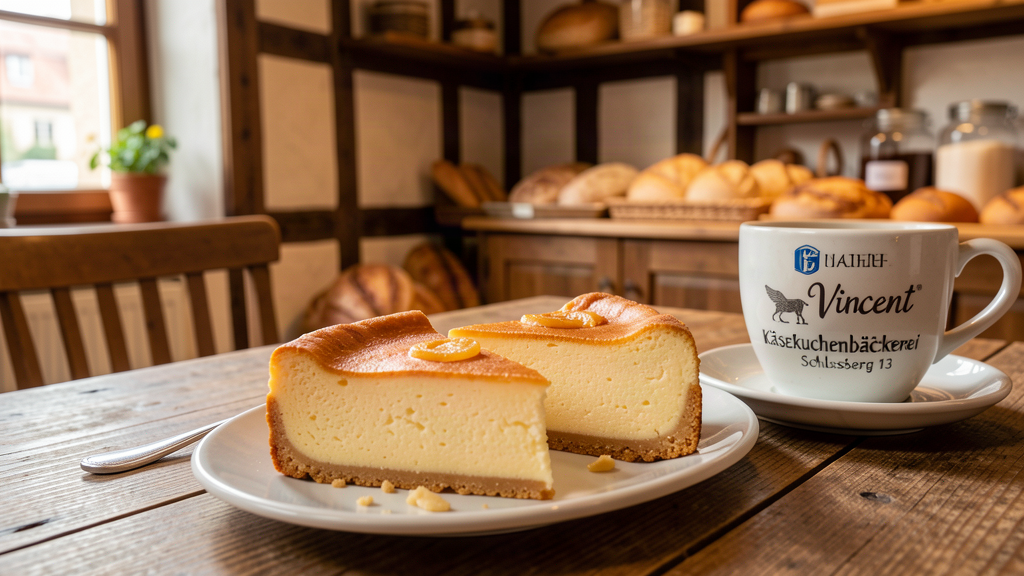
At Schlossberg 13, almost at the foot of the climb, Käsekuchenbäckerei Vincent turns out more cheesecake varieties than any reasonable town needs. Quark, cream, thin base, flavors that rotate with the board. I order one slice and a coffee after the crypt, not before. The sugar hits harder when your legs have done the steps. Seats fill mid-morning. Take the window if you can and watch the hill traffic thin.
South of the Altstadt, the Bode moves under bridges toward Brühlpark. Cross and the town exhales. Plane trees, lawn, locals with dogs, a park that does not need a theme. Brühlstraße on the approach still shows villa frontages from later prosperity. I walk the park the way people who live here do after work: one loop, maybe a bench, no itinerary. In spring the undergrowth smells like wild garlic. In winter, the paths stay useful when the castle queues shrink.
If your legs still want ground, the Harz edge is close: Bodetal toward Thale, a short rail hop to Wernigerode, or a riverside path without a summit badge. I save the bigger Harz days for another trip. Quedlinburg itself is enough for two nights if you stop treating it as a checklist.
Center rhythm and how you move
Markt is the obvious hinge: cafés, the town hall, Hotel zum Bär’s long frontage, day visitors clustering around noon. I use it for orientation, then leave it for the side streets. Münzenberg, west of Schlossberg, is a quieter hill neighborhood with church ruins and fewer tour groups. Neustadt, east, has a different timber grain and St. Nikolai. It feels residential in a way the postcard core does not.
Quedlinburg Hbf sits north of the center. The walk into the Altstadt takes fifteen to twenty minutes depending on bags; taxis and buses cover the gap when weather turns. Regional trains link Magdeburg in roughly an hour, Halberstadt faster still. Inside town, feet beat any car. The core is a cobbled maze with limited access, and fringe parking beats forcing a nav app down Wordgasse. Shoe leather covers Finkenherd, Schlossberg, Vincent, and Brühlpark.
Advent weekends and summer Saturdays fill rooms and courtyard events, so book ahead if your dates hit those. Shoulder seasons keep Finkenherd quieter and the bakery line shorter.
A clean day once bags are down: Finkenherd and the western alleys early, Schlossberg and St. Servatius mid-morning, Vincent when the crypt chill leaves your hands, Markt for a practical lunch, Brühlpark in the afternoon, Münzenberg or Neustadt before dinner if you want a second register. Second morning for the Ständerbau museum, a longer Bode walk, or a short Harz hop. Hold the Magdeburg connection until you have climbed the hill twice. I book one bakery stop and one proper dinner and leave the rest loose.
Places to Stay
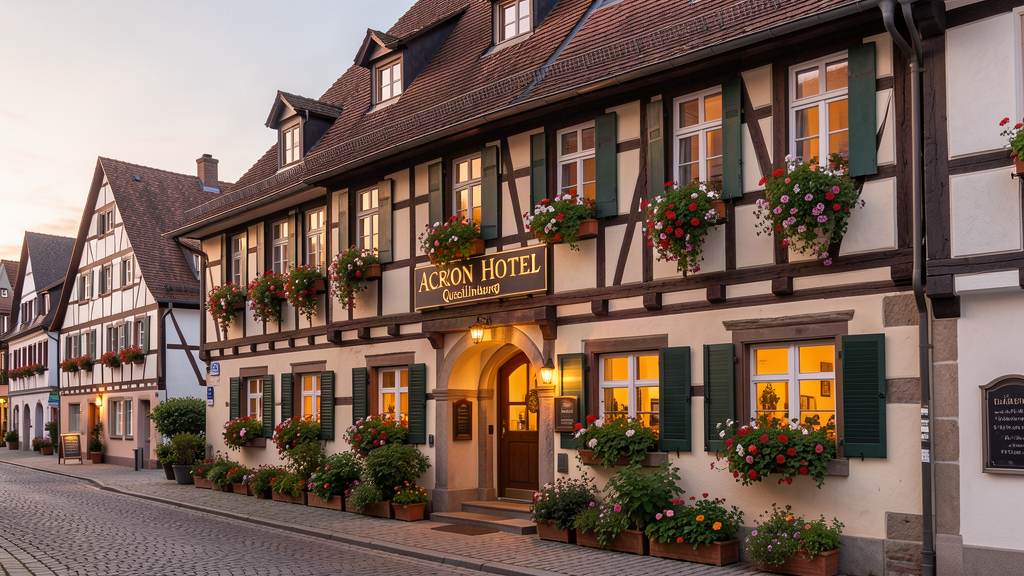
Acron Hotel Quedlinburg (value, near Neustadt)
Gartenstraße 44A, 06484 Quedlinburg
Straightforward three-star rooms a short walk from historic Neustadt: buffet breakfast, quiet bar, free Wi-Fi, paid parking when a space is free. I use it when the budget should go to Schlossberg tickets, Käsekuchen, and a brewery dinner rather than a half-timber façade outside the window.
Hotel Zum Brauhaus / Brauhaus Lüdde (mid, between Markt and Schlossberg)
Carl-Ritter-Straße 1 (hotel) / Blasiistraße 14 (brauhaus), 06484 Quedlinburg
Private house brewery with rooms next door in the seam between market square and castle hill. You sleep inside the walking core, smell mash when the tanks are working, and walk about thirty meters to dinner. My default when the Finkenherd–Schlossberg loop is why you came, and you want beer brewed on the same block.
Romantik Hotel am Brühl (upper, south of Schlossberg)
Billungstraße 11, 06484 Quedlinburg
Spread across restored historic buildings: old barn volumes, vaulted brick, quieter rooms than the Markt frontage hotels. Two on-site restaurants if you want to stay put in the evening. You pay for fabric and hush after the cobbles, plus an easy drop toward Brühlpark. Keep Finkenherd for the morning walk, not the view from the pillow.
Restaurants and food
Brauhaus Lüdde (mid, house brewery)
Blasiistraße 14, 06484 Quedlinburg
Historic private brewery between Markt and Schlossberg: own beers, schnitzel and mushroom sauces, full plates, wooden rooms that fill early on weekends. Closed Sundays, last I checked; confirm before you plan the night around it. My pick when the day was all timber and crypt, and you want something local in the glass.
Käsekuchenbäckerei Vincent (casual, Schlossberg foot)
Schlossberg 13, 06484 Quedlinburg
Cheesecake bakery at the base of the castle hill: rotating flavors, quark-rich slices, coffee, small seats that turn over fast. Not a full dinner. Go after the climb. I treat it as the dessert the town is actually known for, not an optional café stop.
Hotel zum Bär (mid, Markt)
Markt 8–9, 06484 Quedlinburg
Long-running house on the market square with a restaurant that catches overnight guests and walk-ins when other kitchens rest. German plates, steady portions, windows on the Markt bustle. I use it when Lüdde is closed, or the brewery wait looks long, and I still want to eat inside the old town fabric.
Bakeries on the approach streets and simple Imbiss counters near the station fill gaps when restaurant hours go quiet mid-afternoon.
Walk Finkenherd long enough that the beams stop looking like a set. Climb Schlossberg once without rushing the crypt. Eat cheesecake on the way down before you decide the town is done. Cross the Bode into Brühlpark without a camera in your hand. Two nights of that is enough for Quedlinburg. It beats another same-day sprint that only photographs the Markt Roland from a Magdeburg-bound platform.
