
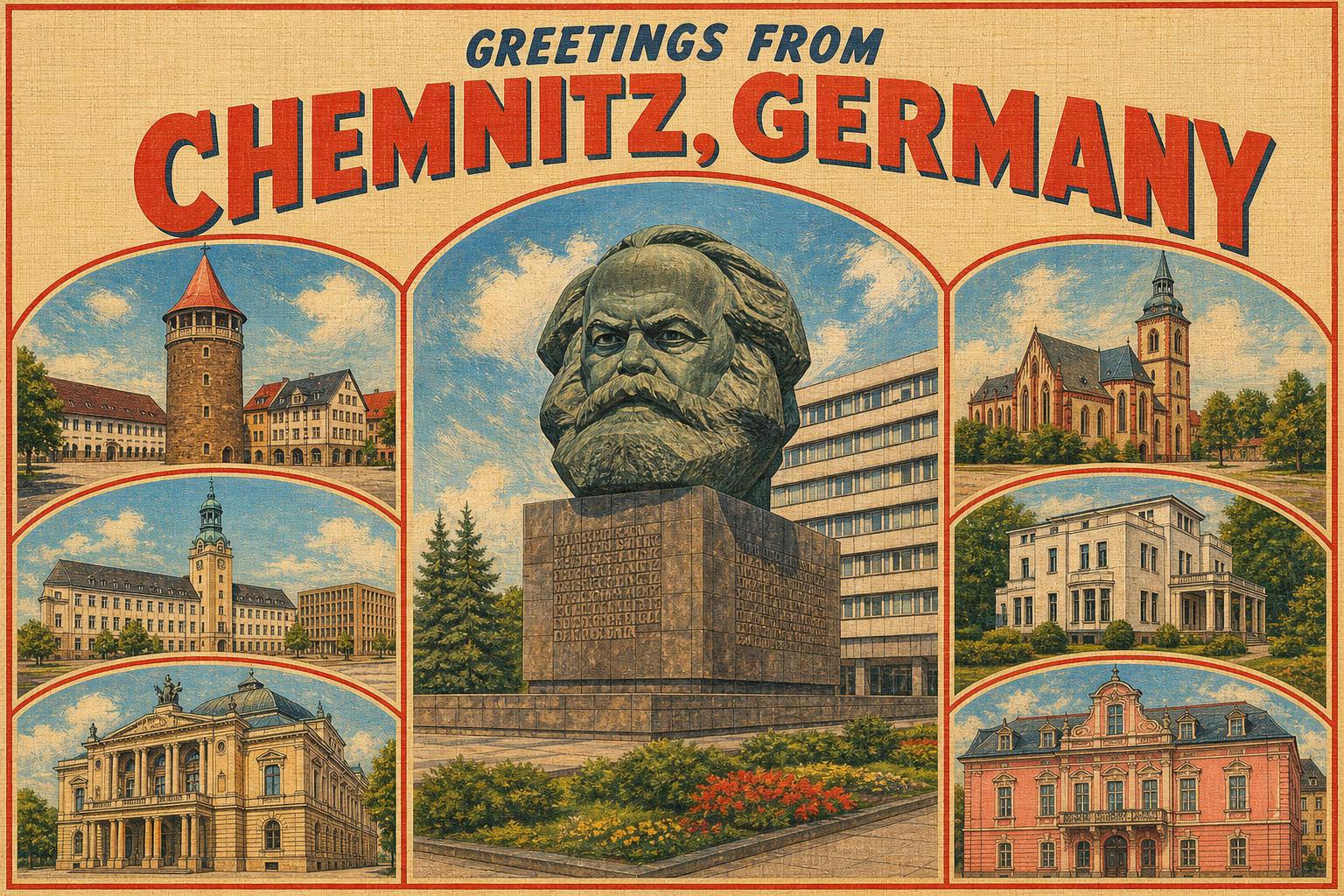
Most people treat Chemnitz as the industrial stop between Dresden and Leipzig, or as the city with the giant Marx head. Fair if you only have a platform change. I leave the station and climb west instead, up to the Kaßberg, where Gründerzeit and Jugendstil blocks sit about thirty meters above the river. Laundry lines still cut the courtyards. The street grid feels lived-in.
Chemnitz is Sachsen’s third-largest city after Leipzig and Dresden. From 1953 to 1990 it was Karl-Marx-Stadt. The Nischel still watches Brückenstraße. I still start on the ridge: Kaßberg mornings, Schloßberg and the mill pond later, then food once my legs cool down.
Kaßberg west of the center
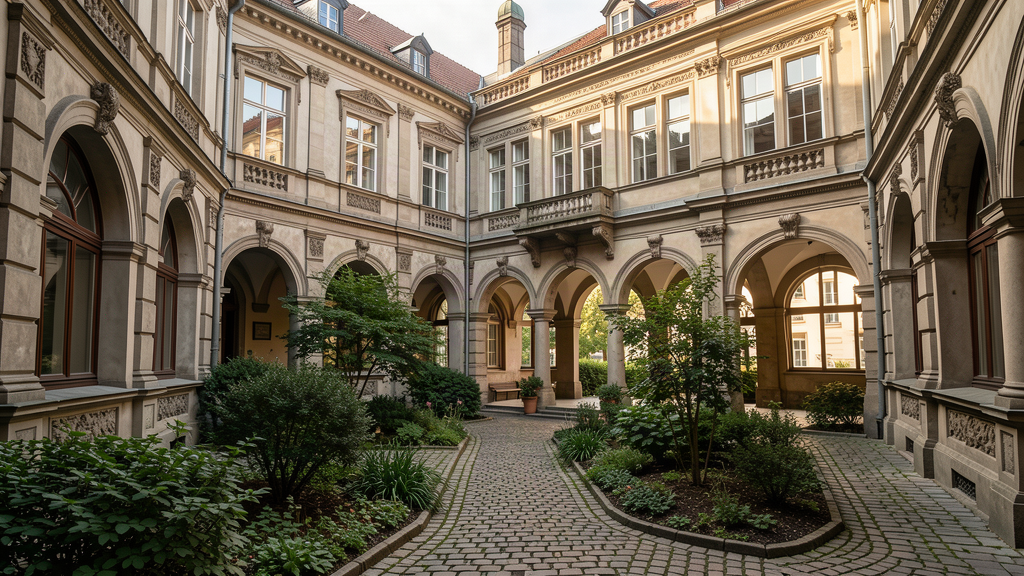
The Kaßberg is Chemnitz’s most populated district and one of the larger continuous Gründerzeit and Jugendstil quarters in Germany. It rises west of the center, close to the Chemnitz River, high enough that the air cools a little and city noise thins. Stair streets drop toward the water. Long residential blocks keep bay windows, stucco detail, and deep Hof courtyards. People live here. Delivery bikes, bakery bags, a dog on a short lead before eight.
I walk Franz-Mehring-Straße and the parallel grid without much plan beyond noticing which façades still hold original ironwork and which courtyards leave their gates open. Early is better. Chairs are still stacked. Trams climb half empty from the valley. Later the same streets fill with errands and students. Before noon you mostly meet people who actually sleep upstairs.
You do not need a guided architecture tour. Stand in one courtyard long enough to hear a bicycle lock and a kitchen window. The Kaßberg is housing that went through industrial boom, war damage, GDR decades, and the odd empty shopfront. It never became a museum street.
From the western edge you can drop toward the river and the lower city, or keep the ridge and loop back toward the Gunzenhauser. I usually do a slow circuit first, then decide whether museums still make sense that day.
Nischel, Gunzenhauser, and the industrial floor
Eventually most visitors photograph the Karl Marx Monument on Brückenstraße. Lew Kerbel’s stylized head is more than seven meters of granite; with the platform the whole thing rises past thirteen meters and weighs roughly forty tonnes. Locals call it the Nischel. Behind it the slogan “Workers of the world, unite!” still runs in German, English, French, and Russian. I look once, walk around the base, and move on. Worth seeing. Not the whole trip.
A short walk south, the Museum Gunzenhauser at Stollberger Straße 2 holds Alfred Gunzenhauser’s modern collection in a converted 1930 savings-bank building: thousands of works, strong on twentieth-century German painting, opened in 2007. I go when I want quiet rooms after the ridge walk. Hours shift; check before you count on a late afternoon.
The Industriemuseum Chemnitz at Zwickauer Straße 119 sits on the industrial floor of the story. Machine tools, textile history, the reason this valley filled with factories and worker housing. Chemnitz made things. The museum still smells a little like that, even with polished floors. Walk Kaßberg streets first and the contrast is clear without a lecture.
Optional later, not instead: Villa Esche at Parkstraße 58 in Helbersdorf, Henry van de Velde’s 1902–03 Art Nouveau house for textile entrepreneur Herbert Esche, interiors and park as one design. Short hop south of the densest center. I save it for a second afternoon if the rooms or the villa restaurant fit the pace.
Schloßberg, Schloßkirche, and the pond
North of the center, Schloßchemnitz holds the Schloßberg. The Schloßkirche sits on the rise and is still the building locals point to when someone asks what is worth climbing for. Gothic fabric, old stone rather than shopping glass. Below it the Schloßteich opens a green bowl: path, water, ducks, and enough bench space that you can sit without turning it into an event.
I walk the church exterior, then the pond loop, then find a table if the day has gone long. Gasthaus and Kellerhaus rooms cling to the Schloßberg addresses; they make sense after the hill, not as a taxi drop with empty legs. The Chemnitz River is the city’s name-giver, a right tributary of the Zwickauer Mulde. You meet it as a working watercourse and park edge more than a grand embankment.
A simple day if bags are already down: Kaßberg before the shops fully wake, coffee on the ridge, Nischel as a short stop, Gunzenhauser or Industriemuseum depending on paint or machines, Schloßberg and pond when the light softens. Two nights cover early ridge light, a full museum block, and an evening table without rushing the stairs.
How Chemnitz moves
Chemnitz Hauptbahnhof sits a short tram or walk from the center, depending on luggage. Trams cover Kaßberg climbs, Industriemuseum, and the Schloßberg side better than circling for parking. The district grids are walkable once you accept stairs and the odd steep sidewalk. Drivers hit residential limits and weekend competition; I leave the car at the hotel when the day is central.
Regional trains link Dresden and Leipzig in under an hour on good connections. Chemnitz works as a two-night pause on a Sachsen rail triangle, or a quieter base when the bigger cities feel loud. Confirm museum rest days and restaurant closed days before you build lunch around a specific door. Kaßberg mornings do not need a reservation. Weekend dinners do.
Places to Stay
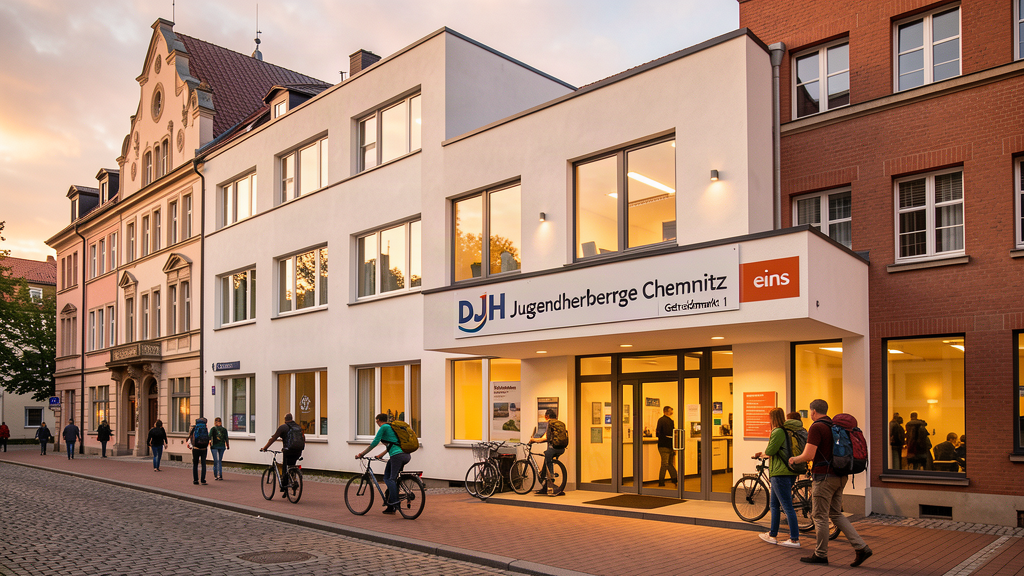
DJH Jugendherberge Chemnitz "eins" (value, center edge)
Getreidemarkt 1, 09111 Chemnitz
Youth hostel with private-room options near the center, practical beds, and an easy hop toward Kaßberg and the Nischel. Straightforward when budget matters more than design furniture. Station-adjacent energy, short walk or tram before the ridge morning. Book early around event weeks; shared spaces are part of the deal.
Hotel an der Oper (mid, Straße der Nationen)
Straße der Nationen 56, 09111 Chemnitz
Mid-range stay on the main central axis near the opera house, full hotel bed, walking reach to Brückenstraße, Neumarkt, and the first Kaßberg streets. I use it when I want evening tables and morning trams without a suburban ride. Breakfast covers a slow start. Parking is its own problem; tram is simpler.
Schlosshotel Wasserschloss Klaffenbach (upper-unique, moated castle south)
Wasserschloßweg 6, 09123 Chemnitz
Rooms inside the moated Renaissance castle complex in Klaffenbach, south of the center, water on the walls, quieter nights than the Neumarkt. You trade doorstep Kaßberg for a distinct base and a short drive or transit hop into town. Book when the stay itself is half the reason you came. Not a backpacker walk from the Hauptbahnhof; plan the transfer once.
Restaurants and food
Onkel Franz (mid, Kaßberg German kitchen)
Franz-Mehring-Straße 2, 09112 Chemnitz
Neighborhood German plates on the Kaßberg, open through the day, and a room that fits after a courtyard loop. I use it for a proper sit-down without leaving the ridge. Weekday lunches are calmer than Saturday nights. Reserve if the street is busy; walk up if it is not.
Restaurant Kellerhaus Chemnitz (mid-upper, Schloßberg)
Schloßberg 2, 09113 Chemnitz
Seasonal cooking on the castle hill, outdoor seats when weather holds, short walk from the Schloßkirche and pond. My pick when the day ends north of the center and I want stone and water instead of a shopping street. Closed Mondays on the usual map; confirm before you climb hungry. Evenings need a reservation more often than lunches.
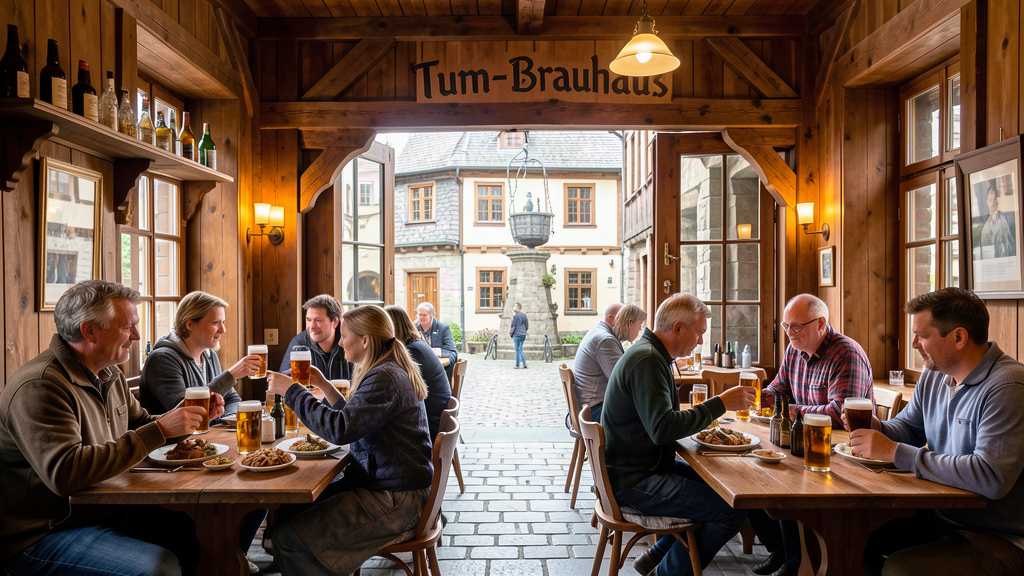
Turm-Brauhaus (mid, Neumarkt brew-house)
Neumarkt 2, 09111 Chemnitz
House beer and German plates on the Neumarkt, tables outside in the pedestrian zone, indoor room when Sachsen wind picks up. Handy after the Nischel or a Gunzenhauser hour when half the table wants another glass and half wants dinner. Flexible, local, not precious. Good fallback when Kaßberg kitchens are closed or you are already downtown.
Bakeries on the Kaßberg cover rolls and coffee before the grid walk. Café Milchhäuschen by the Schloßteich works when you want cake facing the pond rather than another full dinner. Saxon food stays plain in a useful way: bread, pork when you want it, seasonal sides, beer that matches the walk. I lock one dinner and leave lunch open.
Walk the Kaßberg early enough that courtyard gates are still propped open. Stand once under the Nischel. Sit above the Schloßteich when the light drops. That is enough Chemnitz for two nights.
