
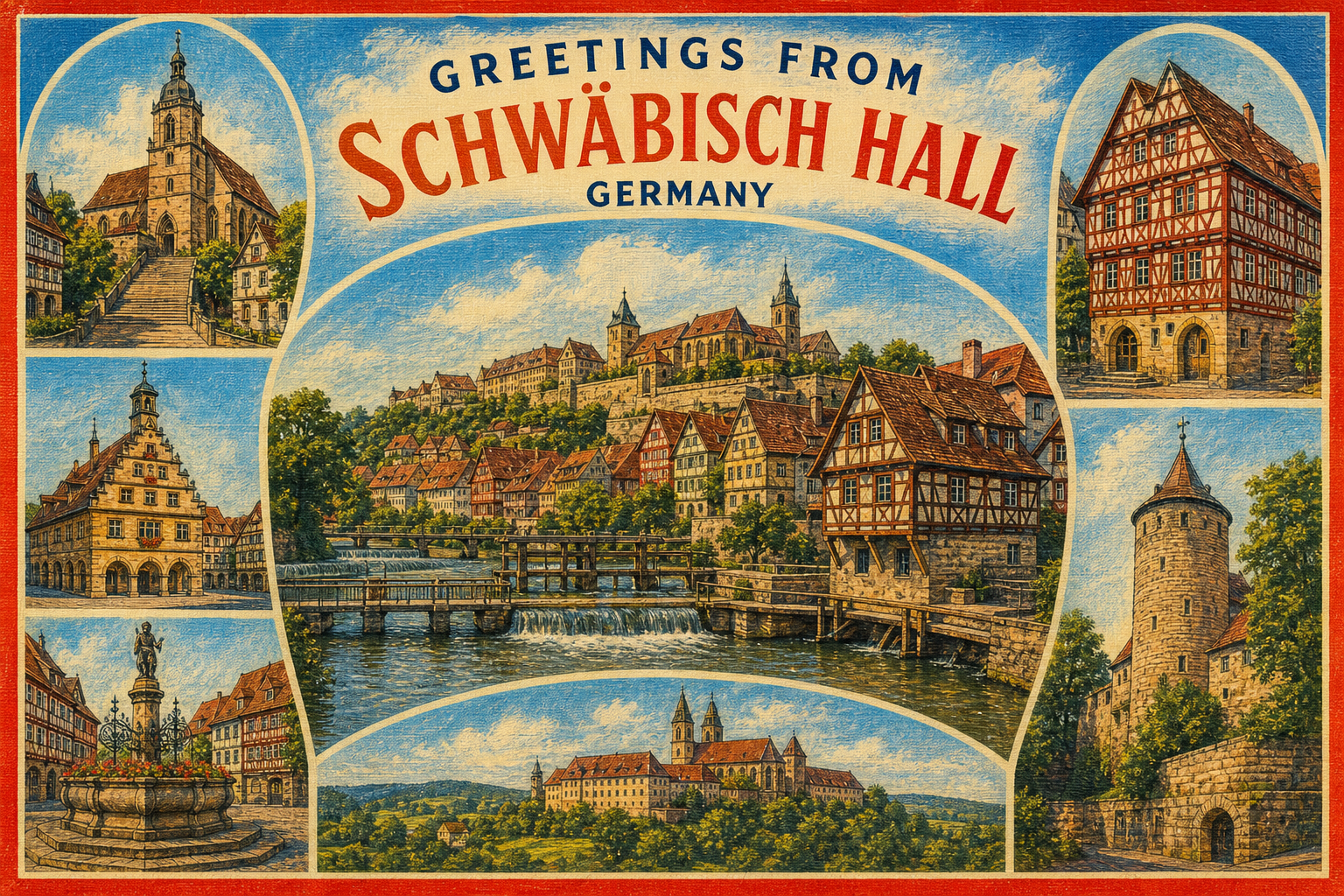
Most people who detour into Schwäbisch Hall come for the staircase. St. Michael’s wide stone steps open onto a market square that looks, from the top landing, like someone arranged half-timber and Baroque façades for a postcard. The town’s origin story sits lower, almost at river level, on a small square called Haalplatz where salty groundwater still rises under paving stones.
Hall is the old name. “Schwäbisch” got stapled on later. Hall meant salt — pan boiling, brine rights, wagons leaving for Speyer and Frankfurt with white cargo and coming home with wine. Start at the spring. The church steps can wait until your shoes have already been wet by the Kocher mist.
Haalplatz, the spring, and the old exit road
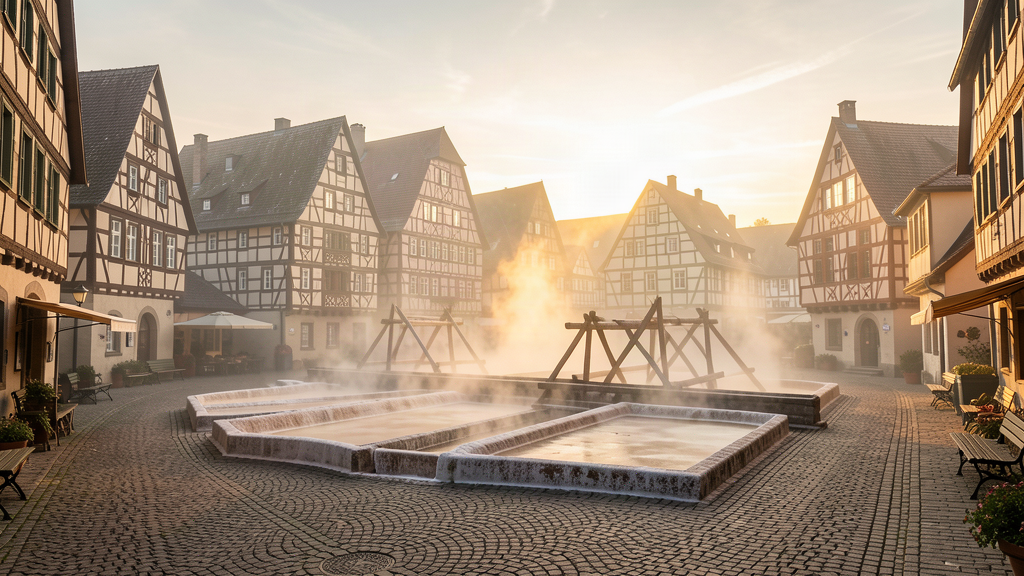
Haalplatz sits on the right bank of the Kocher, a short walk from the covered wooden bridge and the stone footbridge called Steinerner Steg. For centuries this was not a scenic plaza. It was industrial ground. Brine was drawn from a deep well — roughly thirteen meters down in the old Haalbrunnen — and boiled in Haal houses around the square. Salt masters and simmerers ran a rights system so complicated that families threw lots for pan time. Descendants of some simmerer lines still joke about a symbolic pension that survives on paper more than on a bank statement.
Stand at the fountain on Haalplatz in the morning before tour groups thicken. Water moves. The industrial pans are gone; the Solebad spa up the hill still uses local brine. What you feel underfoot is older work — low buildings, river humidity, a square that never quite turned decorative. Look for carved motifs nearby: simmerers at the pan, the Heller coin, reformers and emperors layered into wood and stone.
From Haalplatz the old salt road climbed away from the water. Untere Herrngasse and the stone bridges carried wagons out of the boiling quarter toward markets far west. Walk that climb once without a map. You pass cellars deep enough to hold wine that rode home on empty salt carts, and alleys that still drop hard toward the river. The Hällisch-Fränkisches Museum complex nearby puts those layers into townhouses and the old Stadtmühle if you want one indoor hour. One is enough. The streets teach more.
Marktplatz, Neubau, and the climb you earn
When you finally take the steps of St. Michael, take them slow. The staircase doubles as civic stage — open-air theater still uses it in season — and the square above mixes Gothic church mass with Baroque town-hall bulk rebuilt after the great fire of 1728. Locals shop here, meet here, cross it on the way to work. Sit once with a paper bag of something baked and watch who actually uses the square: Goethe-Institut students, office people from the Bausparkasse orbit, older couples who have claimed the same café table for decades.
Neue Straße cuts as a fire break from river toward market — laid after 1728 so flames would have less continuous timber to eat. Use it as a spine when you get turned around in the half-timber maze. The Neubau, the big late-medieval storage and armory block, still anchors concert and meeting life more than tourist fantasy. Read the volume from the street and keep walking.
Gentlemen’s lanes — Oberer and Unterer Herrngasse — hold the taller merchant houses with deep cellars. They are handsome without a scripted audio guide. Notice door heights, coat-of-arms leftovers, laundry lines that refuse the museum look. That is Hall living on top of Hall money.
Katharinenvorstadt and the Kocher’s working edge
Cross to the southern bank and you leave the postcard core for Katharinenvorstadt, the craftspeople’s expansion of the fourteenth century. Houses sit cell-like along the river; the quarter once had its own gates. Weilertor still names the river approach near Ringhotel Hohenlohe. Riedener Tor is gone; a powder tower and bulwark fragments remember the wall. Walk without hunting every plaque. Timber density, sudden river views, and streets where people still repair bikes in courtyards do the work.
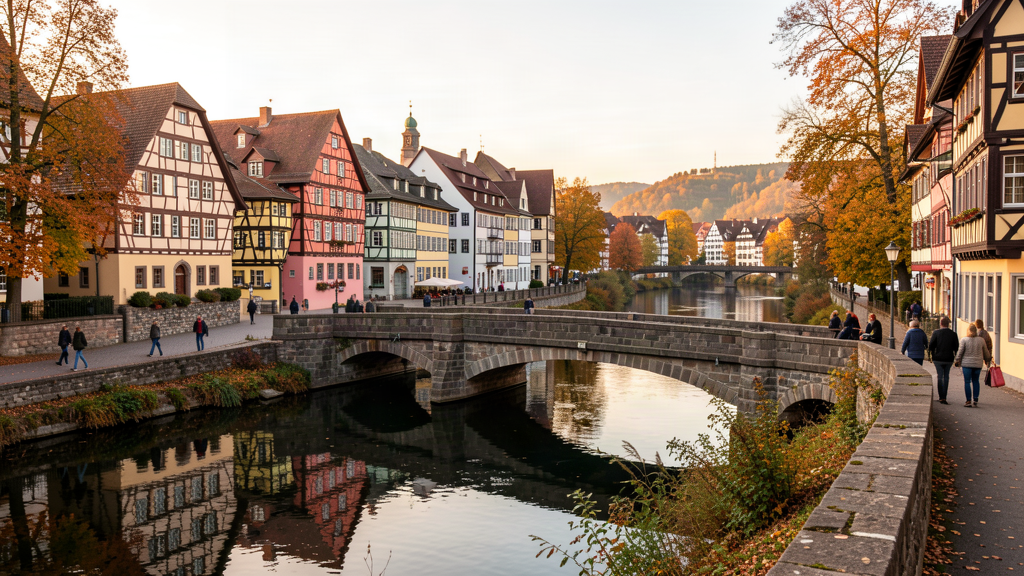
The Kocher is the town’s long outdoor room. Grasbödele and Unterwöhrd islands take summer feet, boat rentals, and evening strollers who do not need another church interior. City park lawns along the bank are where people sit after work. In late August the Summer Night Festival turns the park into lantern ground. If you miss it, go anyway at blue hour. Half-timber reflections on the water beat the daytime rush.
A wooden bridge leads toward the New Globe on Unterwöhrd, the open-air Shakespeare-style house that runs warm-season performances. You do not have to book a play to walk the approach. Culture here still uses islands, steps, and temporary light. Above the valley, Limpurger hills and Hohenlohe fields start almost immediately — a short bus or bike ride if old-town stone tires your knees. Come back down for dinner.
Places to stay
Base in or across from the Altstadt if you want morning river walks without a car. Distances collapse once you accept stairs as normal.
Hotel Scholl Garni (value / near Klosterstraße climb)
Klosterstraße 2–4, 74523 Schwäbisch Hall
Straightforward rooms in a house-scale garni setup — clean bed and breakfast without a big lobby show. You are inside the old fabric rather than watching it from a spa corridor. Expect stairs, street noise on event nights, and a short walk down toward market and river. Good for walkers who treat the town as a compact loop.
Trip Inn Der Adelshof (mid-range / on the market square)
Am Markt 12–13, 74523 Schwäbisch Hall
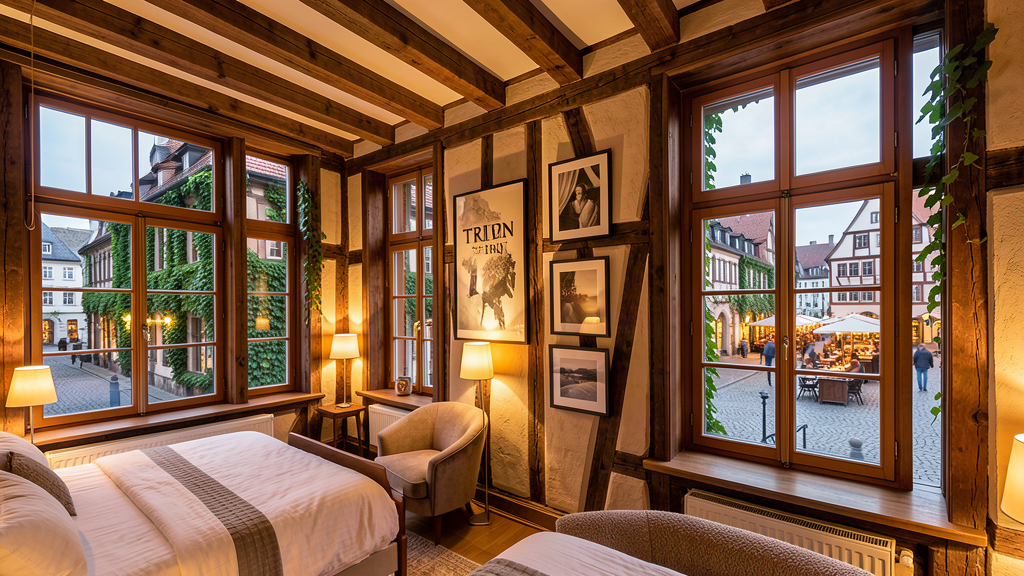
A market-square address with real weight — you sleep on the square instead of commuting to it. Rooms vary with the old structure; some face St. Michael’s mass, which is either magic or too much bell and foot traffic depending on your sleep. Use it when evenings on the square and no transit hop matter more than a quiet spa wing.
Ringhotel Hohenlohe (splurge / Kocher bank at Weilertor)
Weilertor 14, 74523 Schwäbisch Hall
Family-run four-star superior on the riverbank opposite the densest timber skyline, with wellness facilities tied to the town’s brine tradition. You trade alley grit outside the door for a proper breakfast room and a view that explains second nights. Cross into Katharinenvorstadt on foot; put the extra money into slow terrace mornings rather than another museum ticket.
Where to eat
Skip interchangeable “medieval” menus under the church steps. Eat where the river and the Hohenlohe hinterland still show up on the plate.
Entenbäck
Steinerner Steg 1, 74523 Schwäbisch Hall
Right on the stone footbridge approach — Balkan and regional plates in a room that feels more neighborhood reservation than themed tavern. Handy after Haalplatz and the salt-road climb when you want substance without a taxi. Book on weekends.
Restaurant at Trip Inn Der Adelshof
Am Markt 12–13, 74523 Schwäbisch Hall
Market-square dining when weather or tired feet argue against leaving the plateau. Useful after open-air theater on the steps, or for lunch when the square is in full local use. Order Swabian standards if they are on; the view of St. Michael is fine company, not the reason to sit down.
Reber’s Pflug
Weckriedener Straße 2, 74523 Schwäbisch Hall
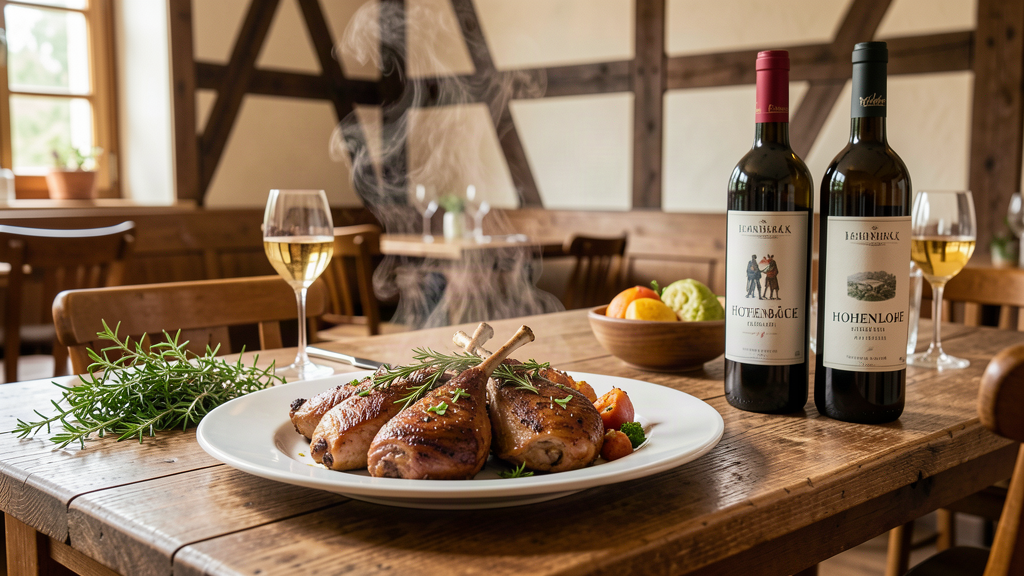
A short hop from the densest tourist core into serious Hohenlohe cooking — landhaus plates, regional duck and dry-aged beef when available, a terrace that feels more garden than set piece. Book. This is the meal that makes the detour from Stuttgart or Heilbronn worth it. Go hungry and let the kitchen set the pace.
Market mornings, buy bread and fruit near the square and eat on a Kocher bench. Hotel breakfast can wait until a rain day.
Getting around without fuss
Schwäbisch Hall’s old town is stairs and lanes, not a driving problem. Park once — hotel garage or an edge lot — and walk. The valley folds force elevation changes; shoes with grip beat cute soles on wet stone.
Trains serve Schwäbisch Hall and Schwäbisch Hall-Hessental; local buses stitch the halves and the heights. If you arrive at Hessental, budget the hop into the center instead of assuming the platform opens onto timber gables. Bikes work along the Kocher valley paths more kindly than up the tight Altstadt grades.
Day trips pull toward Comburg’s monastery ridge and Hohenlohe wine villages if you have a car. None of that replaces a slow day on Haalplatz, the bridges, Katharinenvorstadt, and the islands. Two nights beat a rushed afternoon.
Give the brine its due. The steps of St. Michael are handsome, the open-air plays draw crowds, and the half-timber photographs well. Under Haalplatz the water that named the town still moves — quiet, mineral, older than the Baroque rebuild. Walk there first. Climb second. Eat after the river has already gotten into your clothes.
