
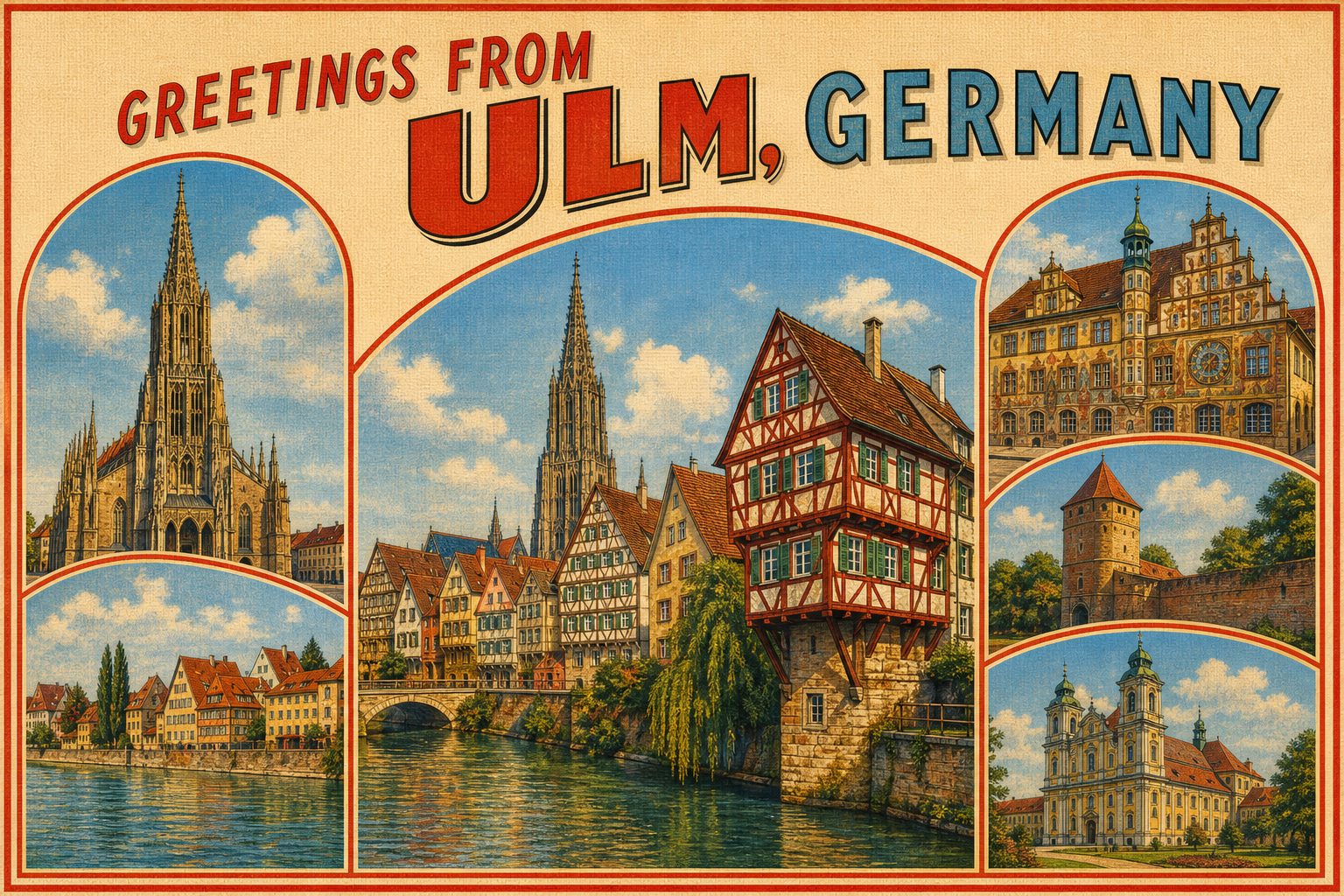
Ulm sells itself with a steeple. Fair enough. The Minster still owns the skyline. The town I come back for sits lower, where two thin arms of the Blau slide through half-timber and tip into the Danube. Locals say Fischerviertel and point south of the Rathaus; the careful name is Fischer- und Gerberviertel.
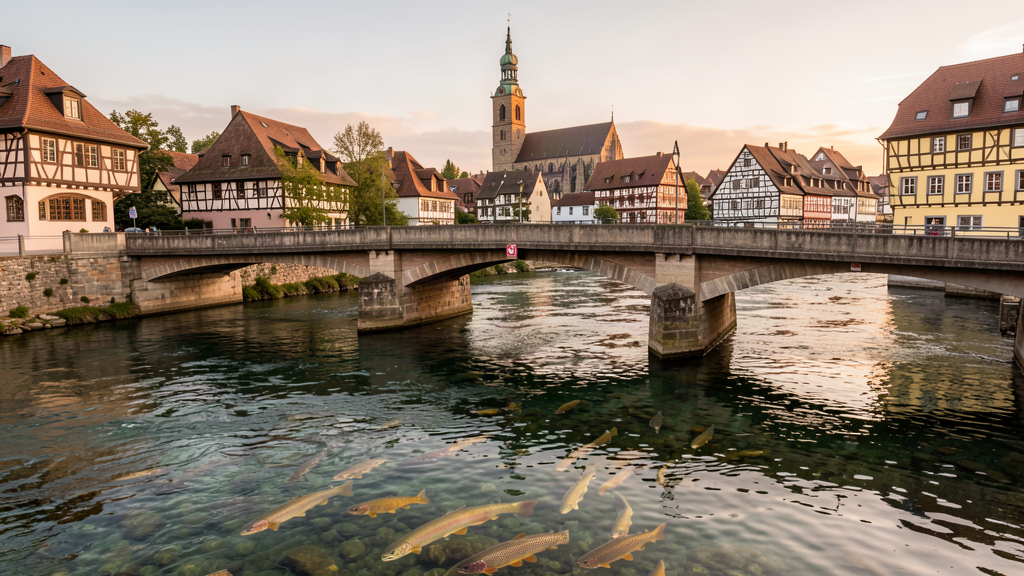
I start at the water, not the tower. Look over a railing on a quiet morning, and you will almost always see trout facing upstream, holding station in clear current that once powered tanneries and mills. That is enough of a reason to be here. Everything else can wait its turn.
Weinhof into the wet streets
Drop from the Weinhof and the modern center thins fast. Cobbles get rougher. Facades lean. Delivery bikes still squeeze through, which is how you know people actually live here between the Münster and the next ICE.
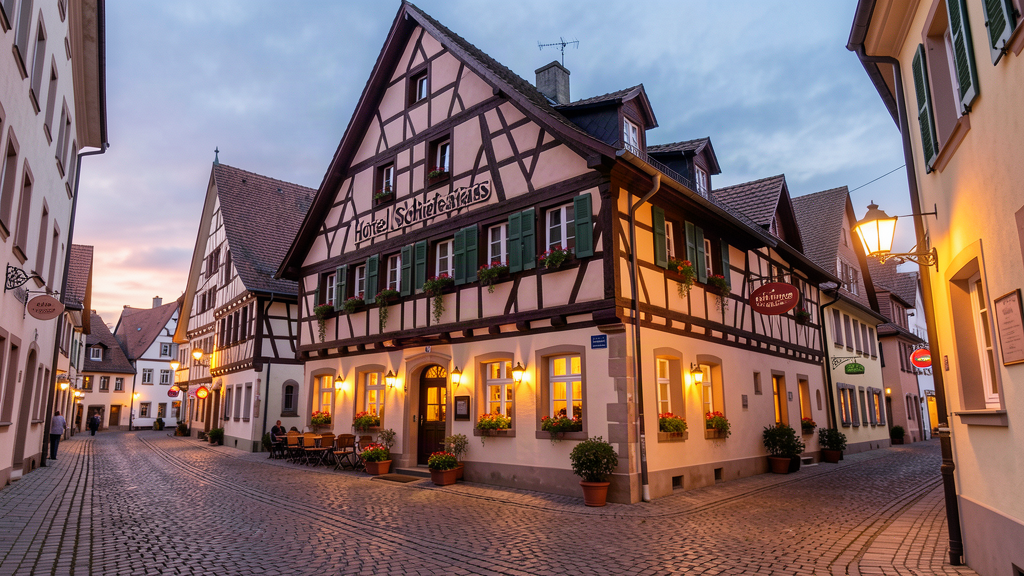
Schwörhausgasse and Fischergasse branch off from the Blau. Houses from the fifteenth to seventeenth centuries put part of their foundations in the water; soft ground did the rest, so timber frames tip a few degrees off plumb. The Schiefes Haus at Schwörhausgasse 6 is the famous one. Guinness lists it as the most crooked hotel, going about ten degrees toward the river. It is not alone. Whole rows settle the same way. After the third block, you stop photographing every lean and start noticing laundry, flower boxes, and the mill wheel still turning at Gerbergasse 6.
The proper name of the district includes the tanners for a reason. Galleries on wooden piles once held skins dripping over the stream. You will not smell that now, but the buildings still show the work: walk Auf der Insel for the backside view of Fischergasse, a straight run of those tanner houses with water on both sides of the lane. Midweek before ten is best. Weekend noon fills the bridges with phones.
Forellenbrücke, Gumpen, Fischerplätzle
Forellenbrücke is probably Ulm’s oldest bridge, built in 1316 if the city story holds. Both arms of the Blau, Große Blau and Kleine Blau, pass under it. The name comes from the inn beside it, Zur Forelle, once just called Häusle. Lean on the stone and watch the fish. They are not a stocked display. The Blau comes out of the Blautopf system upstream; the water stays cold and oxygen-rich enough that trout keep their place in the middle of a working city.
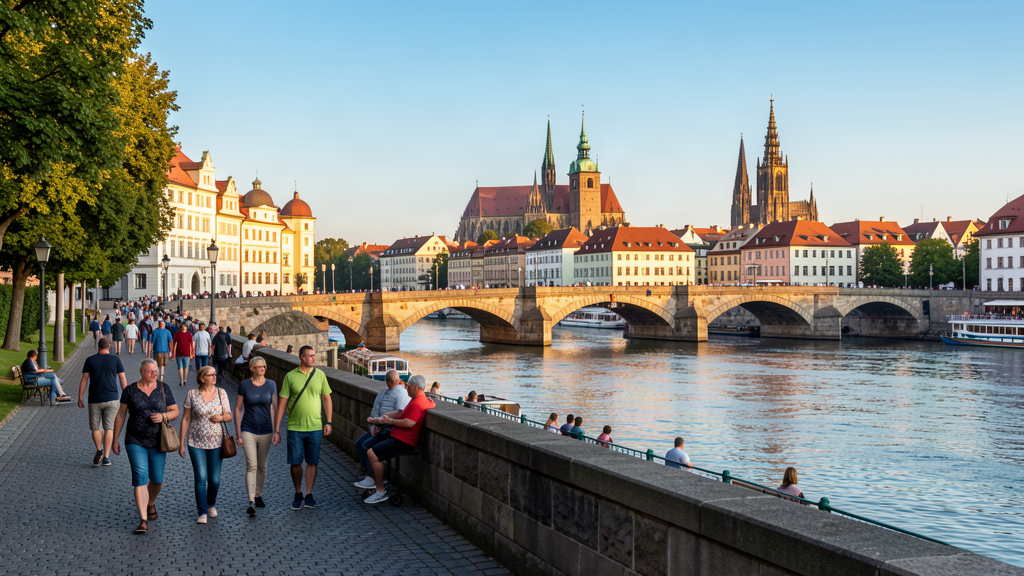
A few turns south, Fischerplätzle opens against the city wall. It used to be a small harbor opening toward the Danube. The Schöne Haus and the old mariners’ guild footprint still sit on the edge. In summer the square takes tables and low talk. Every four years the Ulmer Schifferverein still stages Fischerstechen on the Danube water jousting that can sound made up until you see how seriously the club upstairs at Fischergasse 31 treats it. In ordinary years the wall is enough: one side half-timber, the other the wide river and Neu-Ulm’s Bavarian bank.
I walk the wall path when the lanes get thick. Sunset is the postcard hour and still good. Morning fog on the Danube is quieter. I prefer the fog.
Saumarkt, Wilhelmshöhe, and the ordinary climb
Not everything in the quarter is water romance. Schweinmarkt, Saumarkt to locals who still use the older word — sold pigs into the 1970s. A bronze of a farmer, a butcher, and three pigs marks the trade. From there, a short climb reaches Wilhelmshöhe for a roof-level look back over the Blau lanes without paying for a Minster ticket.
This is the Ulm that belongs to errands. Bakery bags. Kids cutting through to school. A man hosing a courtyard while a tour group photographs the wrong doorway two streets over. Sit on a bench long enough and the quarter starts to feel ordinary again, which is the point.
Watch for Ulmer Schachteln in museum labels — flat wooden “box” boats that once carried people and goods down the Danube. Shipbuilding sat next to fishing here. Barges and cyclists own the river now; the memory still shapes how the wall meets the water.
Minster, Metzgerturm, then leave them
You will see the Minster. Climb if the weather is clear and your legs agree; the view locks the Danube bend and the Swabian plain into one picture. Then come down. Give the rest of the day to the lower town.
Metzgerturm, the Butcher’s Tower on the wall line, leans for the same soft-ground reasons as the houses. Legend invents huddled butchers; soft soil is the real story. Pass it and keep moving. Richard Meier’s white Stadthaus on Münsterplatz resets the eyes after too much timber. Fine. Still, I would trade most of that for twenty unhurried minutes with trout under a bridge.
A short out to Blautopf when you have the afternoon
When the center compresses, the Blau’s source at Blaubeuren makes a solid half-day. The Blautopf is that improbable blue karst spring, crowded on sunny Sundays and almost empty on a grey Tuesday. Buses and regional trains cover it. I go when the Fischerviertel has already given me what I came for. Do not let the side trip steal your evening wall walk.
Places to stay
Stay within walking distance of the Blau if you can. Festival weekends and Christmas market dates tighten inventory around the Minster.
Hotel Garni Neuthor (value / center)
Neuer Graben 17, 89073 Ulm
Small non-smoking garni a few minutes on foot from the Minster, Hauptbahnhof, and the north edge of the old town. Modern rooms, breakfast in-house, practical rather than storybook. You sleep quiet, walk south into the Fischerviertel in under fifteen minutes, and spend the saved money on dinner by the water.
Boutique Hotel am Rathaus / Hotel Reblaus (mid-range / Altstadt)
Kronengasse 8–10, 89073 Ulm
Two linked houses at the edge of the fishermen’s quarter, steps from the Rathaus, the glass library pyramid, and the Danube cycle path. Individually furnished rooms, old-town fabric without the full crooked-house premium. Check in at Kronengasse; navigation often sends cars to Weinhof 21 first. Easy base if you want half-timber outside the window and a real mattress.
Hotel Schiefes Haus (splurge / on the Blau)
Schwörhausgasse 6, 89073 Ulm
The crooked house itself, expanded toward the river in 1443, now a tiny hotel inside a listed shell. No elevator, no air conditioning — the house is clear about both — and floors that remind you the ground moved. Book early; rooms go fast. The better reason to stay is waking above the same water the tanners used. You are inside the walk, not next door to it.
Where to eat
Menus in three languages cluster on the busiest corners. A few doors off, the cooking gets more useful.
Zur Forelle
Fischergasse 25, 89073 Ulm
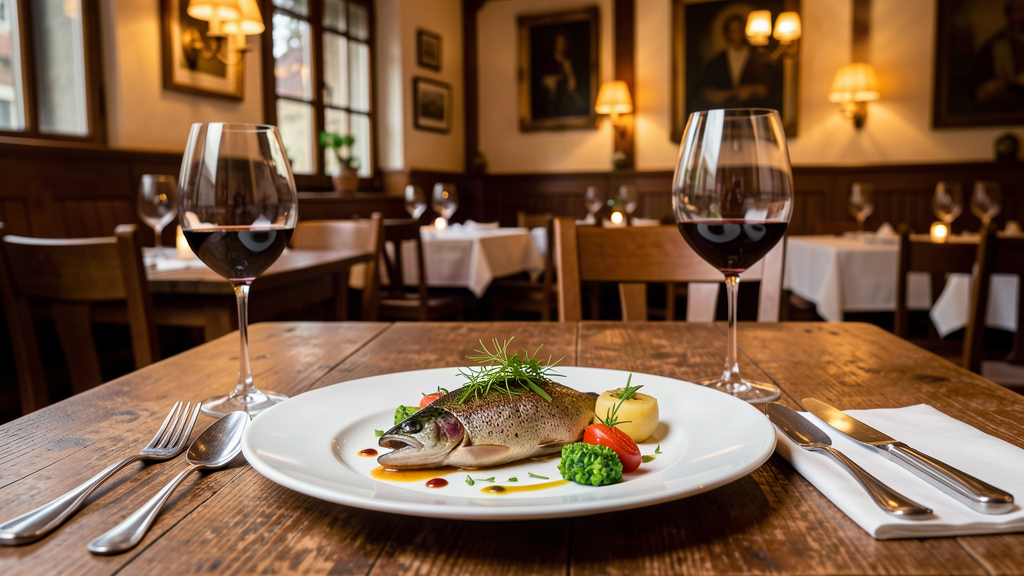
Beside the bridge that shares its name. Order trout when it is on — Müllerin or however the kitchen is running it that day — and sit where you can hear the Blau. The room has been hospitality longer than any rebrand. Go early or book; the obvious address fills first.
Zunfthaus der Schiffleute
Fischergasse 31, 89073 Ulm
Former shipmen’s guild house on Fischerplätzle, restaurant since the late 1970s across three open floors, terrace on the square in summer. Swabian plates done straight: Maultaschen, Käsespätzle, Zwiebelrostbraten when you want beef and onions. Locals use it for ordinary evenings, which is the recommendation.
Gerberhaus
Weinhofberg 9, 89073 Ulm
Sixteenth- and seventeenth-century tanner building by the Saubrückle, right on the Blau. Lunch and dinner service, water noise included. Less postcard-facing than the square tables, still fully inside the quarter. Good when you want the craft history under your chair and a slower pace than the bridge crush.
On a market-energy morning, grab bread and cheese near the center and eat on the wall above the Danube. Crumbs and cyclists share the view.
Getting around without fuss
Ulm’s core is a walking town once you leave the station. Hauptbahnhof to Fischerviertel is about ten minutes on foot; the Minster sits in between. Bus line 5 serves Steinerne Brücke if legs are done. Parkhaus Fischerviertel and Parkhaus am Rathaus handle cars better than hunting for curb space in the lanes.
Trams and buses cover outer districts; bikes own the Danube path. Neu-Ulm is a bridge away if you want the Bavarian bank at golden hour. For a short stay, I barely use tickets inside the ring — the Blau loop, the wall, and one Minster climb are enough geography.
You can come for the steeple. Most people do. I stay for the fish holding station under the old bridge, the galleries that still remember hide and water, and the hour when the tour groups thin and the quarter sounds like a neighborhood again.
