
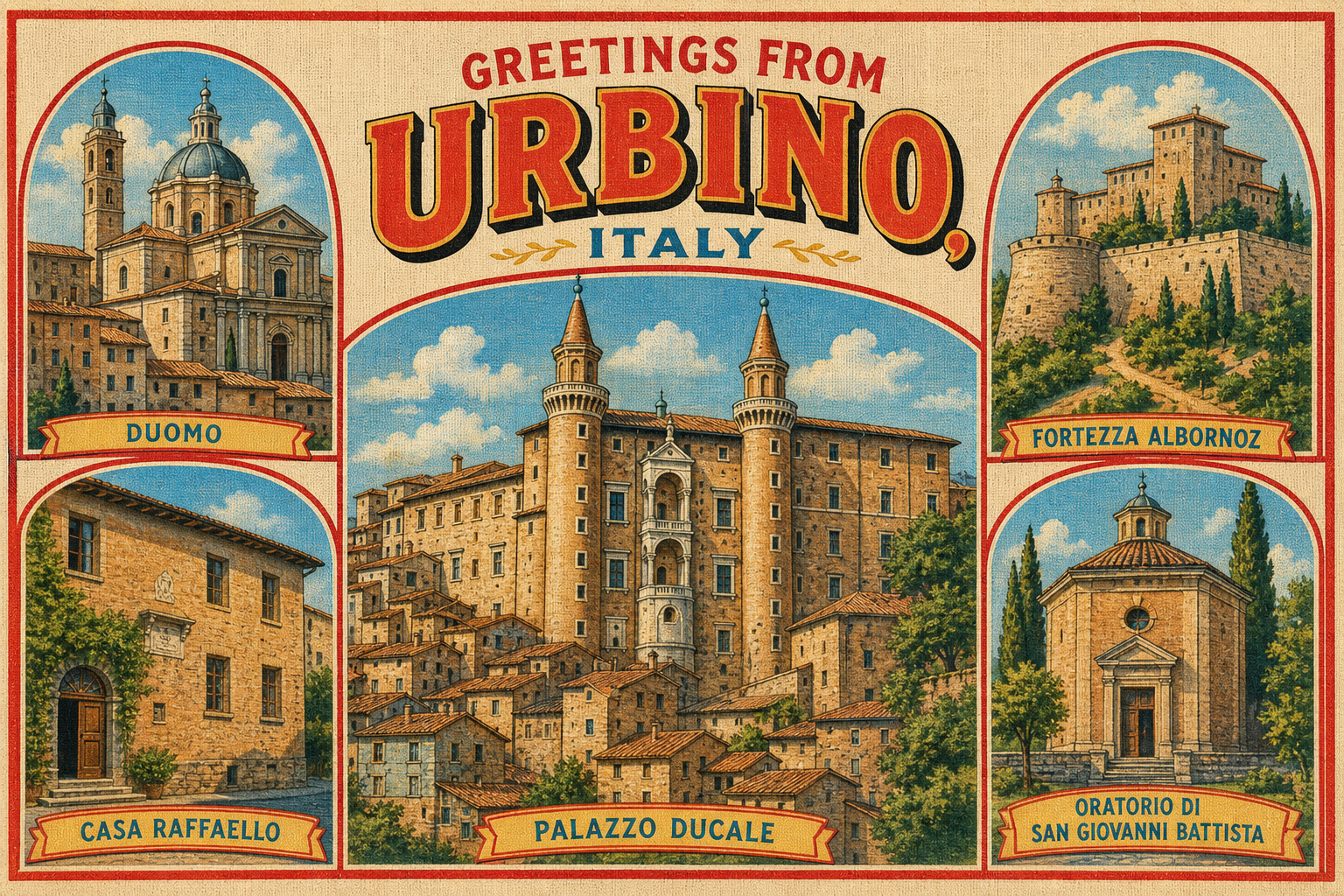
Urbino sits on two hills in the Marche and still feels like a small court that never quite got demoted. Buses dump you at Piazza Mercatale below the walls. From there you take the elevator up toward Corso Garibaldi, or you walk the grade and arrive slightly winded, which is honest. The brick is pink-brown. The streets switch back. Students from the university cut through alleys with backpacks and no interest in your map.
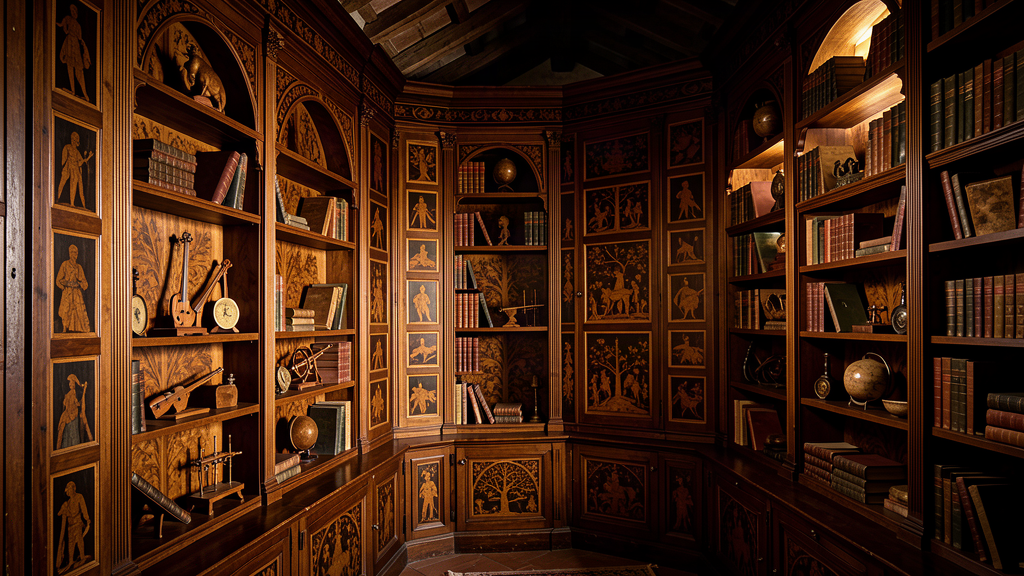
Most people come for the Palazzo Ducale and leave with a gallery ticket stub and a photo of the towers. Fair enough. The palace is the reason this hill still matters. What sticks with me is smaller: the studiolo of Federico da Montefeltro, a room lined with wood so carefully inlaid that open cupboard doors and stacked books are tricks of the grain. You stand in a space built for a duke who wanted to look like he read. The light is low. The marquetry holds. Outside, Urbino keeps being a working hill town with laundry and bars that open for locals first.
From the parking lot to the twin hills
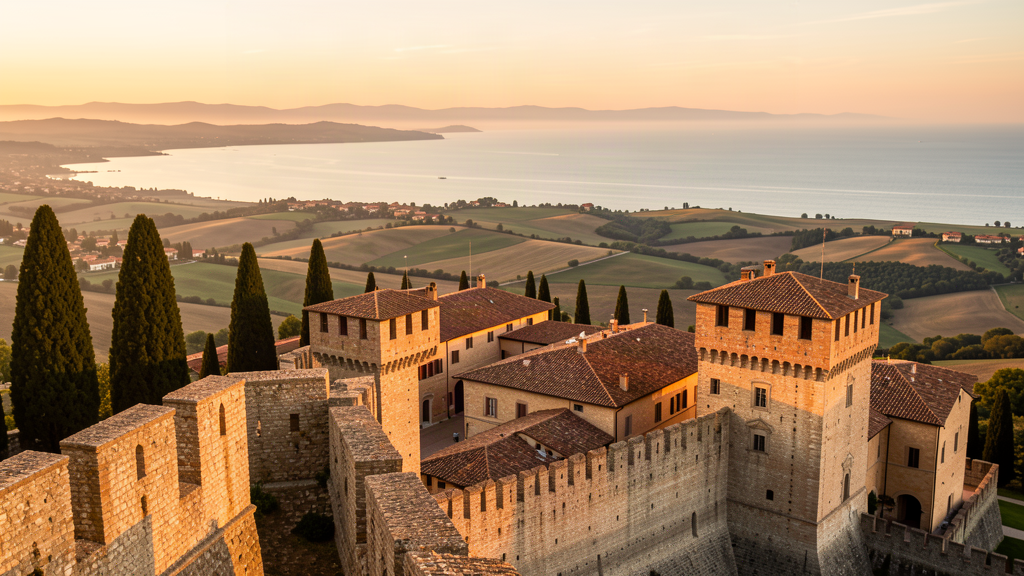
Urbino is not a flat stroll. It is stacked on ridges, with the historic center pulled tight inside brick walls and bastions. Piazza della Repubblica is the hinge: cafés, bus stop energy, people meeting under the clock. From there, Corso Garibaldi and the lanes toward Piazza Duca Federico take you into the court side of town. Via Raffaello climbs the other way, past Casa Natale di Raffaello, the painter’s childhood house, toward higher streets and quieter doors.
Park at Mercatale or the signed lots and walk. The ZTL is real; driving into the centro for “just a minute” is how you meet a camera fine. The elevator from the lower level is not cheating. It is infrastructure for a town built before suitcases had wheels that hated stone.
Give the walls a slow circuit when your legs allow it. The Torrioni and the outer brick faces look east and west over farmed hills, not Adriatic postcard water. Urbino is inland Marche: olive, wheat, distance. On a clear day the air feels bigger than the street plan suggests.
The palace that still sets the temperature
The Palazzo Ducale fills one side of Piazza Duca Federico with a calm that seems almost too quiet for a building this large. Courtyards, staircases, the Galleria Nazionale delle Marche. You can spend a full morning without rushing. Skip the gelato-stop sprint. The collection is uneven the way real galleries are, and that is fine. You came for the rooms.
The studiolo is the piece I would not skip. Small, complete, a little severe. The inlaid wood turns flat walls into shelves, instruments, armor, even landscapes. Federico’s monogram sits at eye level among false cupboard doors and stacked books that are only grain. Outside the room, tour groups compress and expand. Inside, people tend to go quiet without being told.
Elsewhere in the palace, windows frame roofs, walls, and the drop of the hills. Walk the exterior too. The twin towers and the brick mass change as you move around Piazza Rinascimento and the side streets. From most angles the skyline is just the palace, the dome, and the slope under them.
Raphael’s street and the ordinary centro
Casa Natale di Raffaello on Via Raffaello is modest next to the Ducal Palace, which is part of the point. A house, a courtyard, the story of a kid who left and ended up on half the museum labels in Europe. Go if the queue is short. Then keep walking uphill.
The better Urbino sits between monuments. Students sit on steps with plastic cups. A hardware shop still sells rope and lightbulbs. Someone carries groceries up a grade that would count as a hike in a flatter city. Via Saffi and the lanes off the main squares still feel like addresses people actually use.
If you want a church stop beyond the palace orbit, the Duomo and the smaller oratories nearby give you cool stone and a break from sun on brick. I would rather lose half an hour in a side street with a view slit between buildings than collect another façade photo.
University life keeps the town from turning into a pure museum. Term time means more open bars and more people who live here for reasons other than your long weekend. Shoulder seasons are kinder if you want tables without a wait and streets that echo.
Where to eat
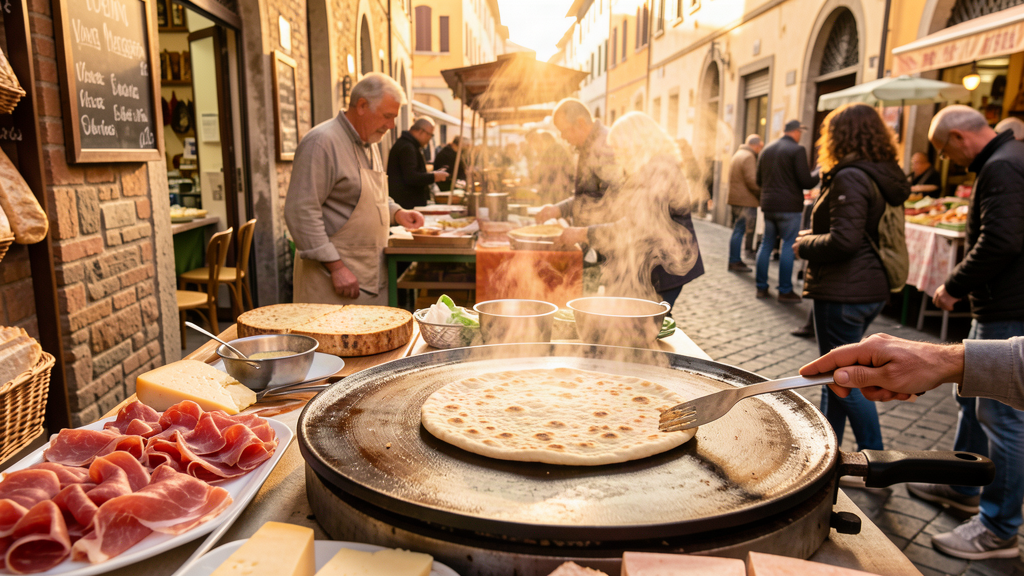
Marche food here is land-facing: crescia (the local flatbread, often flaky and warm), cured meats, sheep cheeses, greens, rabbit, truffle when it is honest, pasta that does not need a speech. The sea is a drive away; do not demand seafood theater in a hill court town.
Antica Osteria Da La Stella
Via Santa Margherita 1, 61029 Urbino PU, Italy
Historic rooms, serious Marchigiana cooking, the kind of place where crescia and salumi still open the meal the right way. Book when you can. Good for the night you want dinner to be the event without leaving the walls. Portions and prices sit above a student trattoria; go hungry and let the kitchen lead.
Ristorante Vecchia Urbino
Via dei Vasari 3/5, 61029 Urbino PU, Italy
A reliable centro dinner when you want traditional plates and a room that has been feeding people long enough to stop explaining itself. Useful mid-stay: full meal, local wine, walk home under brick. Sit inside if the street is loud. Order the plate; ignore the terrace theater.
Osteria Urbino km Zero
Via Francesco Puccinotti 21, 61029 Urbino PU, Italy
Shorter menu, closer to the farm, crescia and seasonal cooking without ceremony. Good lunch or unfussy dinner after a palace morning. The name is more promise than brand: eat what the hills are doing this week.
Between reservations: espresso standing up near Piazza della Repubblica, a pizza slice walked toward a wall with a view, market fruit if you hit the right morning. Student bars are fine for a spritz.
Places to stay
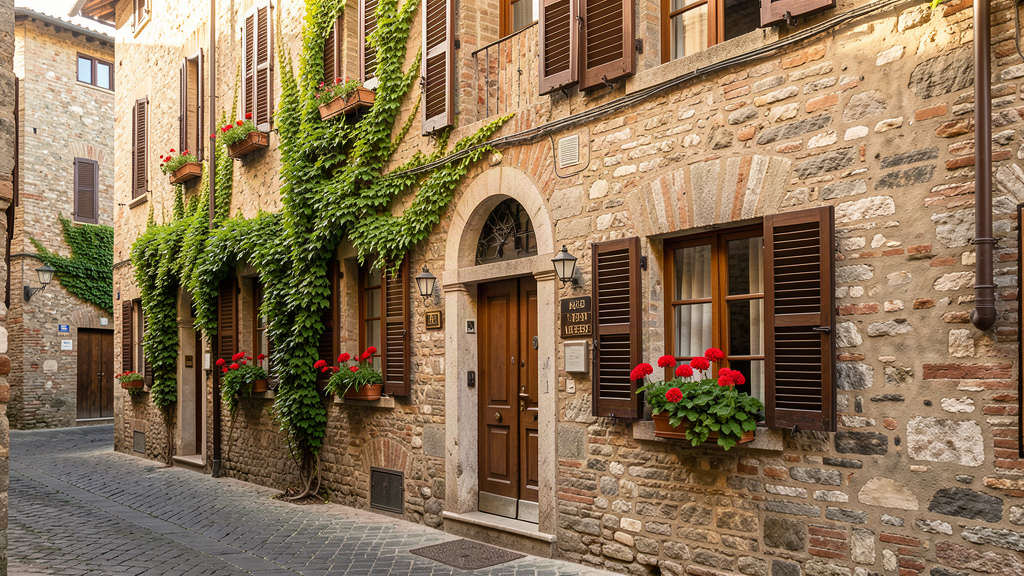
Sleep inside or hard against the historic center if you can. At night Urbino is mostly footsteps and distant scooters, with the hills still out there past the last lamp. Bags on wheels will suffer; pack to carry.
B&B Albornoz — value, inside the walls
Via dei Maceri 23, 61029 Urbino PU, Italy
Small rooms in a lived-in house near Via Raffaello and the fine arts side of town. Practical base when you want the centro without a hotel lobby. Stairs are part of the deal. Ask about parking outside the walls; you will walk the last stretch either way.
Albergo Italia — mid-range, historic center
Corso Garibaldi 32, 61029 Urbino PU, Italy
Urbino’s long-running hotel a short walk from the Ducal Palace side. Straightforward rooms, breakfast that gets you out the door, location that makes the twin-hill days easier. Not a design magazine. Solid for two or three nights when the town is the point.
Palazzo Giusti Suites and Spa — splurge, restored palazzo
Via Vittorio Veneto 37, 61029 Urbino PU, Italy
A Renaissance building redone with serious suites and a spa that feels almost out of scale for a town this size. Book when the stay should match the palace mood: heavy doors, better linens, quiet after the day crowds leave the courtyard streets. Confirm arrival details; the centro is not casual for cars.
Two nights minimum. Three if you want one full palace-and-studiolo day, one slow Via Raffaello and walls day, and one meal you do not rush.
Getting there and moving around
Urbino has no train station in the centro. You come by bus from Pesaro (Adriatic rail hub) or other Marche links, or you drive and park below. Pesaro to Urbino is the classic approach: coast plain, then inland climb into brick. Check bus times in both directions; evening service can thin out.
Once up, walk. Shoes with grip beat smooth soles on polished brick after rain. Summer heat sits on the south-facing climbs; early and late are kinder. Winter fog can erase the hill views and make the palace interiors feel even more like the main event.
For day trips, the Montefeltro hills and smaller borghi are the logical extension, not a forced Adriatic beach run unless you want the contrast. Urbino itself is enough for a short stay if you stop treating it as one museum between Florence and somewhere louder.
I leave with the studiolo still in my head: wood pretending to be open shelves, a duke’s idea of order. Outside the room, the town keeps climbing its own two hills whether anyone is watching or not.
