
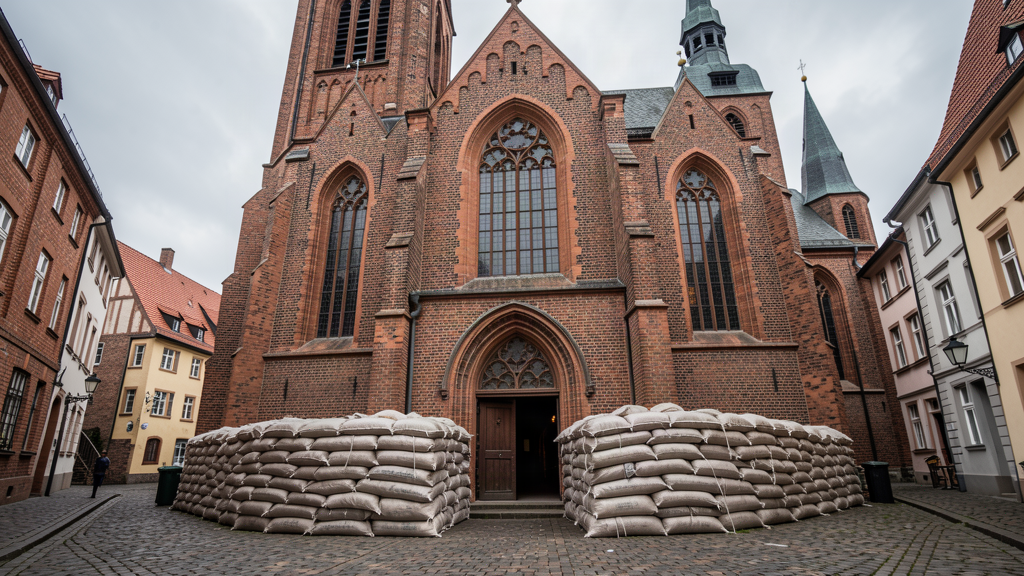
You hear it before you quite believe it. Not a fanfare. Just a low organ tone hanging in the bare stone of St. Burchardi, held by sandbags on the keys and a bellows that refuses to hurry. John Cage’s ORGAN²/ASLSP has sounded here since the turn of the millennium, stretched toward 2640. Chord changes arrive years apart. Most days you simply stand in the quiet and let one long note do its work.
That tone is a fair way into Halberstadt. The town sits on the northern edge of the Harz, in Sachsen-Anhalt, where church power, wartime damage, and ordinary errands share the same streets. April 1945 took most of the old core. What you walk now is a rebuild in layers: half-timber that survived, careful reconstructions, plain postwar blocks, and two great churches still facing each other across Domplatz as if the square refused to empty out for good.
Domplatz, two choirs, open grass
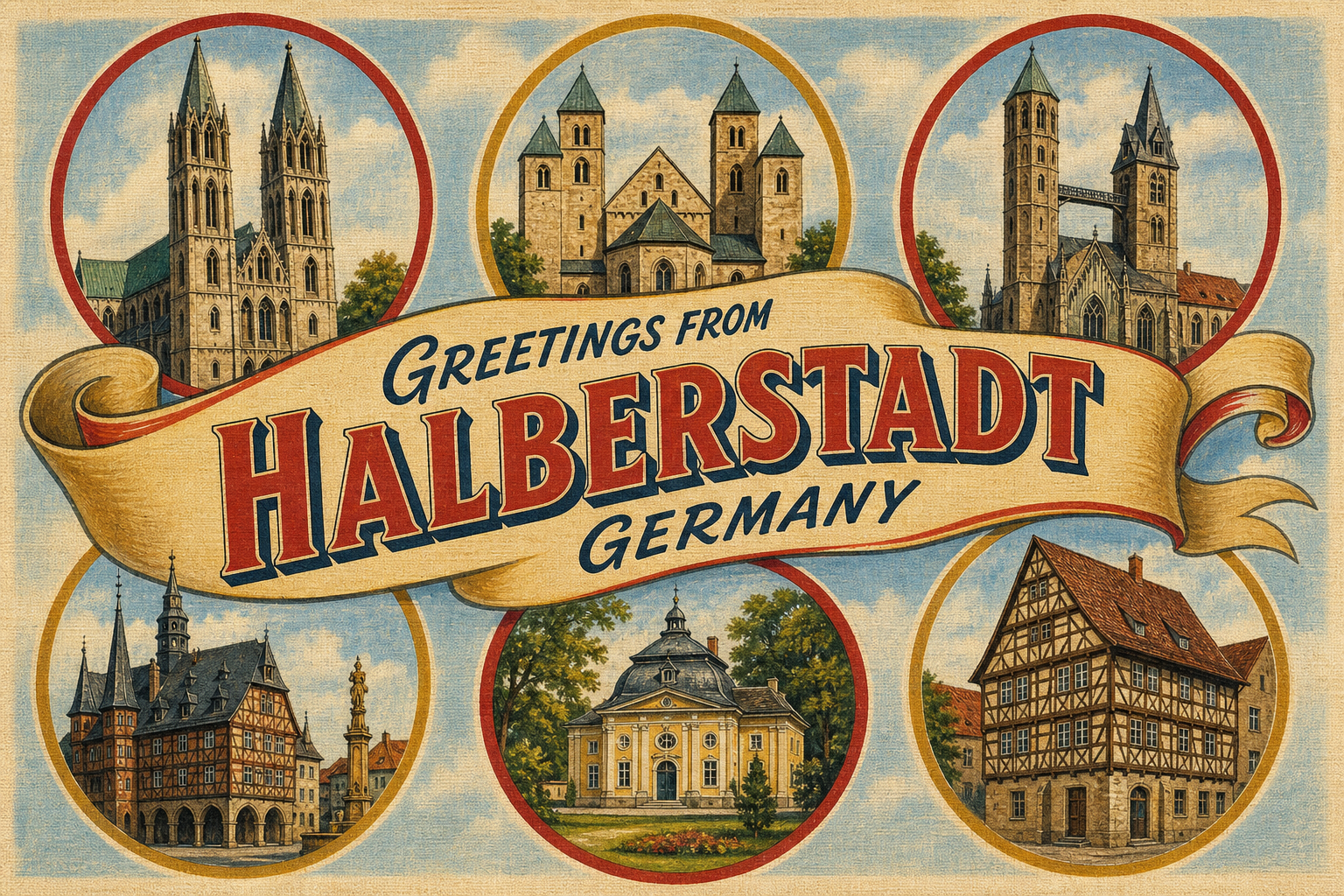
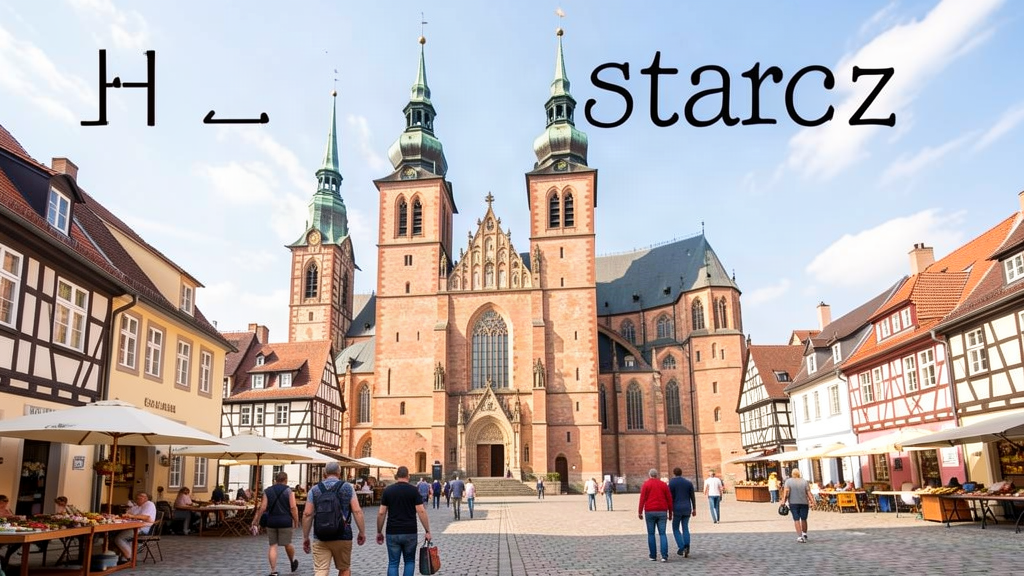
Start on Domplatz. Give yourself a few minutes before any ticket line. On one side rises the Dom of St. Stephen and St. Sixtus, French Gothic, tall and cool, built across the thirteenth to fifteenth centuries. Opposite stands the Liebfrauenkirche, a four-towered Romanesque basilica that feels older in the bones even when the light is the same. Between them, grass and paving hold the middle. Canons’ houses edge the square. On a weekday morning the place can feel almost residential: someone crossing with a bag of bread, a cyclist cutting the corner, schoolkids ignoring the architecture the way locals do.
The Dom is free to enter. Go in for the height first. The nave climbs high enough that your neck notices before your guidebook does. Then stay for the stained glass and the medieval furnishings that somehow outlasted both Reformation politics and bombs. The Domschatz, in the cloister buildings beside the church, is why a lot of people stay longer than they meant to. It is one of the richest medieval church treasuries still kept near its original home: liturgical textiles, goldsmith work, ivories, sculptures, the famous Abraham tapestry from around 1150. The rooms stay quiet and measured. You move from case to case and keep thinking about hands. Who wove this. Who carried it. Who hid pieces in 1945 so they could come back.
Cross the square to Liebfrauenkirche when you can. The four towers give the exterior its silhouette. Inside, look for the twelfth-century stucco choir screen, a Romanesque cycle that rewards slow looking more than a quick photo. The square works because the two churches do different jobs: Gothic height on one side, Romanesque weight on the other, neither trying to cancel the other out.
A short loop that stays local
From the Dom’s choir side, the Gleimhaus is almost next door at Domplatz 31. It is one of Germany’s oldest literary museums, set in the former home of Johann Wilhelm Ludwig Gleim, and it still feels like a house of friendship more than a hall of greatness. Portraits, letters, books. The Enlightenment as a social habit. You do not need to be a specialist. Half an hour is enough to catch the tone: conversation as culture, not as a brand.
A few steps along the square, the Heineanum keeps birds and deep time under the same roof, natural history next door to liturgy. The museum strip is compact. A morning without taxis can still cover medieval faith, Gleim’s letters, and a room of birds before lunch.
For the quieter story, walk north toward the former Jewish quarter and the Berend Lehmann Museum, on ground tied to the old Klaus synagogue. Halberstadt once held a significant Jewish community. The museum does not rush that weight. The streets around it make more sense afterward.
Farther out on foot, St. Burchardi holds the Cage project. The church is spare. The organ is built for one piece: pipes hung and removed as the score demands, keys weighted so a chord can last. You may catch only the current sound. That is still the visit. Check aslsp.org for Klangwechsel dates. August 2026 marks another change. Ordinary afternoons are the honest version.
Spiegelsberge and the edge of town
When the stone starts to feel heavy, head for the Spiegelsberge. The landscape park has been the town’s green break for roughly two and a half centuries: meadows, wandering paths, ruins and viewpoints toward the Harz foreland. Locals use it properly. Dogs, short loops after work, longer Sunday circuits. Bring a sandwich if the weather holds.
The Holtemme threads the wider setting more as habit than attraction. Halberstadt is a Harz gateway, but it does not live only for day-trips. Stay overnight and evening streets thin: bakery shutters, a few lit restaurant windows, Domplatz emptier and better for it.
Places to Stay
Three bases, three budgets, all workable if you want the center on foot.
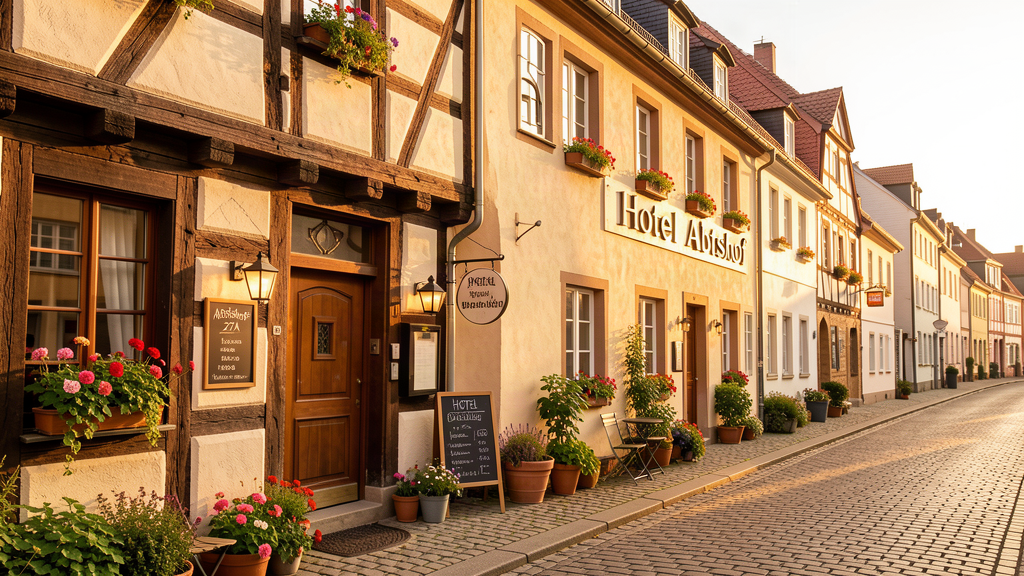
Hotel Abtshof sits in the old-town fabric at Abtshof 27A, 38820 Halberstadt. Family-run, three-star practical, courtyard parking when you can snag it, breakfast that actually fuels a museum morning. It is the sensible pick when you want clean rooms and a short walk to Dom and Martini without paying for spa theater.
Hotel & Restaurant Halberstädter Hof, Trillgasse 10, 38820 Halberstadt, occupies a half-timber house dated 1662. Rooms vary; the building’s age is the point. You are in the historic core, close enough to wander back after dinner without negotiating a ring road. The house restaurant and terrace make it easy on nights when you would rather not map another address.
Parkhotel Unter den Linden, Klamrothstraße 2, 38820 Halberstadt, is the step-up stay: a Muthesius villa from 1910/11, garden and terrace, four-star calm a little removed from the tightest Altstadt lanes. If you want quieter sleep and a proper house restaurant after Spiegelsberge or a Harz drive, this is the comfortable one.
Book early around chord-change weekends at St. Burchardi. The town is small, and curiosity travels.
Restaurants / Food
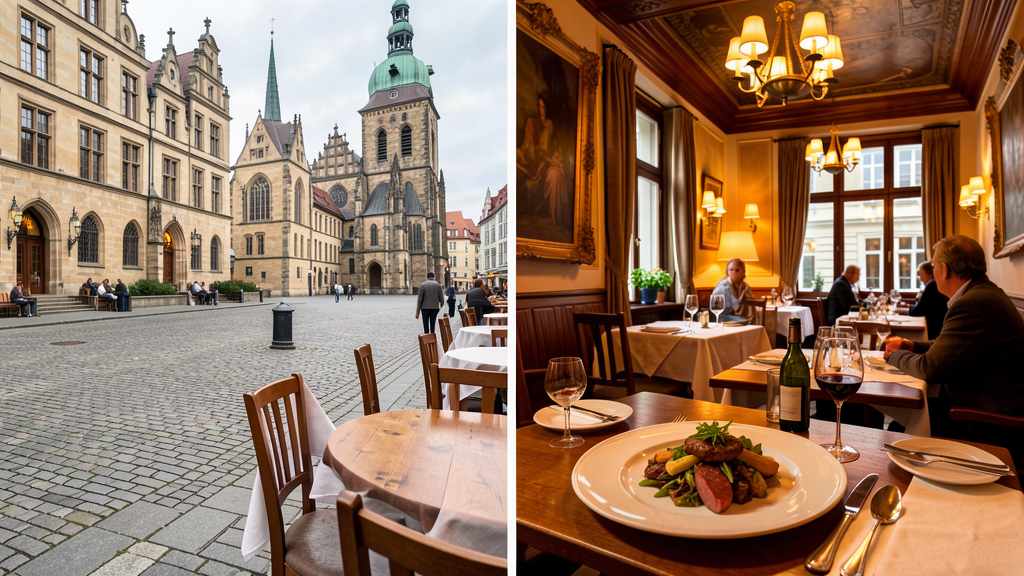
Eat simply and close in. Halberstadt is not chasing tasting-menu fame. It feeds people who live here.
Stephanus, Domplatz 40, 38820 Halberstadt, puts you on the square with German and Mediterranean plates, coffee, and a terrace when the weather cooperates. Useful after the Domschatz, when you want to sit facing the same stones you just left.
Restaurant at Halberstädter Hof, Trillgasse 10, 38820 Halberstadt, leans regional and hearty inside the half-timber rooms: lunch menus, proper evening plates, beer garden air in season. The room does a lot of the hosting for you.
Parkhotel Unter den Linden restaurant, Klamrothstraße 2, 38820 Halberstadt, is the polished dinner: villa setting, terrace over the garden, a quieter meal when you have spent the day on foot and want cloth and pace rather than a quick bite near the Markt.
Between museums, follow whatever bakery still has a mid-morning line. A warm Brötchen and coffee on a bench usually beats hunting for something special.
Getting around without fuss
Halberstadt Hbf sits southeast of the core, about fifteen minutes on foot to Domplatz, or a short bus if bags are heavy. Trains link toward Magdeburg and the Harz lines. Once in the center, walk. Mondays are awkward: Domschatz, Gleimhaus, and several museums rest. Plan churches and park walks then.
If you drive, park once and leave the car. The pleasure is sequence on foot: Domplatz grass, treasury textiles, Gleim’s portraits, soup, then the walk out to a single organ tone with nowhere urgent to be.
Why linger
Halberstadt rewards people who like seams. Gothic against Romanesque. A cathedral treasure packed away and returned. An Enlightenment house of letters a minute from medieval glass. A ruined century and a rebuilt street. And in a nearly empty church, sandbags on an organ keyboard, holding a chord while the rest of us check the time.
Stay two nights if you can. One day rushes the Dom and leaves. The second is for Spiegelsberge light, another coffee on Domplatz, and St. Burchardi again when you already know the sound and still want it.
