
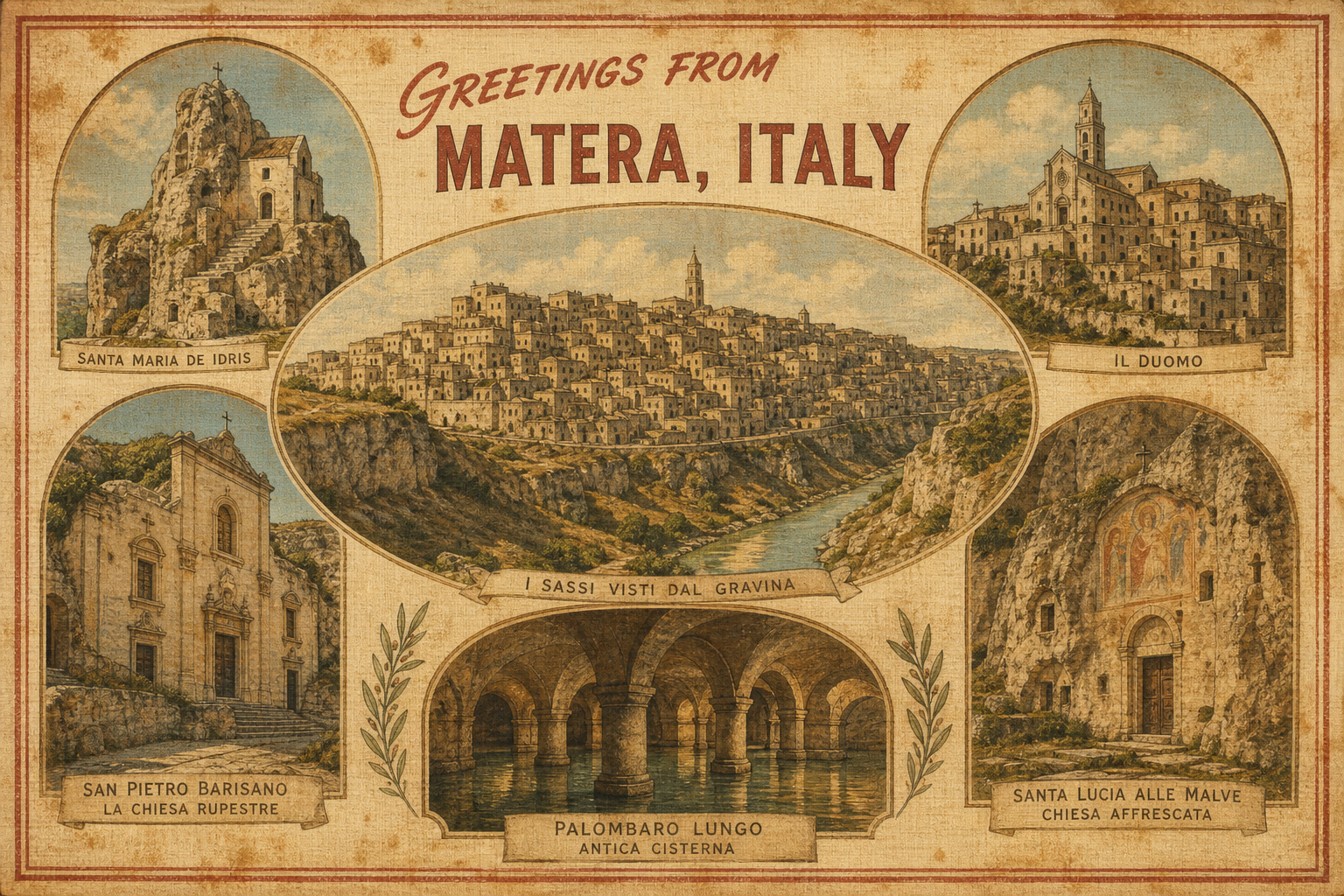
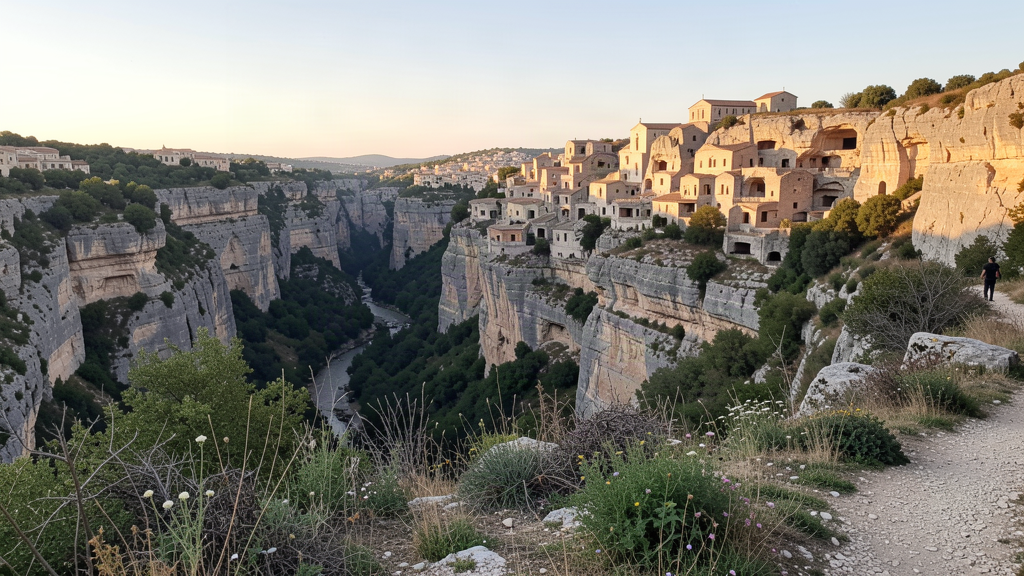
Matera does not need another speech about being the oldest city still lived in. What I come for is simpler: a limestone gorge cut by the Torrente Gravina, and churches carved into the cliff face. From certain balconies you look straight across at frescoed caves on the far bank. City on one side. Park and quiet on the other. Most day-trippers stick to the postcard rim. I keep catching myself staring at the drop even while I'm still in the Sassi lanes.
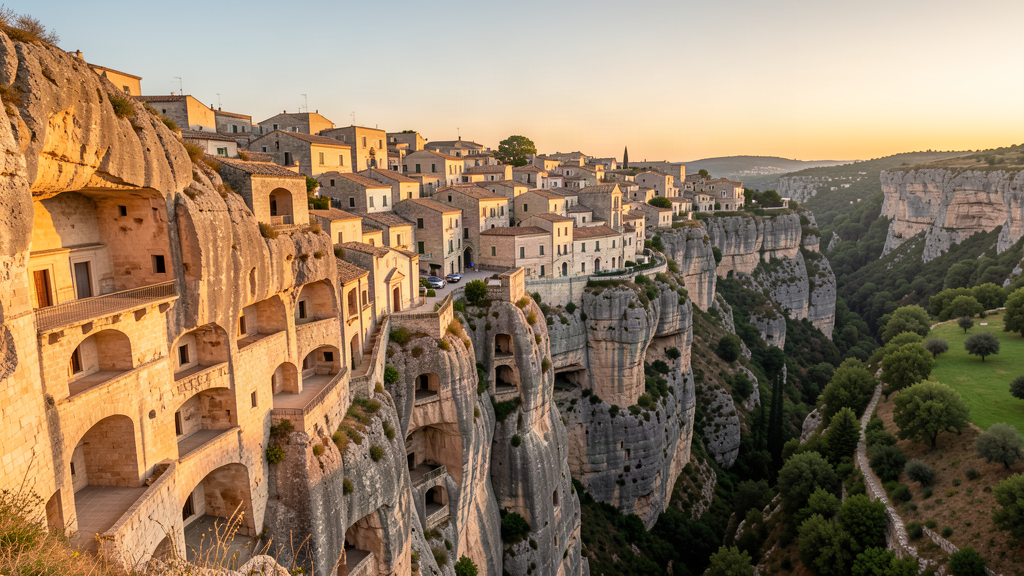
I start early, before the stone turns white-hot and the luggage wheels take over. Coffee up in the Piano, the newer grid above the caves. Then down into Sasso Caveoso, where the rock churches sit like ordinary neighbors among restored cave houses. Matera is Basilicata, not Puglia, though the border is close enough that people blur it. The bread has its own pull. The gorge messes with your sense of height.
Churches that are caves first
Santa Maria de Idris sits on a rock outcrop above Sasso Caveoso — half church, half cliff. You climb more than you stroll. Inside is cool and uneven. Frescoes look back from stone that was never meant to be a clean gallery wall. Nearby, Santa Lucia alle Malve and the Madonna de Idris cluster reward the same slow feet. Buy the combined ticket when they offer it. Don't rush the sequence like a checklist of holy caves.
I treat these as working religious spaces that happen to be spectacular, not photo rooms with pews. If a service is on, leave. If a door is shut, walk the exterior terraces and look across the Gravina anyway. Tour groups spike late morning. Opening hour or late afternoon works better, when the light goes sideways and the stone stops glaring.
Casa Grotta reconstructions nearby show how families lived in single-chamber caves with animals under the same roof into the twentieth century. Useful context. Short visit. Then you're back outside on stairs that pick a new direction every twenty meters.
Across the Gravina
The Sassi face a wilder twin: Parco della Murgia Materana, full of abandoned caves, shepherd paths, and more rock churches than you will ever enter. The classic move is Belvedere Murgia Timone, looking back at Matera's stacked facades. From that side the city reads as one continuous cliff of windows and hanging gardens.
There is a pedestrian route down toward the torrent and up the other bank when access allows. Some seasons favor a road approach and a short walk to the belvedere instead. Check current trail advice. The gorge is not a theme-park staircase. Wear shoes with grip. Carry water. I go for standing opposite the Sassi long enough that the drop stops feeling abstract.
On the Matera side, belvederes near Piazza Giovanni Pascoli and along the Civita give you the reverse shot without leaving town. I use both. Morning on the city rim. One late-light hour across the park if legs and logistics agree.
Pane, Piano, and ordinary Matera
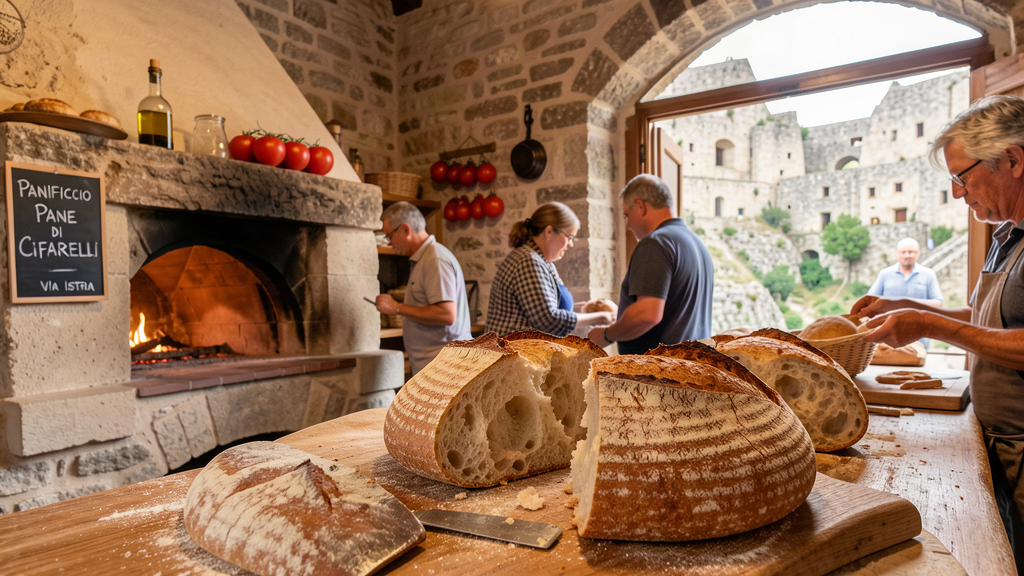
Before the caves get all the attention, I buy bread. Pane di Matera IGP is a durum loaf with a serious crust and a pale crumb that keeps for days — built for shepherds, not brunch photos. Panificio Cifarelli at Via Istria 17, 75100 Matera MT, Italy, is a working reference point for the style. Go for a half loaf if you are alone. Tear it on a wall later with oil and tomatoes.
Above the Sassi, the Piano is where Matera runs errands: shops, offices, evening passeggiata that is not staged for drones. Piazza Vittorio Veneto opens over the Sasso Barisano like a civic balcony. I like dropping from that square into the lanes, getting lost on purpose, and climbing out again when my calves complain.
In the evening the stone holds heat. Kids kick balls in unlikely courtyards. Someone waters plants on a roof you did not notice at noon. That version of Matera sticks with me more than the empty-alley dawn clips.
Where I eat
Lucanian cooking here is durum, legumes, bitter greens, lamb when the kitchen still bothers, and bread that is not a side thought. I skip rooms that only sell the cave vault as the dish.
Panificio Cifarelli
Via Istria, 17, 75100 Matera MT, Italy
Morning stop for Pane di Matera and whatever else just left the oven. Stand in line with people buying for the house, not only for a suitcase prop. Eat half the same day; the crust forgives a second day if you wrap it properly.
Osteria al Casale
Via Madonna delle Virtù, 29, 75100 Matera MT, Italy
Cave room and terrace on the Sassi side without turning dinner into theater. Food of the area — pasta, vegetables, slow meats — aimed at people who booked because they were hungry. I reserve when the night matters.
Baccanti
Via Sant'Angelo, 58-61, 75100 Matera MT, Italy
Deeper into the cave fabric, looking toward the Murgia edge. More polished, still regional under the stone arches. Good when you want a longer meal after a gorge day and a bottle from the plateau. Book. Walk home through lanes that look different after dark.
Between meals: espresso standing up in the Piano, fruit from an ordinary shop, water always. The stone does not care that your itinerary looked gentle on paper.
Places to stay
Sleeping in or against the Sassi changes how the morning starts. You walk out into stone instead of negotiating a taxi into the postcard.
Hotel Sassi (value)
Via San Giovanni Vecchio, 89, 75100 Matera MT, Italy
Long-running base in Sasso Barisano with rooms cut into the hillside and views that do more work than the furniture. Fair rate for the location, a front desk used to suitcase wheels, stairs and uneven floors. Confirm how close you can get a car; the last stretch is often on foot.
L'Hotel in Pietra (mid-range)
Via San Giovanni Vecchio, 22, 75100 Matera MT, Italy
Smaller design-minded stay in restored stone along the same Barisano fabric. Quieter rooms and a bit more polish without going full albergo-diffuso fantasy. I pick it for two or three nights when dinners, rock churches, and a Murgia day all need a stable pin.
Sextantio Le Grotte della Civita (splurge)
Via Civita, 28, 75100 Matera MT, Italy
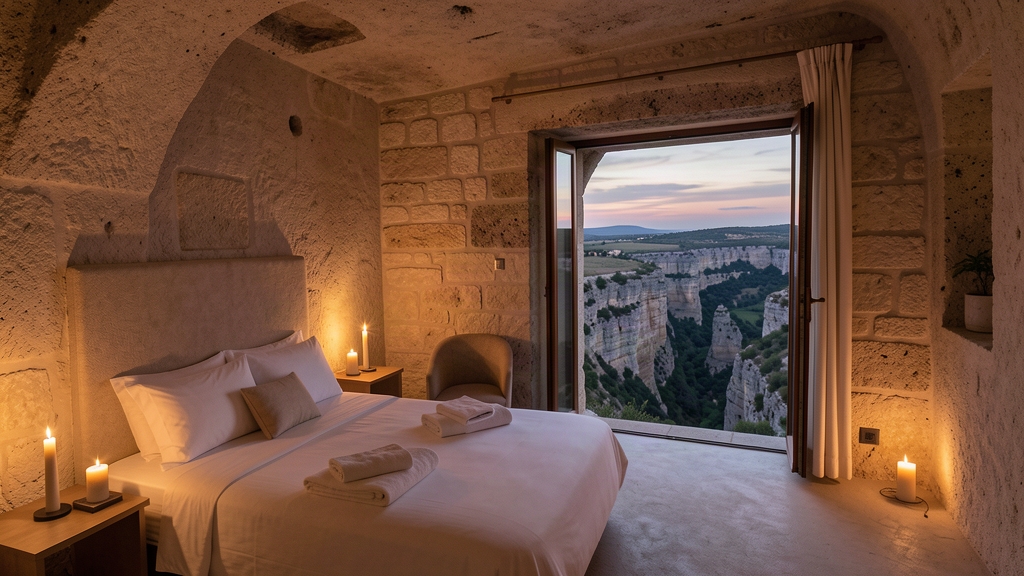
Candlelight, severe beauty, cave rooms facing the park — the stay people mean when they say they slept in the Sassi properly. Come when the budget has room and you want the gorge in your peripheral vision at breakfast. Parking is off-site; luggage is a project. Book early in high season.
Getting here and moving around
Bari Airport is the usual air gate; rental car or transfer covers the inland run in roughly an hour to an hour and a half depending on traffic. Trains reach Matera on the Ferrovie Appulo Lucane line from Bari — check current schedules; this is not Milano–Roma frequency. The station sits away from the Sassi edge; plan a bus, taxi, or a determined walk with luggage you trust on stone.
Inside town, walk. The Sassi punish casual driving and reward calves. ZTL rules and dead ends will humble a rental you only needed for arrival. Park up top and descend. For Murgia Timone, confirm whether you are hiking the gorge route or driving around to the park entrances.
Evenings are for repeating short loops: a belvedere you already saw, a lane that dead-ends into laundry, another piece of bread you swore you would save. Skip the heroic itinerary. Give your eyes time to adjust to vertical living, and let the Gravina stop feeling like a backdrop.
A last look across the drop
Before I leave, I go back to a rim I already used. Same stones. Different light. The rock churches on the far side hold their frescoes whether or not anyone buys a ticket that hour. Down in the Sassi someone rolls a suitcase over rock that outlasted every empire that tried to manage this place. I finish the last of the loaf and climb toward the Piano. My legs will remember Matera longer than the camera roll will.
