
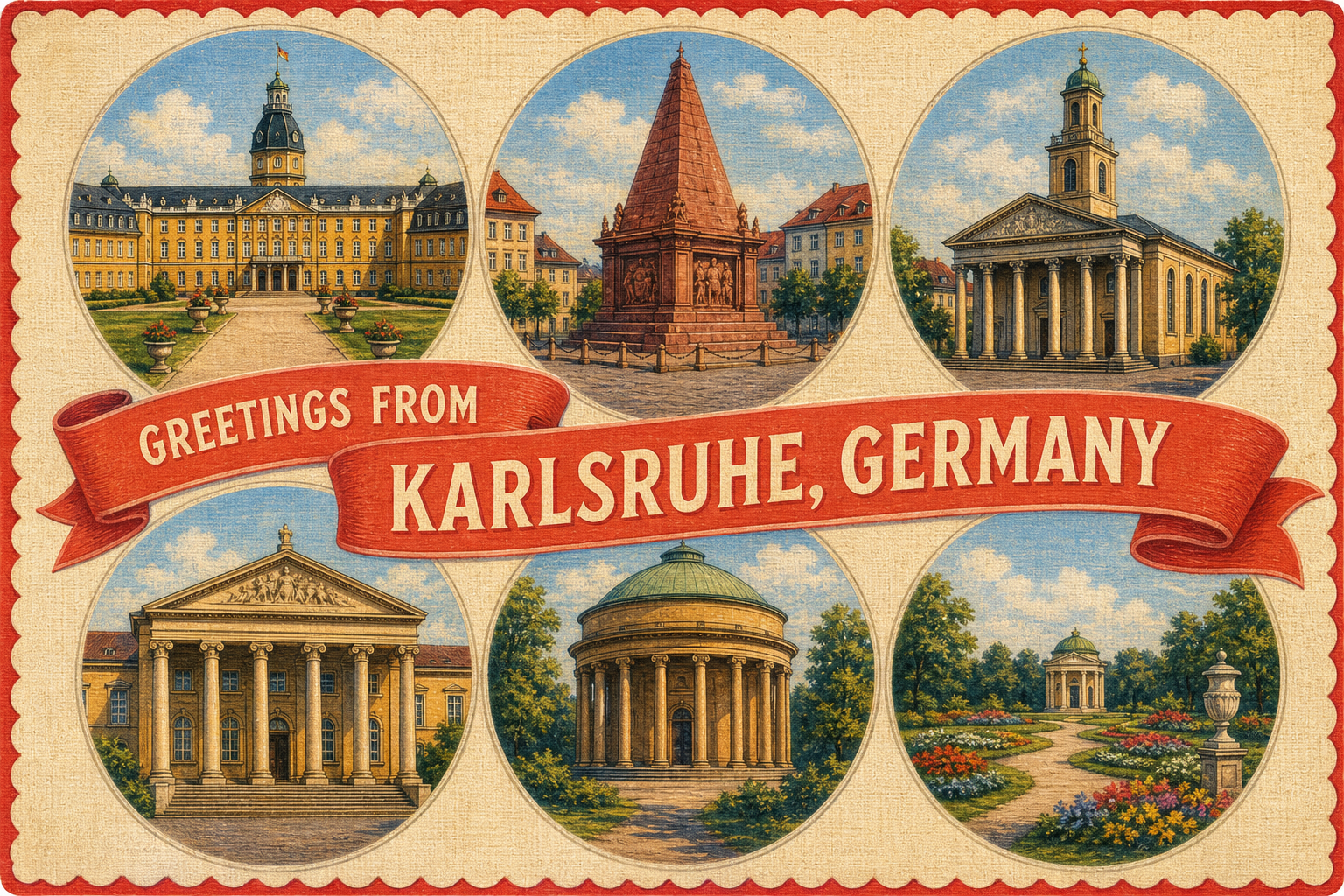
Karlsruhe fans out from a palace like a compass rose drawn with a ruler. The streets admit it — long rays, green parks, courts and museums lined up for people who already know the map. Walk the Schloss once if you feel like it. Then leave the geometry and ride east to Durlach, the older town that used to rule this stretch of Baden and still acts like it remembers.
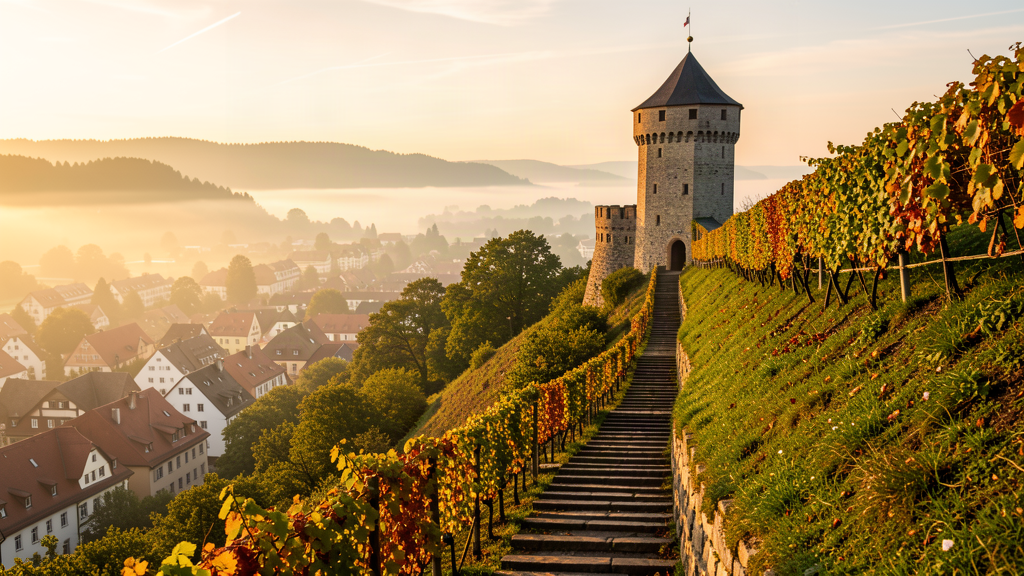
Durlach is not a suburb with a pretty logo. It was the residence before Margrave Karl Wilhelm cut a new capital out of the Hardtwald in 1715. The lanes stayed medieval. The wall left pieces. The house hill kept its funicular and a stair people still call Hexenstäffele — witches’ steps — because 528 stone risers will make anyone mutter. Start there. Karlsruhe’s fan only makes sense after you have climbed out of its mother’s streets.
Durlach Marktplatz before the tram turns around
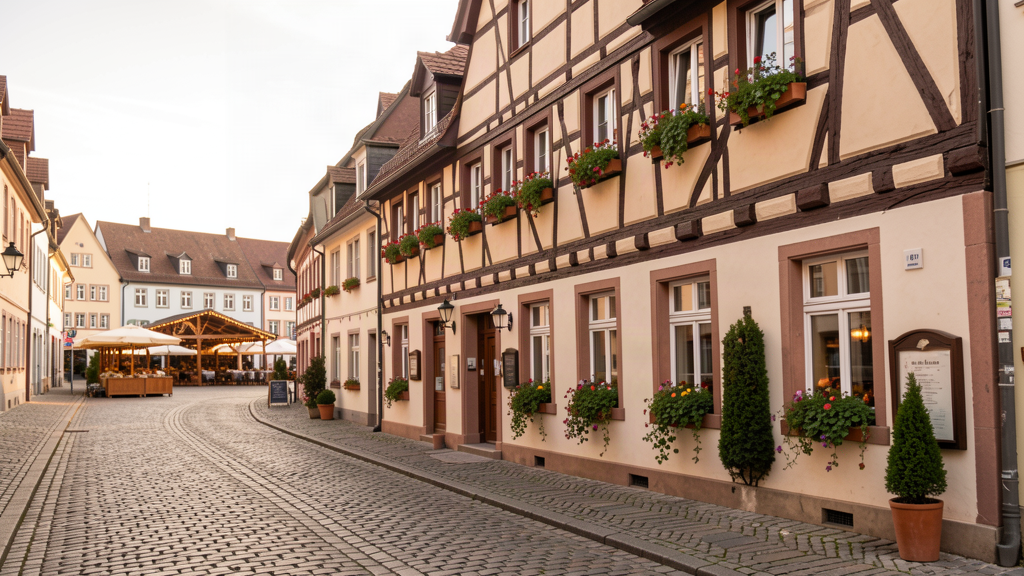
Tram 1 drops you into a traffic-calmed core older than the city on most tourist maps. Marktplatz holds the Rathaus with its balcony knight — locals still call the margrave “Karle mit der Tasch,” the man who allegedly paid builders from a bag he carried himself. Whether the story is true matters less than the habit of telling it while buying bread.
Most mornings the Wochenmarkt fills the square from roughly half past seven to early afternoon: fruit crates, cheese, flowers, regional produce that rolled in from Aue and the Pfinz valley. Go early on a weekday. By late morning the square thickens with errands and coffee stops; before nine you get Durlach shopping for the week.
From the market, alleys tighten toward the old wall line. Basler Torturm on Kelterstraße is the last standing city gate of the former residence — fourteenth-century stone, once part of a south defense with moat and drawbridge, now a monument volunteers have been nursing back since 2018. You do not need a ticket speech. Walk through the arch, notice how the lane scale changes, keep going. Karlsburg, the old palace block on Schlossplatz, holds the Pfinzgaumuseum, a library branch, and music students. The garden beside it is the oldest public garden fabric in Karlsruhe. Sit five minutes. Leave before the visit turns into a checklist.
Hexenstäffele, Turmbergbahn, the hill that corrects the fan
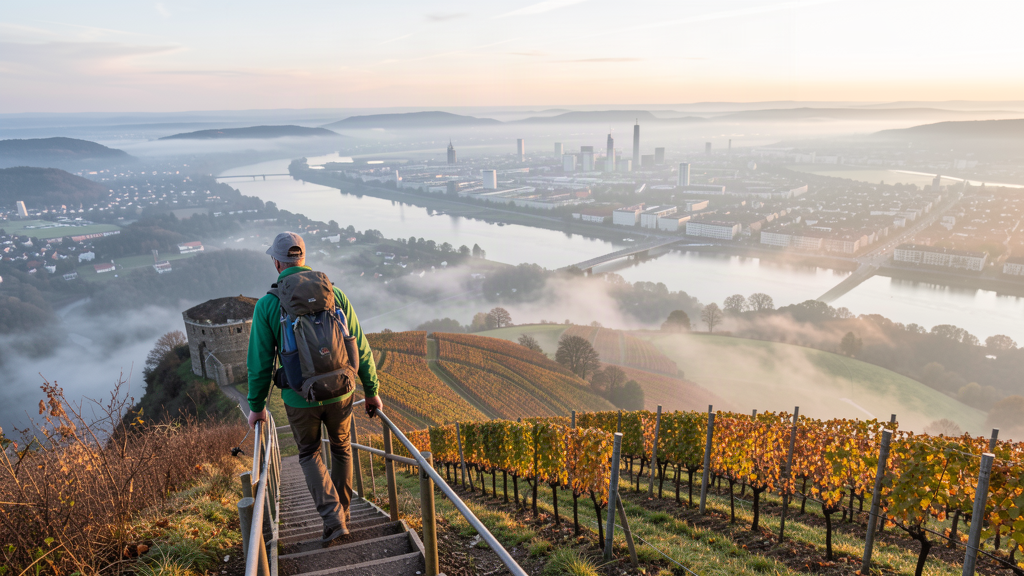
Turmberg is Durlach’s house mountain — about 256 meters, the northwestern edge where Kraichgau hills meet the northern Black Forest. From the plain it looks modest. From the top the Rhine plain opens and Karlsruhe’s rays suddenly read as a planned thing rather than the whole story.
You can take the Turmbergbahn, a funicular running since 1888 and still the oldest operating standseilbahn in Germany. The cars winch through vineyard and tree cover with the practical rhythm of local transit. Fair enough on a hot afternoon or with tired knees.
Or you walk Hexenstäffele. The stair climbs in a direct, slightly stubborn line from the Durlach side — 528 steps, uneven the way old outdoor stairs are uneven, shade and sun alternating. People train here. Kids count out loud and lose track. You stop more than you planned. At the top, ruin fragments and a platform look west over roofs and rail lines toward the fan city you postponed. Rosengarten paths and forest loops peel off if you want another hour. I usually take the funicular down and save the legs for dinner.
Skip the peak-conquering talk. Leave Karlsruhe’s flat layout long enough to see it as one layer on older ground.
Fan city, kept short
When you do ride back into central Karlsruhe, keep the visit short and specific. Schloss Karlsruhe faces its garden; the Bundesverfassungsgericht and other serious buildings remind you this is a working capital of law and tech. Schlossgarten is good for walking off market cheese. Save a full museum day for weather that traps you.
Kaiserstraße and the pedestrian grid will try to keep you shopping. Duck south instead toward Südstadt if you want the city as people actually use it after dark. Werderplatz sits at the neighborhood’s stubborn heart — program cinema at the Schauburg, bars, kitchens from half a dozen languages, a fountain locals still link to the old nickname “Südstadt-Indianer.” The square has rough edges. Social services and nightlife share the same blocks. That is a district that never fully sanded itself smooth for visitors. Walk it in daylight first. Eat there if the room feels right.
City Park and the Oberwald edge give green relief south of the tracks if the Altstadt stones in Durlach have already done their job. Swans on a small water, a water tower turned mini-stay, paths that lead toward the Tierpark without demanding a full day. Use them when you need air.
Places to stay
Base yourself where the mornings match the walk you want. Durlach keeps you next to market stone and the Turmberg stair. The center keeps you next to trams and the palace garden. Pick on purpose.
Hotel zum Erwin (value / Durlach Altstadt) Kelterstraße 10, 76227 Karlsruhe Small protected-building hotel a short walk from Marktplatz, Basler Tor, and the Turmbergbahn valley station. Simple rooms, courtyard air, bike loans if you want to roll toward the fan without a car. You trade spa floors for sleep inside the older town. Spend what you save on a reserved table on the hill.
Hotel am Markt (mid-range / center) Kaiserstraße 76, 76133 Karlsruhe On the pedestrian spine between Marktplatz and the Schloss approach — practical for tram links out to Durlach and for a night when you want museums and court-district walks without a long ride home. Clean, central, no Durlach romance outside the window. Use it when the itinerary splits between hill mornings and city evenings.
Hotel Kaiserhof (splurge / Marktplatz center) Karl-Friedrich-Straße 12, 76133 Karlsruhe Four-star stay directly on the central market axis: brighter rooms, garage convenience, foot access to Schlossgarten, theater, and the shopping grid. Useful when the room itself should feel like part of a longer city break. Durlach is still a direct tram ride; you just return to heavier linen and a quieter door seal.
Where to eat
Tourist menus cluster near the palace rays. Durlach and Südstadt feed people who already live here.
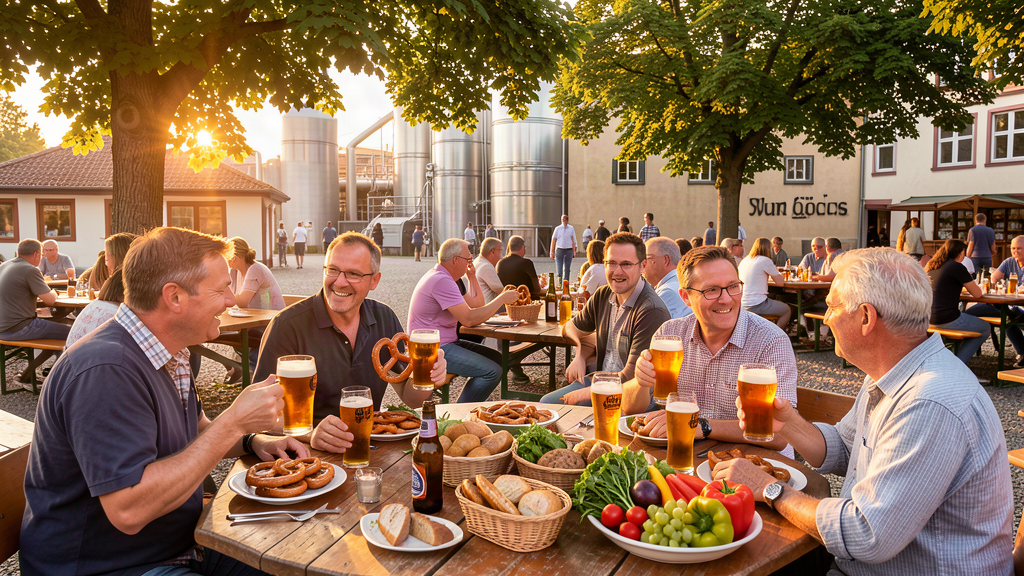
Vogel Hausbräu Durlach Amalienbadstraße 16, 76227 Karlsruhe House brewery in the old town fabric — unfiltered beer, solid plates, a terrace that fills the second the sun holds. Locals treat it as a default evening. Go for the first beer after Hexenstäffele while your calves are still arguing.
Anders auf dem Turmberg Reichardtstraße 22, 76227 Karlsruhe Restaurant and hofbistro up on the hill by the Staatsweingut ground — regional cooking with a view that makes the climb (or the funicular ticket) feel practical. Reservation culture is real; card-only habits show up too. Book the hill dinner once and let the plain lights come on under you.
Wirtshaus Wolfbräu Werderstraße 51, 76137 Karlsruhe Südstadt wirtshaus near Werderplatz: Baden plates, beer garden when weather allows, the neighborhood’s mixed soundtrack rather than a quiet wine room. Pair it with a Schauburg film or a slow loop of the square. If the edges of the block bother you, sit closer to the house and keep the evening short.
Market mornings, skip hotel breakfast. Bread and fruit from Durlach Marktplatz, a bench near Karlsburg garden, crumbs for whoever claims the sparrows. Climb afterward while the legs are fresh.
Getting around without fuss
Karlsruhe’s tram and Stadtbahn net is the real luxury. Line 1 ties Durlach to the center; S-Bahn and regional trains stop at Durlach Bahnhof for wider Baden moves. Buy a day ticket if you will hop more than twice. Bikes work on the flat fan; the Turmberg is the exception your calves already filed.
Drivers should expect pedestrian cores and paid parking. In Durlach, use a garage near Amalienbad or the Festhalle and walk the rest. The Altstadt is small enough that a car becomes a storage problem, not a tool.
Give the place two full days if you can: one anchored on Durlach market, wall fragments, and the hill; one for Schlossgarten, a museum you actually care about, and a Südstadt evening. The fan city stays on the map either way. After the stairs above Durlach, it just sits differently.
