
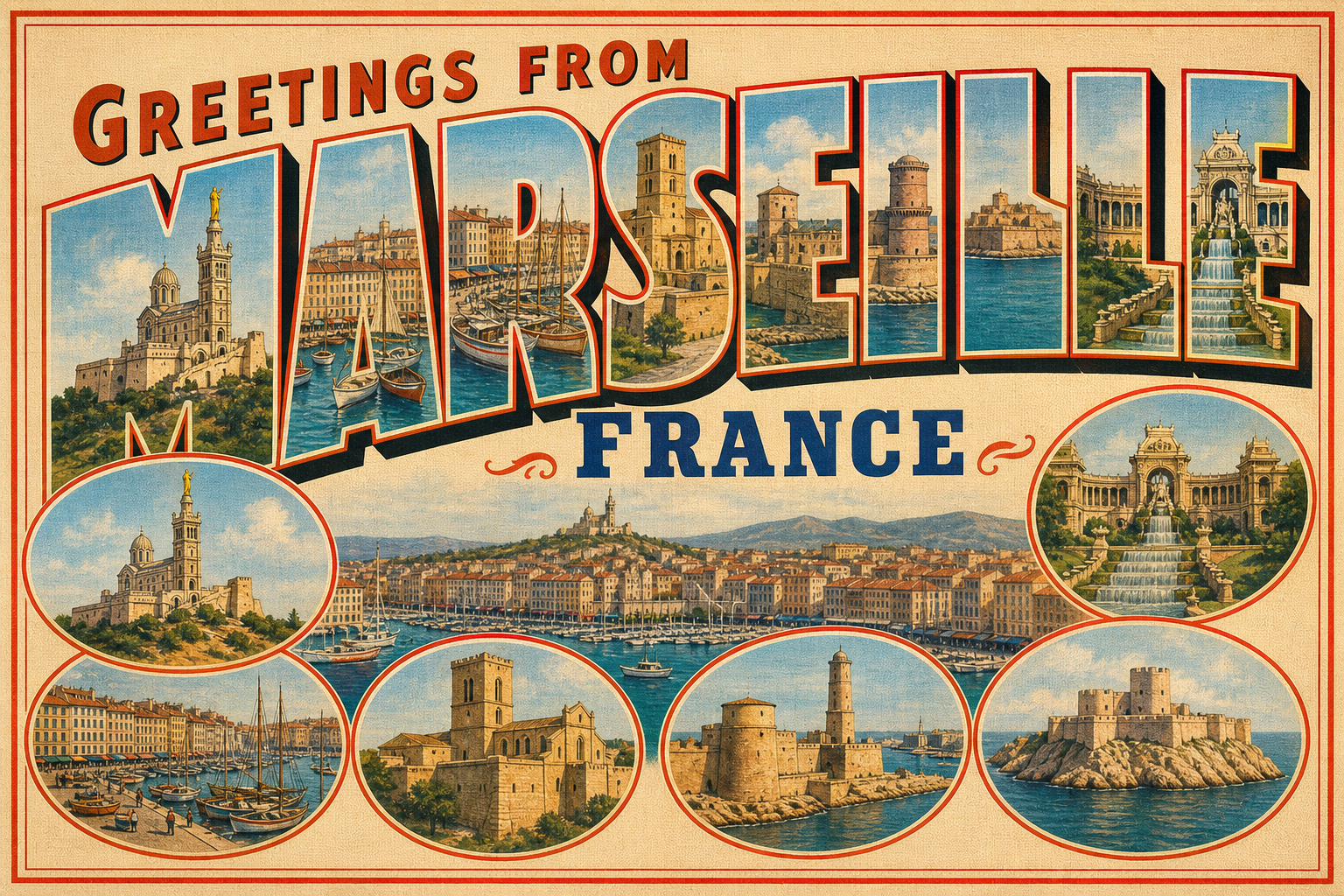
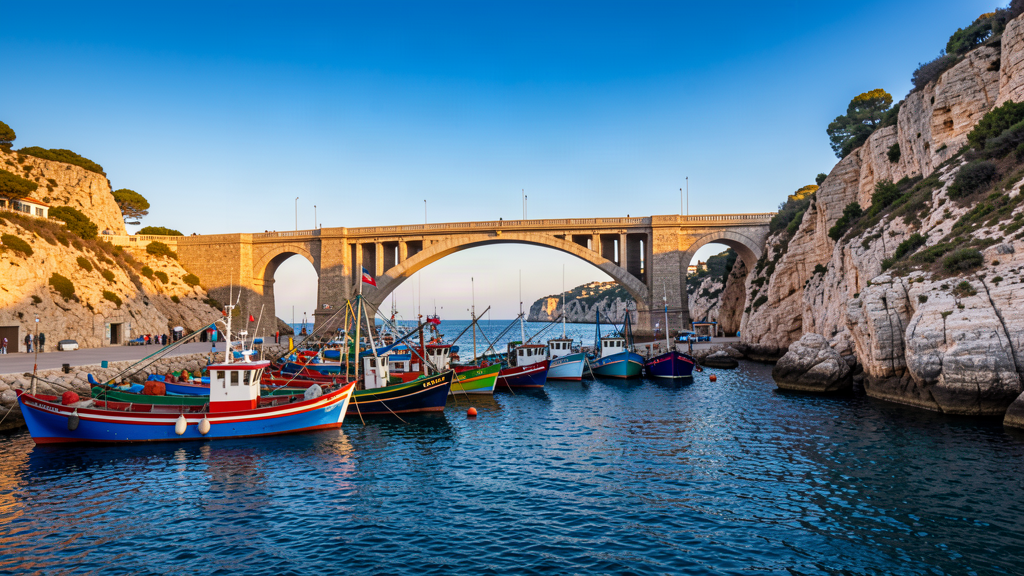
Most visitors meet Marseille at the Vieux-Port, where the water is wide, and the photos look pre-approved. Fair enough — the harbor has earned the attention. But the city I keep returning to sits a short bus or long walk west, where the Corniche lifts over a notch in the cliff, and a fishing cove drops out of sight of the tour buses.
Vallon des Auffes is not a secret. Locals eat here. Photographers lean on the bridge at golden hour. The place still refuses the theme-park treatment. The boats are working boats. The tables face real water. Endoume around it keeps grocery bags and laundry lines in the frame.
I came for fish soup and stayed for hulls knocking gently under the arch.
The cove under the road
From Corniche du Président John Fitzgerald Kennedy, Vallon des Auffes looks like a gap you might miss if you are watching traffic. Then the road bridges the inlet, and the scene opens below: pastel façades, a tight basin, masts, nets, and stone steps into someone else’s morning.
The name comes from auffes — the esparto grass once twisted into rope and fishing gear. Nobody has turned that into a heavy plaque tour. You feel it in the scale. Everything is close. Voices carry. A cat owns a doorstep. Someone hoses a deck while someone else argues about parking two streets up.
Walk the rim first, then go down. At water level, the Corniche turns into a ceiling of traffic that fades into slap and creak. Stand still until the cove stops looking like a backdrop and starts looking like a workday. Early is better. Midday brings more phones. At dusk the light does half the job — warm stone, blue water, a last fisherman tightening a line — and kitchens smell like garlic and shellfish.
Endoume without a checklist
Above the Vallon, Endoume is residential Marseille with salt still on the air. Apartment blocks, corner bars, bakers who know regulars by order rather than name. Loop from the cove toward rocky swimming spots, or cut inland where streets climb and straighten.
I like this stretch because nothing insists on being an itinerary. Buy a panisse — chickpea fritter, crisp outside, soft inside — and eat it walking. Or sit with coffee and watch school kids, scooters, and retirees share the same narrow sidewalk. The sea is nearby; daily life is the main event.
For a longer coastal walk, the Corniche is the spine: island views, joggers at odd hours, monuments locals use as meeting points. Turn inland when the wind gets sharp. Marseille wind is not a backdrop. It will rearrange your afternoon.
Le Panier when the cruise groups thin
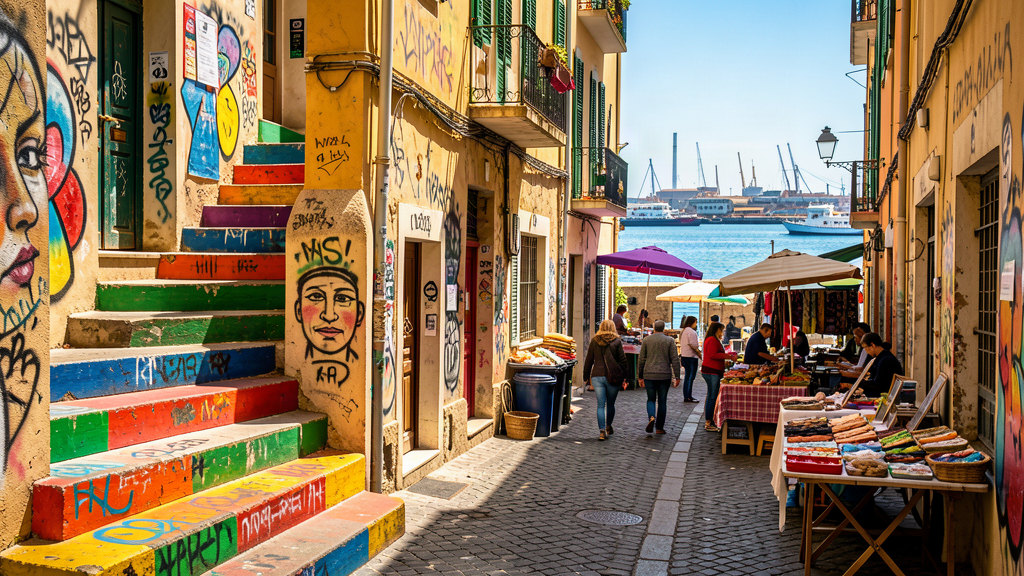
Back toward the old center, Le Panier climbs behind the Vieux-Port in stairs, laundry, murals, and courtyards. It is the oldest district, and some lanes lean hard into postcard Marseille. Others still feel lived-in between the galleries.
Go when the light is low, and the big groups have moved on — late afternoon, or a weekday morning before souvenir doors fully open. Vieille Charité, the 17th-century almshouse turned cultural complex, is worth the stop for the courtyard calm as much as for the exhibition. Streets fold back on themselves. You will get mildly lost. Fine.
This is pizza and anchovy country as much as Provençal market cooking. Marseille’s Italian and Corsican layers show up on menus without apology. Follow wood ovens more than rating apps.
Noailles for the city’s real pantry
If Vallon des Auffes is salt water, Noailles is dry goods and fruit piled high. Marché des Capucins and the streets near the Canebière run early, loud, and practical: North African shops, Provençal produce, spices in open sacks, fish on ice, bakers in the same block.
Come hungry without a rigid list. Buy olives, flatbread, fruit that stains your fingers, a pastry for later. A lot of the city still shops here. Stand aside for handcarts. Say bonjour before you point.
From Noailles walk toward Cours Julien for evening bars and street art, or drift back to the port. Marseille works in short hops: one neighborhood for morning, one cove for late day, one long table at night.
Places to Stay
Three bases at different prices — near the creative sixth, inside a landmark modern block, or above the old port with Le Panier at the door.
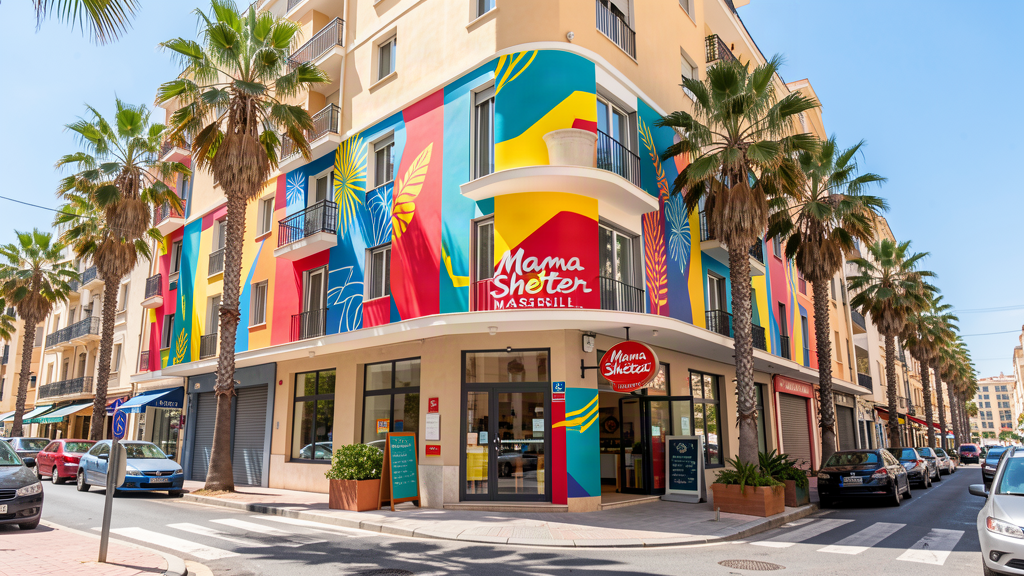
Mama Shelter Marseille (budget-friendly energy, 6th arrondissement) 64 Rue de la Loubière, 13006 Marseille
A playful design hotel near Cours Julien and Notre-Dame du Mont. Rooms are compact and colorful, not hushed luxury. Good for nightlife, independent restaurants, and metro access without Vieux-Port prices. Rooftop and restaurant buzz; ask for a quieter room if you sleep lightly.
Hôtel Le Corbusier (mid-range character, Cité Radieuse) 280 Boulevard Michelet, 13008 Marseille
Twenty-one rooms inside Le Corbusier’s Unité d’Habitation — the Cité Radieuse — still lived in as a vertical neighborhood. Architectural history without museum hush: long corridors, original bones, a rooftop toward the sea. Farther from the old port, so plan tram, bus, or car. Worth it if the building matters more than a harbor pillow view.
InterContinental Marseille – Hôtel Dieu (higher stay, edge of Le Panier) 1 Place Daviel, 13002 Marseille
A conversion of the old Hôtel-Dieu hospital above the Vieux-Port, with Le Panier’s lanes almost at the door. Expensive by Marseille standards: spa, serious dining, a calm lobby after a loud day. Useful when you want the historic core at dawn and a quiet bed after a late Corniche dinner.
Where to Eat
Marseille cooking is fish, olive oil, chickpea flour, tomatoes, and whatever the market still had that morning. Bouillabaisse is real here — and often a reserved, multi-person affair — but so are simpler plates that never make the brochure.
Chez Fonfon 140 Rue du Vallon des Auffes, 13007 Marseille
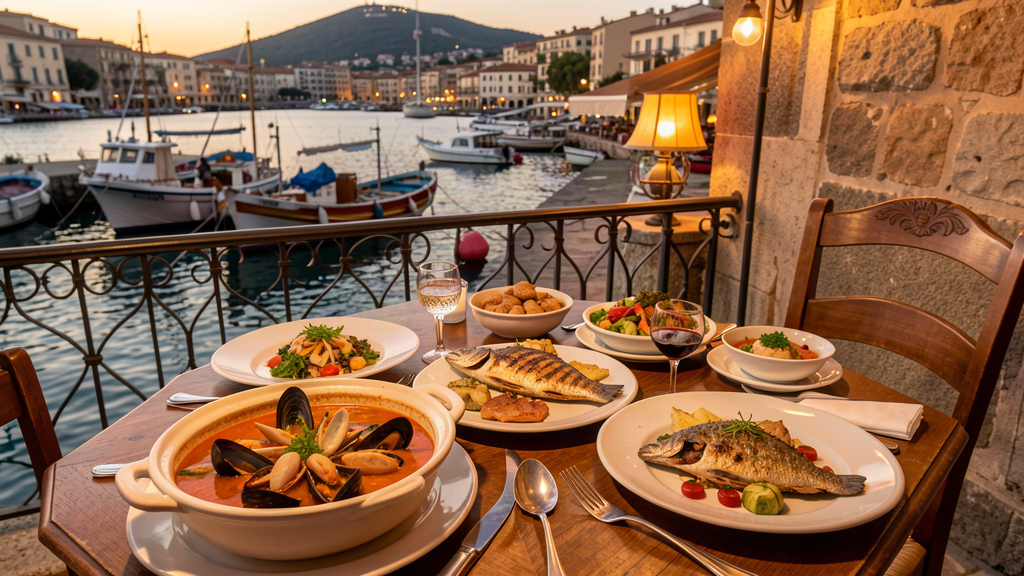
The classic table in the cove itself. Bouillabaisse and Provençal seafood facing the boats you just walked past. Book ahead; not a spontaneous summer Saturday drop-in. Come for the setting as much as the soup. If you only do one dinner under the Corniche, eat with the hulls in view.
Chez Etienne 43 Rue de Lorette, 13002 Marseille
A Le Panier institution for pizza and Italian-Marseille comfort since the 1940s. No white-tablecloth theater. Wood oven, tomato, cheese, anchovy if you are wise, neighborhood noise. Go early or accept a wait. A useful break from waterfront menus written only in tourist French.
La Mercerie 9 Cours Saint-Louis, 13001 Marseille
Market-led cooking near the old center, counter seats facing the kitchen, terrace on the cours when weather allows. Short seasonal menu; locals and travelers who reserved. Order what looks like it left the market that morning. Sits between cove spectacle and snack-bar simplicity.
For cheaper midday, hunt panisses and navettes (boat-shaped orange-flower biscuits) while you walk, or take market fruit to a bench above the port.
Getting around without fuss
The Vieux-Port is the hinge. Ferries cross to the Frioul islands and the Château d’If silhouette when you want open water. Buses and the coastal road link the Corniche to Endoume and Vallon des Auffes; the walk works if you like long views. Metro and tram cover Noailles, the station area, and stretches south.
Taxis help at night after wine. Driving the Corniche is scenic and stubborn; parking near the vallon is a sport. In Le Panier, ignore the grid instinct — there isn’t one. Follow stairs that look used.
Start under the bridge at Vallon des Auffes. Let the boats knock. Climb back up when you are ready, and see which street smells like spice and frying chickpea batter at the same time. That mix is closer to the city than any polished Provençal village script.
