
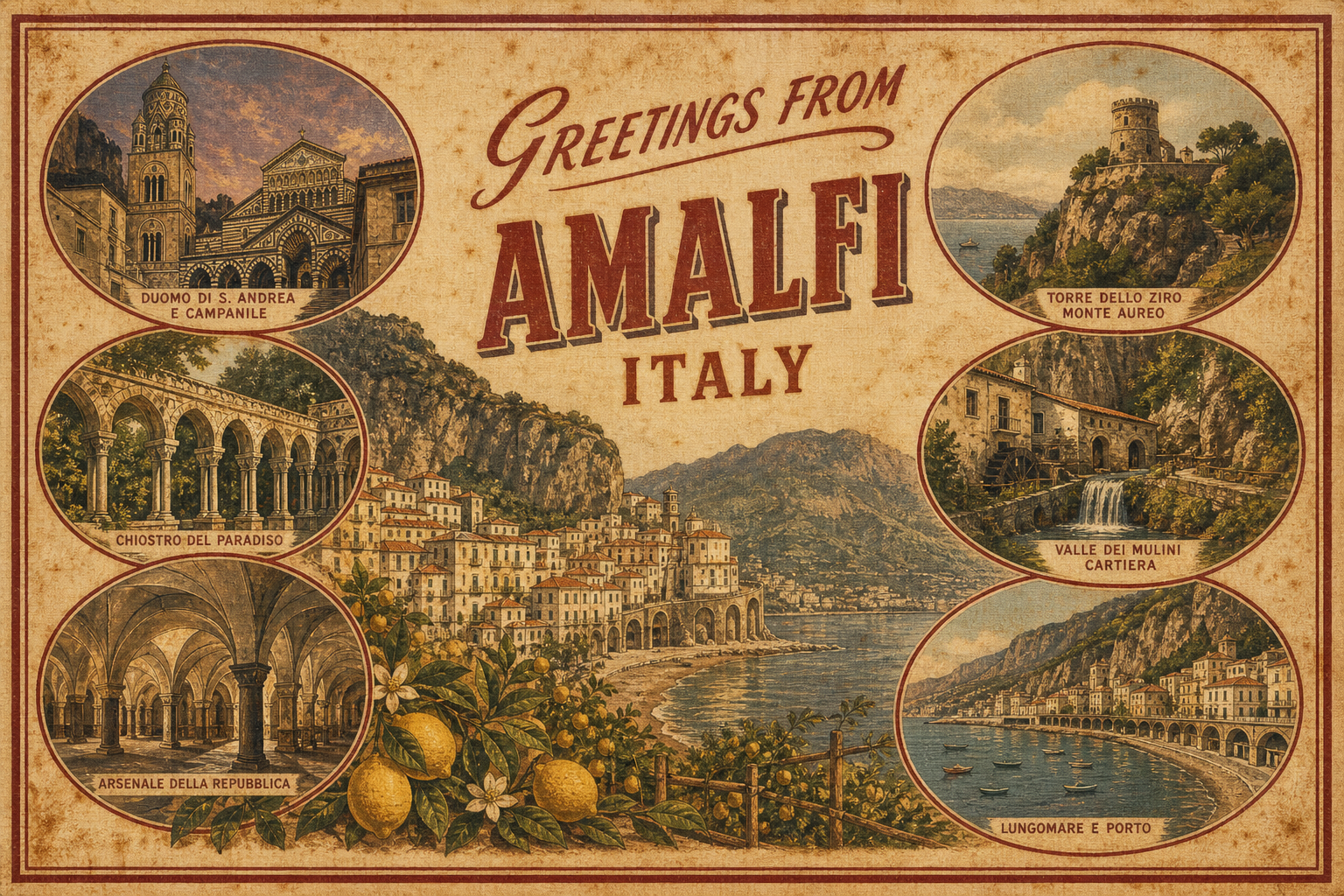
Most people step off the ferry into Amalfi looking up. The Duomo staircase does that to you. I look inland instead. Past the gelato lines and the souvenir limoncello, Via Pietro Capuano turns into Via Lorenzo d’Amalfi, then keeps climbing as Via delle Cartiere. The air cools. You start to hear water. I keep coming back for that stretch: a working valley that once made paper for a maritime republic, still damp and a little noisy if you walk far enough.
The town is small and vertical. You can cross the tourist core in ten minutes if you don’t stop. I stop. I’m less interested in stacking viewpoints than in how the place still acts like a port that had to invent work past fishing and church.
Up the Cartiere Road
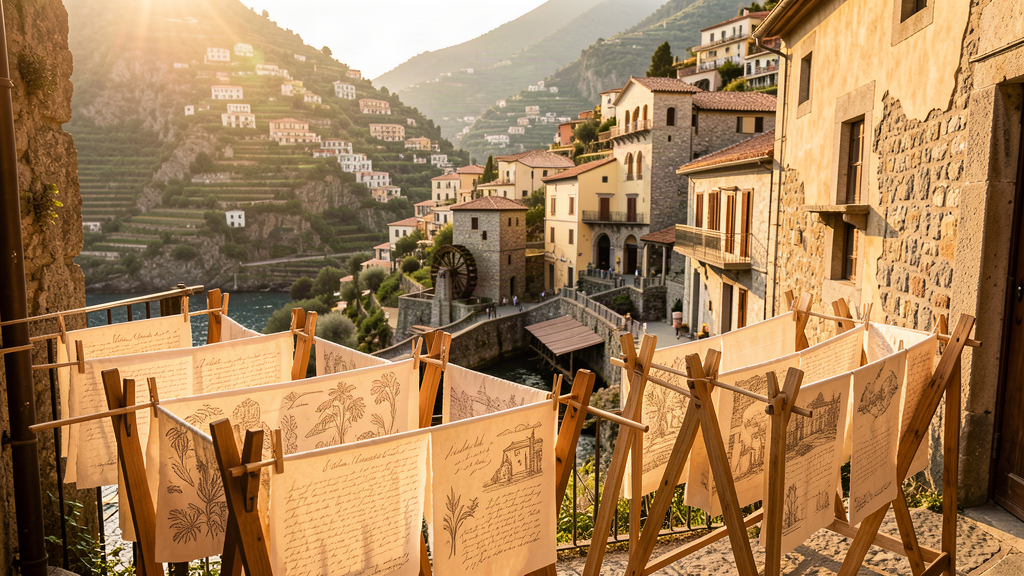
Via delle Cartiere means “paper mills street.” That isn’t a branding exercise. It’s a leftover label from when the Valle dei Mulini held more than a dozen mills among citrus and cliffs. Water came down hard enough to turn wheels. Rags became pulp. Pulp became sheets that Amalfi sold across the Mediterranean.
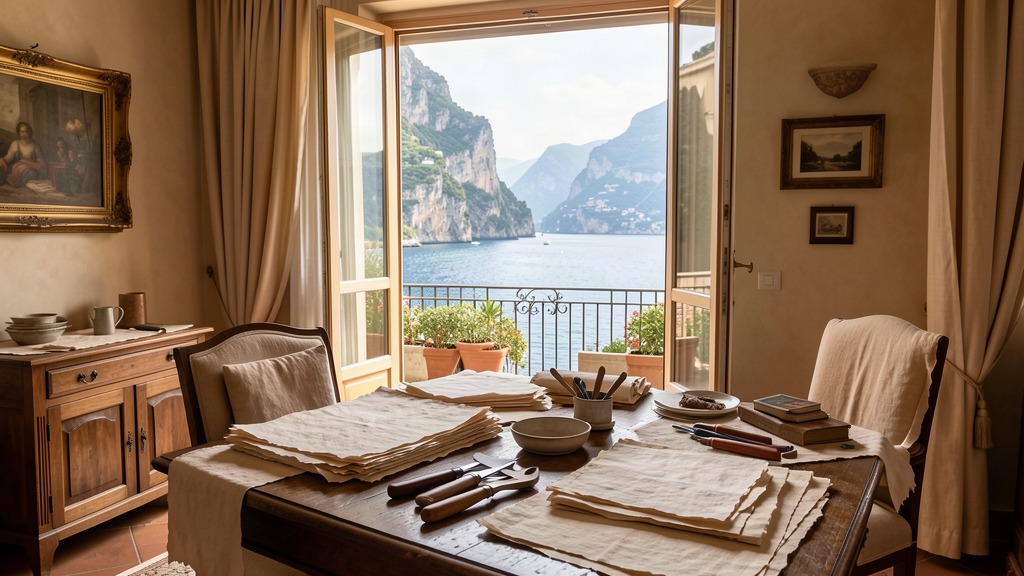
The walk takes maybe fifteen minutes from the main square if bakery windows don’t slow you down. The road narrows. Scooters share the curves with delivery vans. On your left, eventually, the Museo della Carta sits in a medieval mill at Via delle Cartiere, 23–24. Go inside even if museums usually bore you. This one smells right: wood, wet fiber, old machinery. On a guided visit, you can watch rag pulp pressed and lifted the old way. The sheets dry in stacks that look almost edible, pale and uneven at the edges.
I bought a few sheets once and used them for notes that felt too important for a drugstore pad. Slightly ridiculous reason to love a town. Also true. Amalfi’s paper isn’t a metaphor. You can hold it.
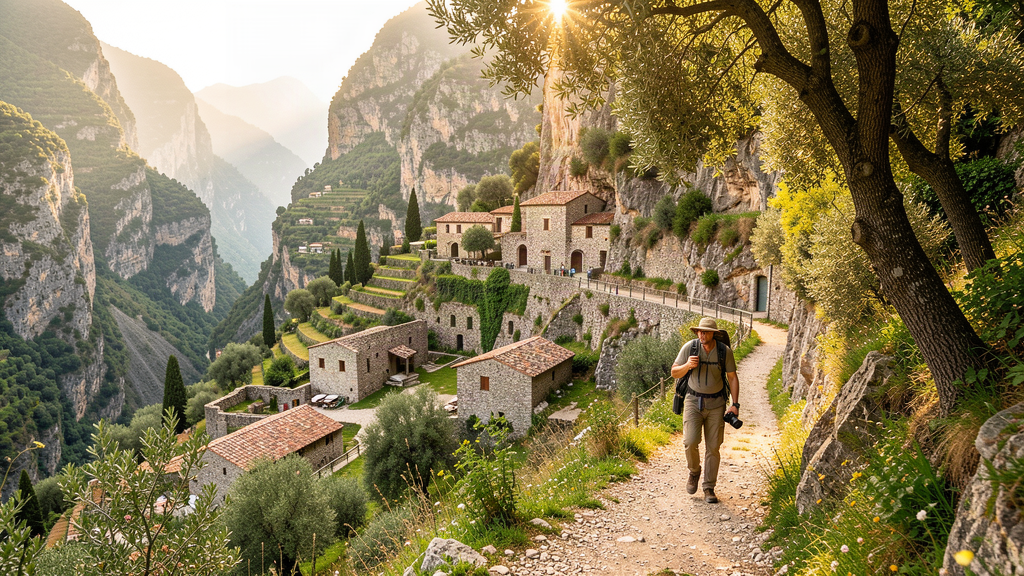
Outside again, keep walking if your knees allow. The valley opens in scraps: garden walls, a channel under stone, laundry that has nothing to do with your itinerary. Tour buses don’t come up here. The pace drops on its own.
Back down toward the arsenal and the square
When you return toward the sea, the scale flips. Piazza Duomo fills and empties with ferry schedules. The cathedral’s striped facade is hard to ignore, and you shouldn’t try. Climb the steps in the morning if you can, before the cruise tenders unload. Next door, the Chiostro del Paradiso is a small cloister of interlaced arches where the light falls in white geometry. Sit for five minutes. Amalfi is easier when you stop performing the coast and take a bench.
A short walk toward the waterfront brings you to the Arsenale della Repubblica, the stone ship sheds of the old maritime republic. The vaults are low and muscular. Hulls were built here when Amalfi punched above its size on Mediterranean trade routes. The Museo della Bussola e del Ducato Marinaro now lives in the complex. You don’t need every compass label. Walk the length of the arsenal and remember this postcard town used to be an industrial waterfront. The ferry dock outside is the modern version of the same job: people and goods moving because the sea is the road.
If you have another hour, walk or bus a few minutes toward Atrani. The neighboring village cups a tiny beach and a square that still feels like a neighborhood after dinner. I go to Atrani when Amalfi’s main drag gets loud. Close enough that you aren’t “doing another town.” You’re just stepping sideways.
Eating without the performance
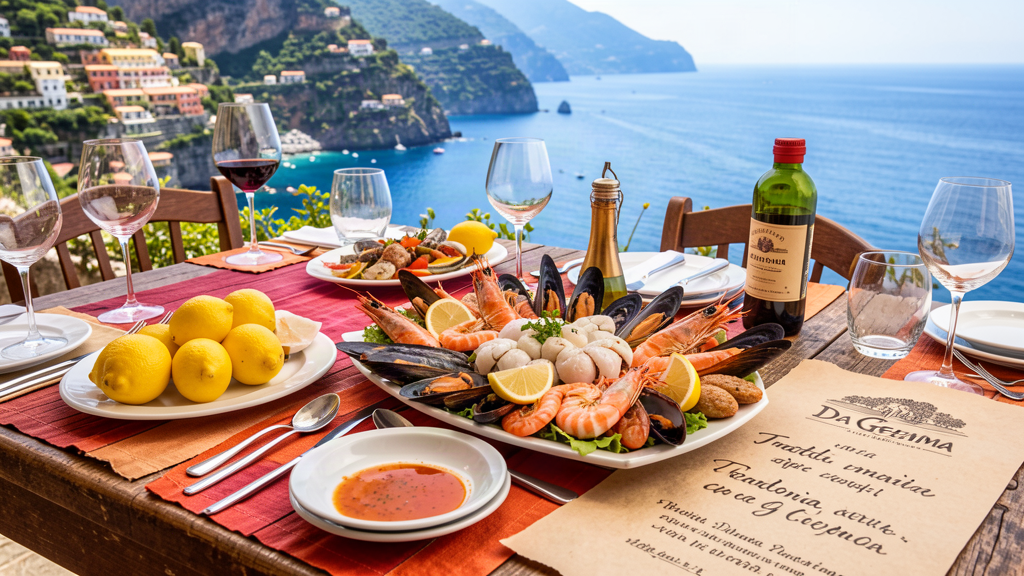
Amalfi food marketing leans hard on lemons, and the lemons are real. I look for a table that still cooks like someone has to feed regulars on a Tuesday.
Taverna Buonvicino
Largo Santa Maria Maggiore, 1, 84011 Amalfi SA, Italy
Tucked off the main flow near Santa Maria Maggiore, this is where I go for pasta that tastes like a kitchen, not a photo. Anchovies in tortiera, a proper genovese when they have it, linguine that actually holds sauce. Book if you can. The room is small and fills with people who already know the walk.
Trattoria Da Gemma
Via Fra Gerardo Sasso, 11, 84011 Amalfi SA, Italy
Just off the Duomo square in a lane you might miss if you keep staring at the cathedral. Seafood is the point. Prices sit above a quick panino stop, and the cooking earns it. I come for a long lunch when the square outside is chaos and the alley goes quiet.
Ristorante Marina Grande
Viale delle Regioni, 4, 84011 Amalfi SA, Italy
On the town beach side, water close enough that the fish list makes sense. This is the splurge when you want the working edge of the bay rather than another cliff panorama. Order simply. Let the catch decide. Stay through the slow second half of the meal, when day-trippers start checking ferry times.
Between meals, do ordinary things. Espresso standing up. A warm sfogliatella if you find one. Fruit from a shop that doesn’t face the pier. Daily life happens in the vertical streets behind the postcard. I’d rather that company than another posed spritz on the waterfront.
Places to stay
Sleep in town if you can. Bus and ferry logistics get simpler, and you get the early hours when the stone is still cool.
Hotel Lidomare (value)
Largo Duchi Piccolomini, 9, 84011 Amalfi SA, Italy
A small, lived-in hotel a short walk from the Duomo square. Rooms vary; some have more character than polish, which is fine if you care more about location than spa menus. You step into the old center without a shuttle ritual. Good base if you plan to walk the cartiere road in the morning and collapse after dinner without a cliffside transfer.
Hotel Centrale (mid-range)
Largo Duchi Piccolomini, 1, 84011 Amalfi SA, Italy
Right on the square, facing the cathedral side of town life. The draw is practical: bells, footsteps, late conversations. Ask about a quieter room if you’re a light sleeper. Breakfast on the upper terrace, weather allowing, is less about luxury and more about watching Amalfi start before the day-trip pulse hits.
Hotel Santa Caterina (splurge)
S.S. Amalfitana, 9, 84011 Amalfi SA, Italy
A classic coastal grand hotel just outside the tight historic core along the Amalfitana. Gardens, sea light, service that absorbs the stress of the drive. Stay here when you want a buffer from the square’s noise and don’t mind a short walk or hop into town. Still Amalfi, with more breathing room and a different morning soundscape.
Getting around without losing the day
Amalfi is a hub, useful and occasionally annoying. Ferries link it to Salerno, Positano, Capri, and other coastal points in season. SITA buses crawl the SS163 with views that make delays easier to forgive. If you drive, accept that parking is a puzzle and the road is a negotiation. I prefer to arrive without a car, sleep in town, and use boat and bus for side trips.
Day trips are easy to overstuff. Pompeii, Ravello, Capri, Positano: each can eat a full day. Anchor in Amalfi first. Paper museum, arsenal, a long lunch, a swim if the beach setup agrees with you, an evening in Atrani. Then add one outward excursion. The coast is better when every village isn’t a checkbox.
Morning and late evening are the town’s best hours. Midday belongs to people who have to be back on a coach by four. No judgment there — just timing. Walk uphill while the stone still holds yesterday’s cool, and save shopping for the limp hour after lunch when you need shade anyway.
A slower way to leave
On my last morning, I usually walk Via delle Cartiere one more time without going into the museum. Just to hear the water. Amalfi’s fame runs along the cliffs and the water. What I remember sits uphill, on a street named for mills, toward a valley that once turned rags into pages.
Take a sheet of carta di Amalfi home if you want a souvenir that isn’t glass or citrus. Write something ordinary on it later. A grocery list. A name. Not for romance. Because this town still has a craft you can trace with your hands, and a street that tells you where to find it.
When the ferry pulls out and the Duomo shrinks, the damp air on the cartiere road sticks longer than any wide shot of the coast. That’s the Amalfi I keep.
