
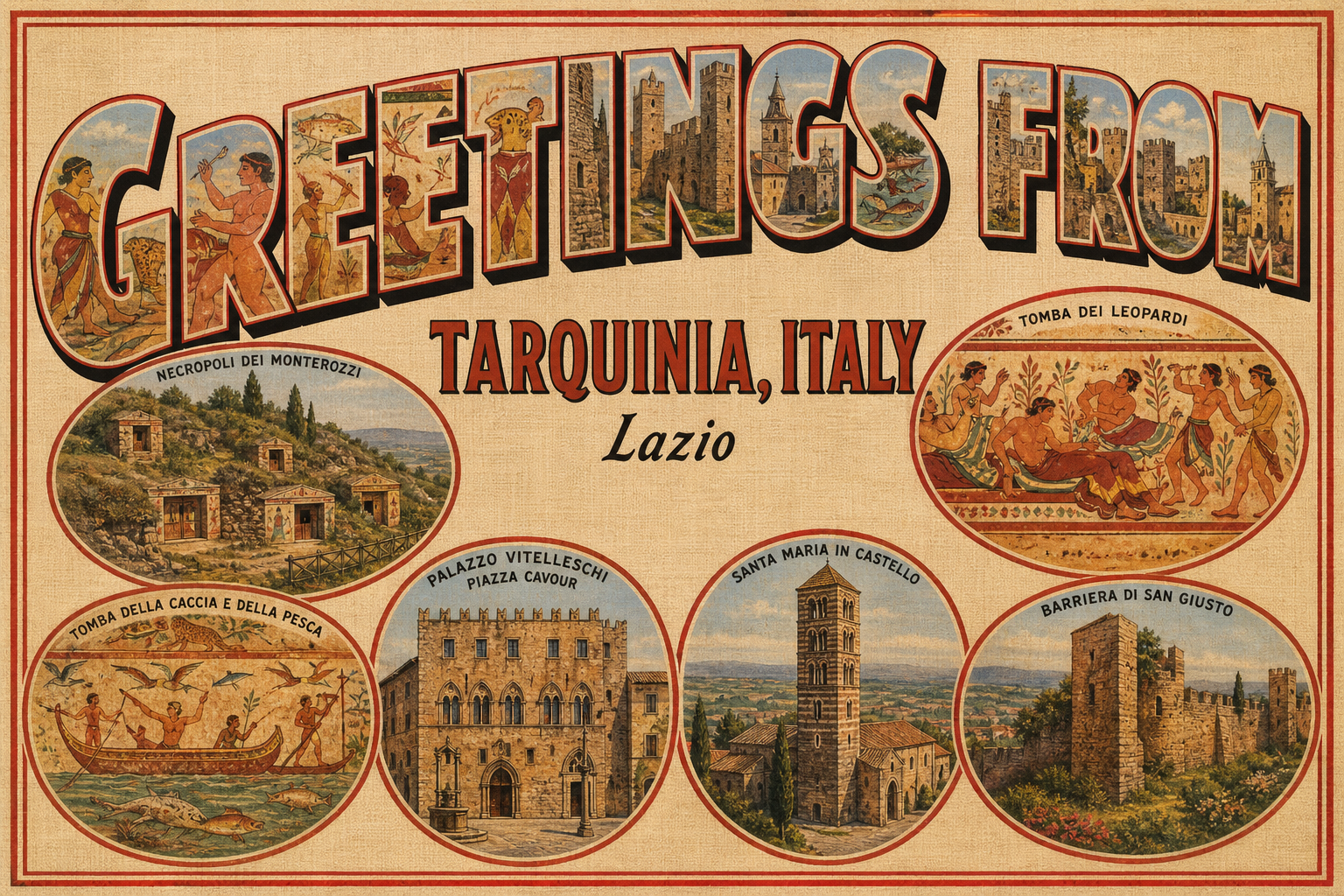
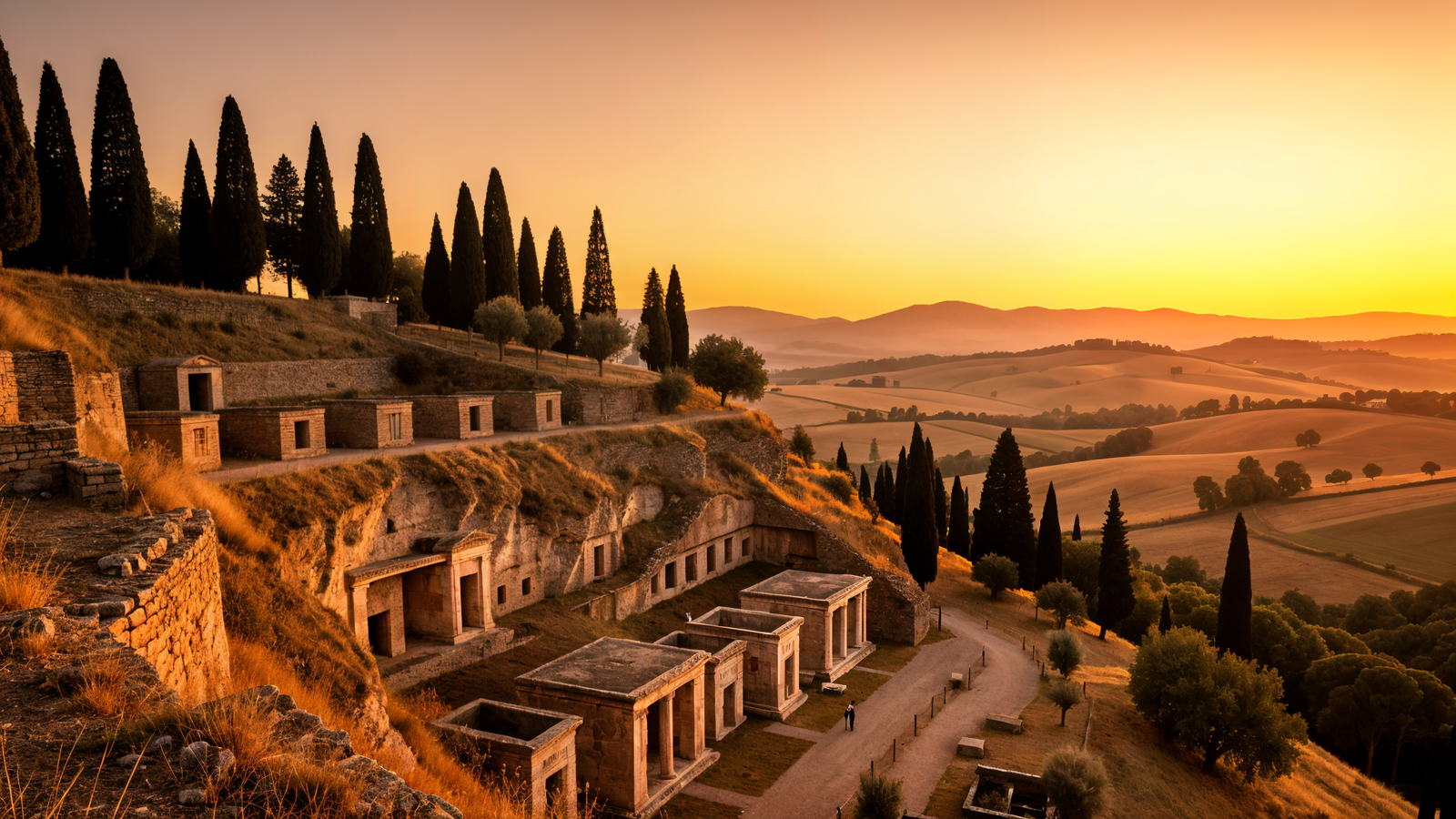
The ridge sits just outside the modern town, a long plateau of scrub and low mounds that locals still call Monterozzi. From the road it looks ordinary: dry grass, a parking lot, a ticket booth that could belong to any small archaeological site in Lazio. Then you walk a few hundred meters, a guide or a sign points you down a short flight of stairs, and the light changes. You are underground, and the ceiling is full of dancers.
Tarquinia is an Etruscan place before it is a postcard hill town. People come for the painted tombs of the Monterozzi necropolis, and the tombs justify the detour. What I remember most is not only the frescoes but the quiet after you climb back up: sea light one way, medieval towers the other, and the living town still eating lunch while the dead keep their banquet painted in red and black.
Start under the painted ceilings
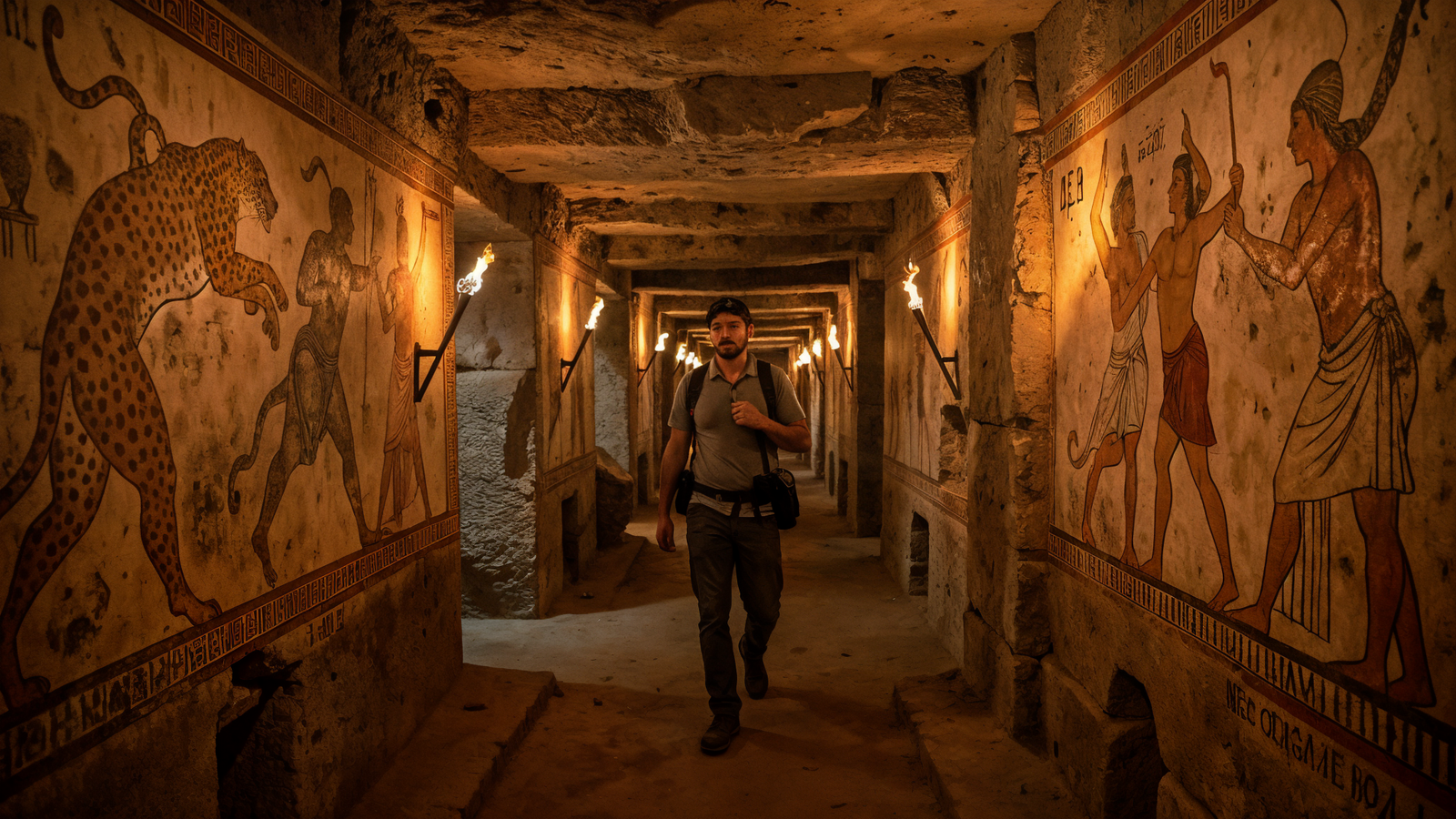
Monterozzi stretches for kilometers along the plateau above the Tyrrhenian plain. Only a rotating handful of tombs open on a given day, because humidity and pigment are fragile, so the visit is a lottery of access rather than a full underground city. That is fine. You will not rush a checklist of fifty chambers. You will go down into three or four, stand longer than you planned, and come back up blinking.
The Tomb of the Leopards is the one people name first. Two spotted cats face each other above a banquet scene: musicians, drinkers, men reclining the way Etruscans did when life still felt worth painting. The colors hold better than they should after twenty-five centuries. Elsewhere you may find the Tomb of Hunting and Fishing, with its little boat and birds, or other chambers whose names shift with the season’s open list. Do not treat the closed doors as a failure. The closed ones protect the open ones.
Guides matter here more than at many Italian sites. A short explanation of who was buried, what the banquet meant, and why the style changed across centuries turns paint into people. If you prefer silence, take it, but read a little first. These are not decorative caves. They are family statements left in rock.
Bring a light jacket even in summer. The air below is cooler and damp. Floors can be slick. Photography rules change; follow the staff. Skip the hunt for a perfect phone shot. The odd part is standing in someone’s afterlife while a busload of day-trippers parks above you and wonders where the “ruins” are.
Palazzo Vitelleschi and the museum upstairs
After the ridge, walk or drive into the historic center and give an hour to the Museo Archeologico Nazionale inside Palazzo Vitelleschi on Piazza Cavour. The building itself is early Renaissance Lazio: stone courtyard, heavy stairs, rooms that once held cardinals and visiting popes. The museum holds what the tombs cannot keep forever: sarcophagi, ceramics, jewelry, and the winged horses that have become Tarquinia’s unofficial emblem.
See the museum either before or after Monterozzi, not as a substitute. Underground you get color and scale. Here you get objects you can circle, inscriptions you can almost touch with your eyes, and a chronology that makes the ridge less mysterious and more specific. I like the museum late morning, when the courtyard is still cool and the school groups have not fully arrived. Pair it with a coffee on the square. The town is small enough that “lost” means a five-minute correction.
The living hill town
Tarquinia’s centro is not a theme park bolted onto the necropolis. It is a working medieval and later town: narrow streets, laundry, hardware shops, the Duomo, stone towers, and residents who are not performing history for you. Walk without a rigid plan. Via di Porta Castello and the lanes around the main squares reward slow looking more than another attraction stamp.
If you have a car and an extra half day, the coast at Lido di Tarquinia is a short drop downhill. Beach clubs in season, quieter sand outside peak weekends, seafood when you are tired of inland plates. One night in town is enough to feel the ridge and the streets as one place instead of a stop between Rome and Tuscany.
Evenings stay low-key. Sit outside if the weather allows. Order Tuscia wine. The painted banquets underground make more sense after you have watched a real table fill and empty.
Getting there without the drama
Tarquinia sits in northern Lazio, inland from the coast and roughly ninety minutes north of Rome by car via the A12/E80 corridor, depending on traffic. Trains stop at Tarquinia station; from there you need a bus, taxi, or transfer up to the centro and necropolis. The station is not at the foot of the painted tombs. Plan the last mile.
Drivers have it easier for Monterozzi. Parking near the entrance is the default. Check opening days for both necropolis and museum before you lock a day trip; schedules shift with season and conservation work. Combine museum and tombs on one ticket when offered. Early morning beats heat and lines. Late light on the ridge is kinder, but last entry cuts you off.
Rome is the usual base. Staying in Tarquinia is better if you want first tickets, dusk streets, and dinner without watching a return train.
Places to Stay
B&B Le Torri di Tarquinia — Via dell’Orfanotrofio 12, 01016 Tarquinia VT.
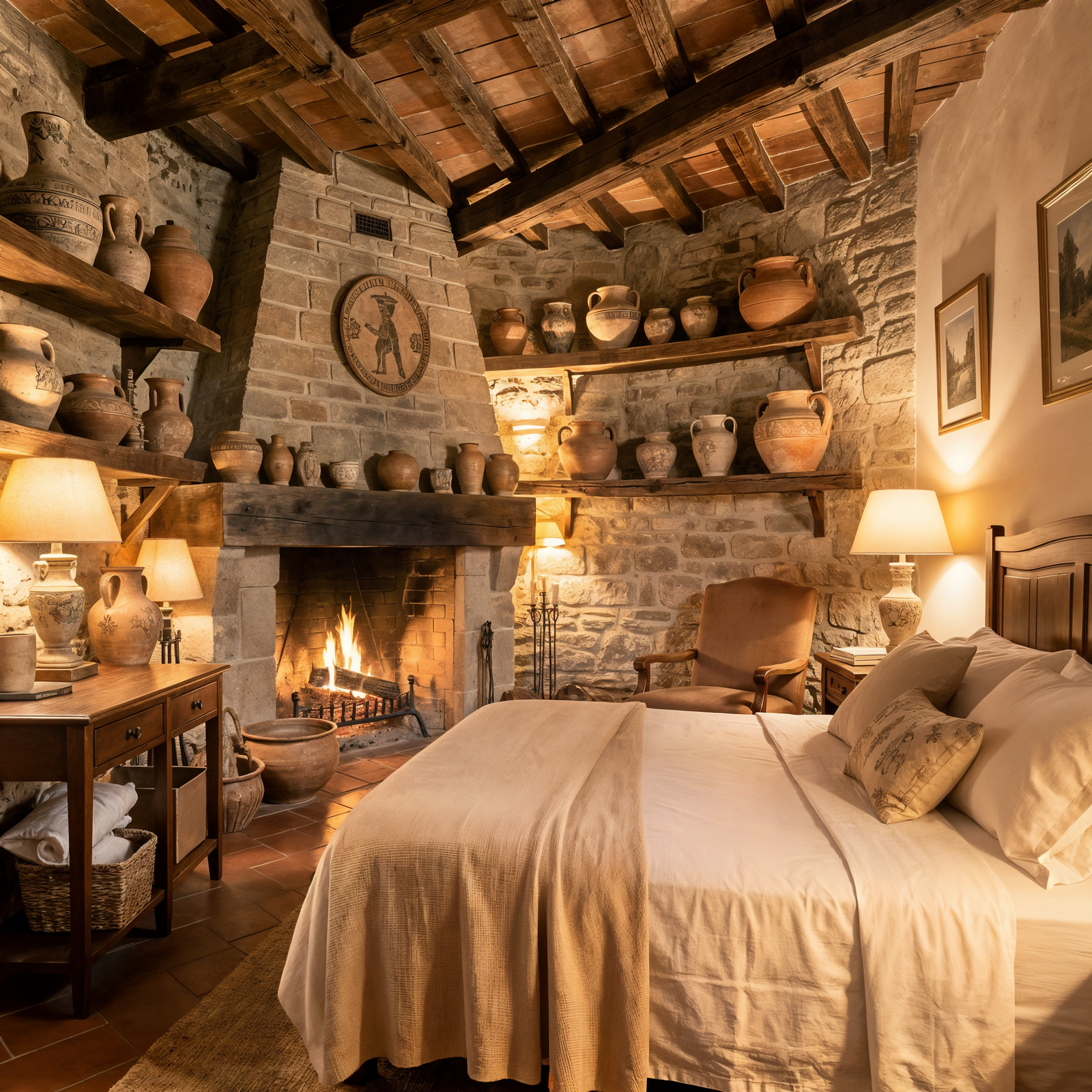
A small historic-center base inside an older building, close enough to walk the evening streets after the necropolis closes. Rooms are straightforward; breakfast is the social hour. Best budget-to-mid pick when you care more about stone lanes than a lobby bar.
Hotel Tarconte — Via della Tuscia 21, 01016 Tarquinia VT.
The long-running full-service hotel just outside the tightest centro core, with parking and a position that makes Monterozzi and the museum easy without wrestling every alley. Mid-range and practical. Sea glimpses on clear days, restaurant next door if you do not want to hunt dinner. Useful if you are driving or arriving tired from Rome.
Tarchon Luxury B&B — Via Giampietri Leoni 18, 01016 Tarquinia VT.
A polished bed-and-breakfast in town for travelers who want quieter design details and a more personal check-in than a multi-floor hotel. Higher end of the local scale without turning the stay into a resort. Book ahead on weekends; inventory is thin.
Where to Eat
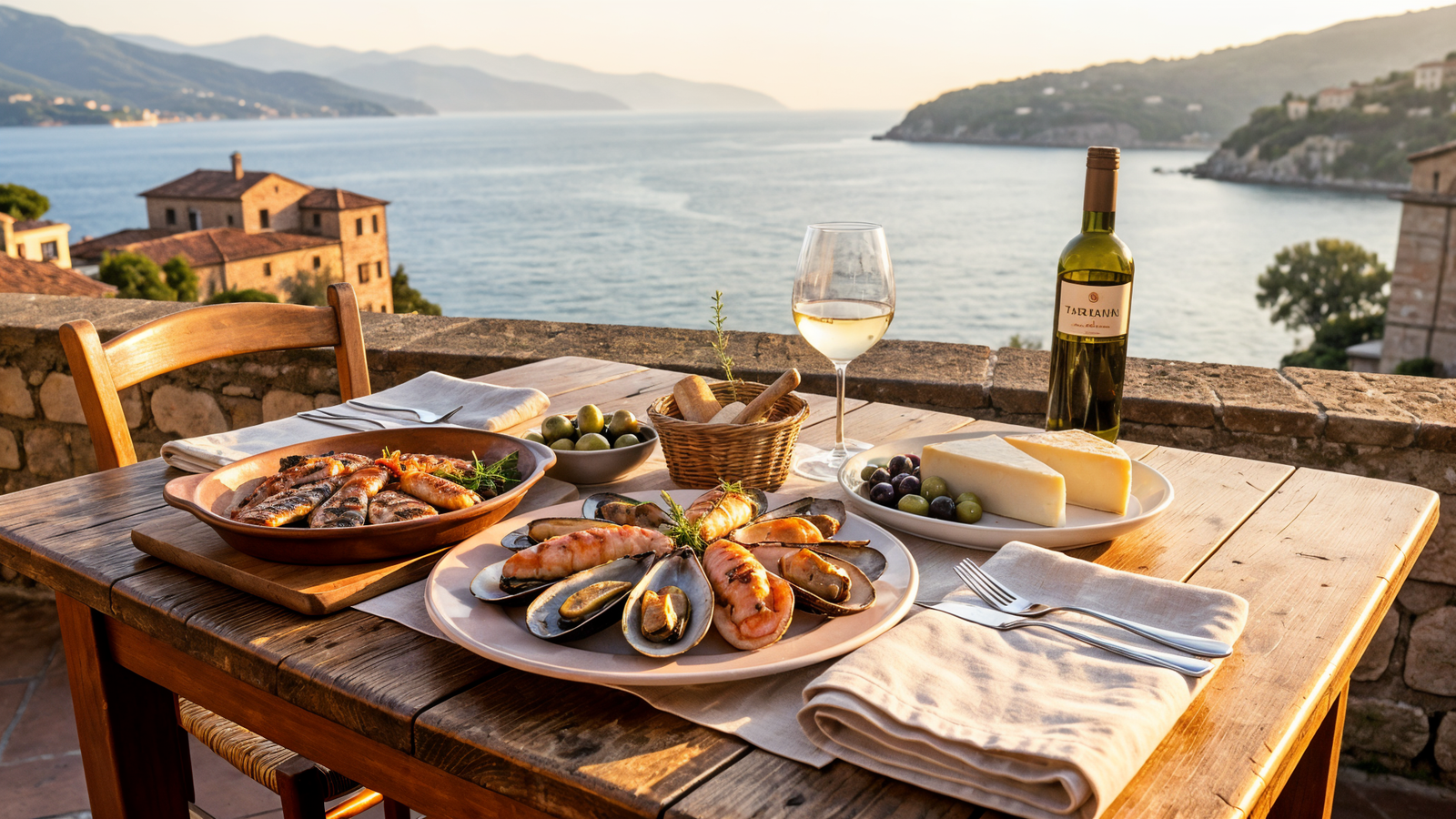
Food here mixes inland Tuscia and the coast: legumes, grilled meats, seasonal vegetables, seafood when you drop to the Lido, wine that does not need a lecture.
Il Grappolo — Via Alberata Dante Alighieri 3, 01016 Tarquinia VT.
A reliable centro address for a proper sit-down. Pasta, local bottles, the kind of service that assumes you might order a second glass. Good after the museum, when you still have dust from the ridge on your shoes and want a table, not a snack bar.
La Capanna del Buttero — Via della Tuscia 19–21, 01016 Tarquinia VT.
Attached to the Hotel Tarconte axis and named for the Maremma cattle-herder tradition that still flavors the inland menu. Expect generous plates, grilled specialties, and a dining room that works for travelers who want dinner handled without a long search. Book on busy nights.
Trattoria Bistrot Al Km 0 — Viale dei Navigatori 65a, 01016 Lido di Tarquinia, Tarquinia VT.
Down on the coastal strip when you want fish and a shorter supply chain. Casual, local, better for a beach-afternoon lunch or dinner than a formal night out. Pair with a walk on the sand if the wind is kind.
A day that actually fits
Morning on Monterozzi while the air is cool and the open tombs still feel private. Midday in Palazzo Vitelleschi, then lunch at Il Grappolo or wherever a short menu looks honest. Afternoon for the centro on foot: towers, side streets, a second coffee. If you still have energy, drop to the Lido for salt air and a simple fish plate. Overnight if you can; the ridge is different when you are not racing a timetable.
Tarquinia is not a substitute for Rome’s museums and it is not a beach resort with a side of archaeology. It is a town that still lives above one of the great painted cemeteries of the ancient Mediterranean. You go down the stairs, look up at leopards and lyres, climb back into ordinary daylight, and eat. That is usually enough.
Give the frescoes the slower look while you are under them. The photos will wait.
