
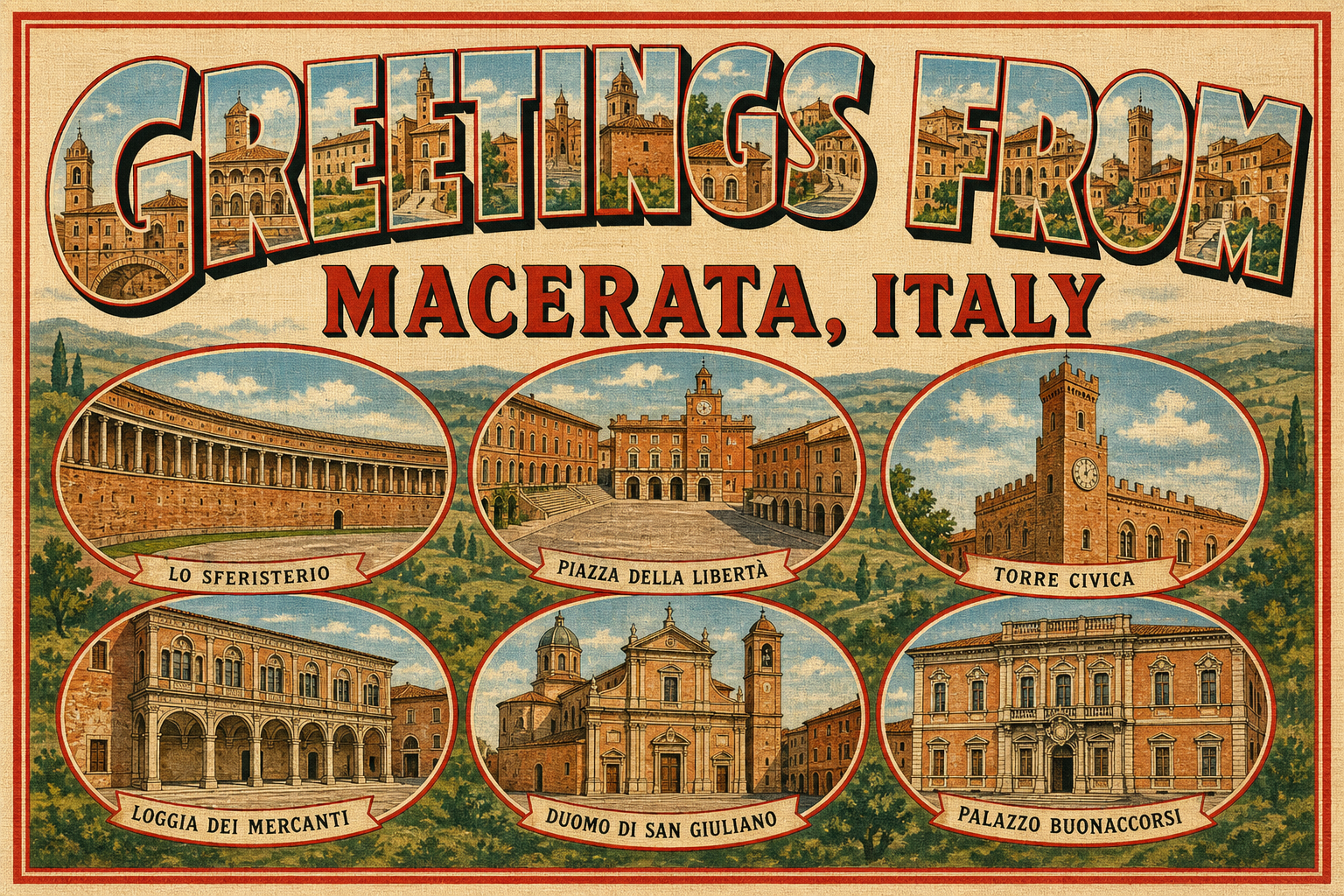
Macerata sits inland on a hill in the Marche, far enough from the Adriatic that the air smells like brick dust and coffee rather than salt. People pass through for the summer opera or a university errand and leave thinking they have seen the place. Usually they saw one building and a parking lot. The rest of the town is quieter: a long main square with a double loggia, side streets that drop toward the walls, and a neoclassical arena built for a ball game long before anyone put Verdi inside it.
I came for that arena — the Sferisterio — and stayed because Macerata still behaves like a provincial capital with students, clerks, and market bags. It does not do hill-town romance the way Umbria does. I liked it more for that.
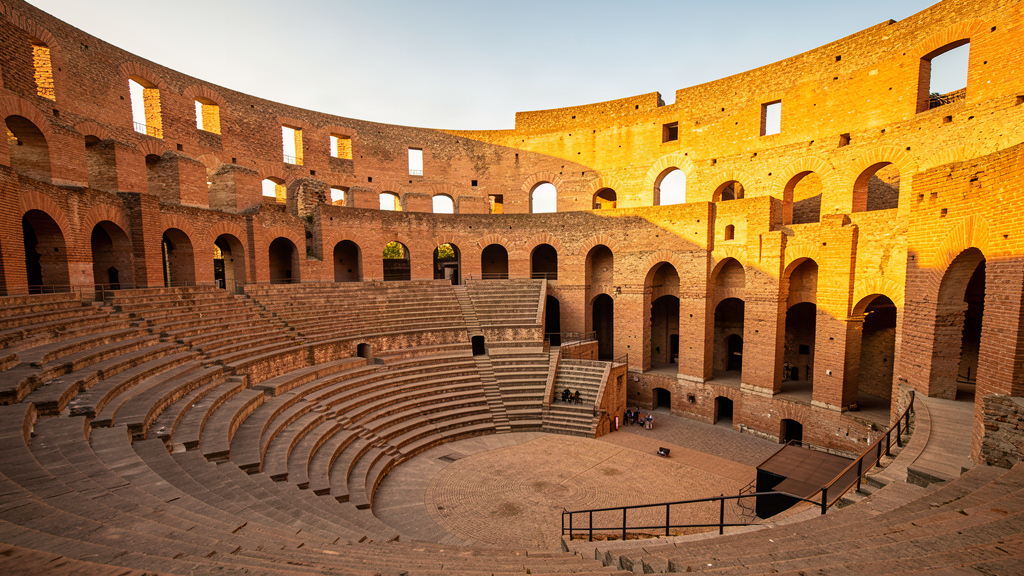
The Sferisterio before the overture
Walk to the Sferisterio in daylight first. The curved brick wall and the long open ellipse make more sense without spotlights. It went up in the 1820s for pallone a bracciale, a hard athletic game that needed a tall rebound wall and a crowd that could shout. Later the city turned the same geometry into an open-air opera house. In July and August, the Macerata Opera Festival fills the seats. The rest of the year, the structure is still worth a slow circuit.
Stand at the curve and look up. The wall is blunt and practical. The seating climbs more like a stadium than a gilded theater. Sport bones first, music later. Catch a performance if you can. If you cannot, come in the morning when delivery vans still use the nearby lanes and the brick holds cool shade.
Around the arena the streets tighten. You are inside the historic core here, not a tourist enclosure. Scooters pass. Someone argues about parking. The Sferisterio does not float above daily life. It sits in it.
Piazza della Libertà and the Loggia dei Mercanti
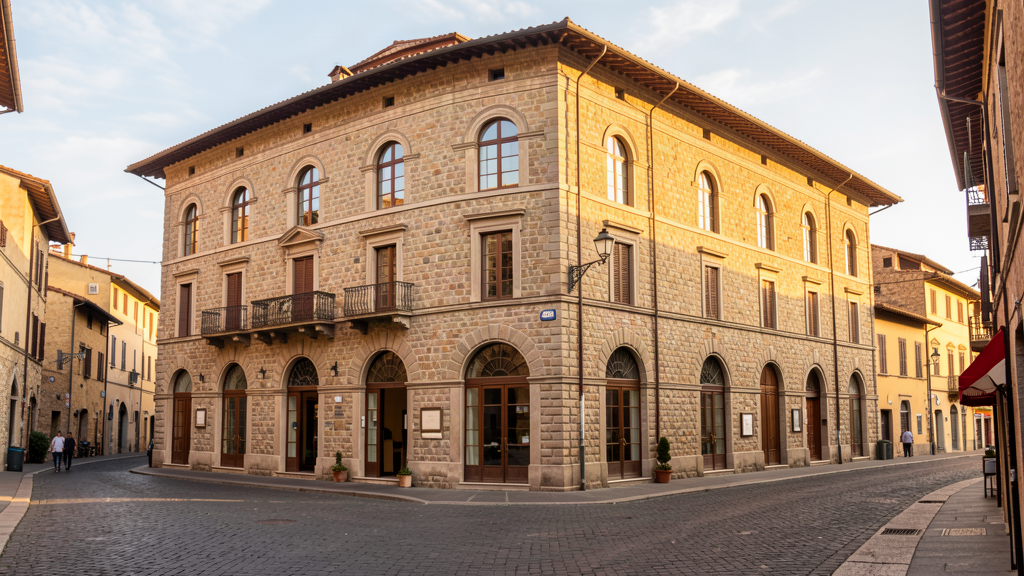
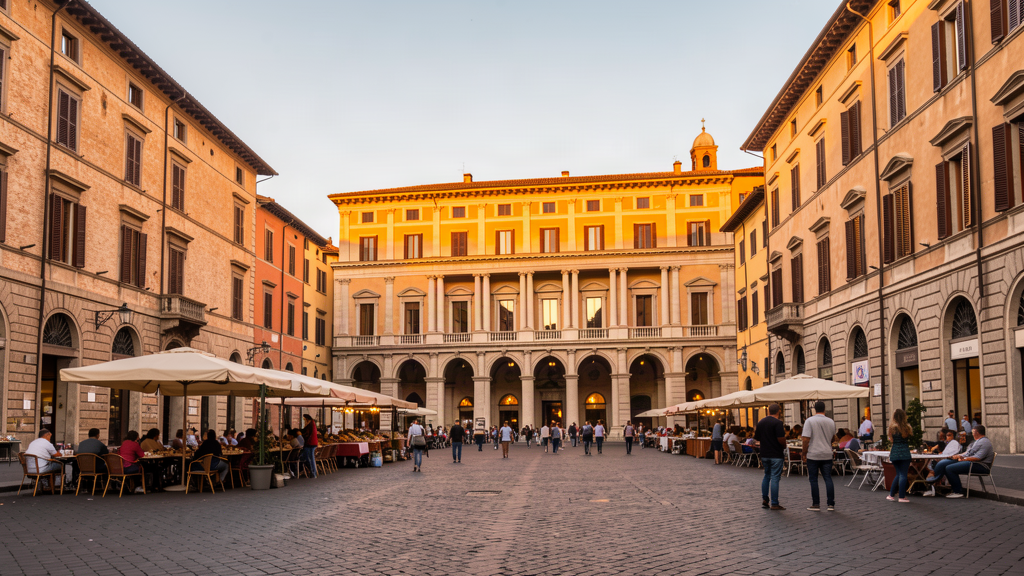
A few minutes uphill or along the centro, Piazza della Libertà opens as the city’s living room. The Loggia dei Mercanti runs in two tiers of Renaissance arcades — stone that once framed trade and still frames people who sit with a coffee and watch the square work. Across the space you pick up the civic tower, university buildings, the Teatro Lauro Rossi, and the ordinary shuffle of a town that never emptied itself for visitors.
This is where Macerata sets its pace. Morning means errands and students cutting across the pavement. Midday thins. Evening brings back the paseo energy without costume. Sit once and leave the phone alone. Watch how the loggia shade moves. Notice who stays standing at the bar.
If you hit a Wednesday market day in or near the center, let the square and side streets fill with produce, clothes, and voices. People actually shop here. Buy fruit you can carry. Move on when the bags get heavy.
From the piazza, wander without a checklist. Mannerist and Baroque church fronts appear when you look up. Courtyards open behind plain doors. The university keeps the age mix younger than many Marche hill towns, which softens the silence that settles on prettier, emptier places after lunch.
Walls, viewpoints, and the slow drop of the streets
Macerata is a hill town that still feels vertical under your calves. Streets fall away from the centro toward older defensive lines and wider views over the countryside — fields, farmhouses, other brick towns on other ridges. You do not need a famous belvedere name. Any break in the buildings where the land opens is enough.
Walk the edges more than the monuments list. You start to feel how a courtly city like Urbino and a port like Ancona sit differently on the map, and why Macerata lands between them as administration, study, and inland appetite. Bring water in summer. Stone holds heat. Early and late walks beat the white noon on open pavement.
Vincisgrassi and the Macerata table
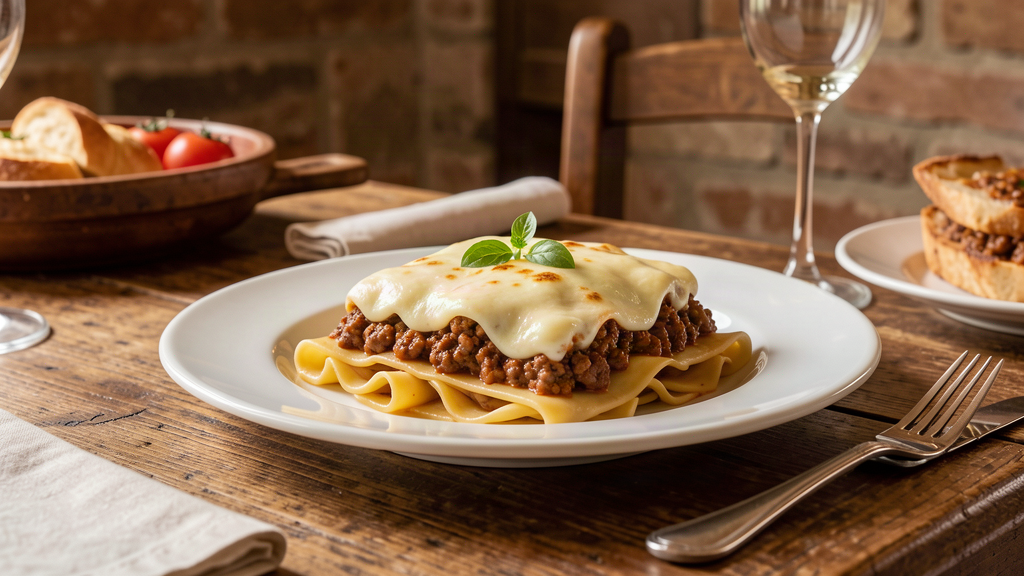
If the Sferisterio is the outdoor signature, the plate is vincisgrassi. Call it lasagna at your own risk. In the Macerata tradition the pasta sheets meet a ragù that often runs richer and more complex than the tourist version of Bolognese — meat, sometimes giblets, béchamel, time. Houses argue about the exact mix. What matters is that kitchens here still treat it as a local claim, not generic baked pasta.
Around it you will meet ciauscolo (soft, spreadable salami), crescia or other flatbreads, rabbit, lamb, pecorino, and greens that taste like the inland hills. Wine leans local: Verdicchio when you want white with enough edge, or sturdy Marche reds with the ragù. Eat at lunch when kitchens are serious, and the room is half regulars.
Osteria dei Fiori
Via Lauro Rossi 61, 62100 Macerata MC, Italy
Family-run room in the historic center, long known for vincisgrassi and seasonal Marche cooking. Small enough that the room feels like a conversation. Book when the opera crowd is in town; the streets around the Sferisterio fill fast on performance nights.
Trattoria Da Rosa
Via Leopoldo Armaroli 17, 62100 Macerata MC, Italy
A local address for the classics — vincisgrassi, rabbit in porchetta, the kind of plates people recommend when they stop performing for outsiders. Come hungry. Check hours; trattorie keep their own calendars.
Osteria La Volpe e l’Uva
Via Berardi 39, 62100 Macerata MC, Italy
Centro osteria with fresh pasta, vincisgrassi on the board, and secondi that stay close to the territory. Good when you want a slightly broader menu without leaving the old streets. Closed Sundays in normal weeks — confirm before you walk over.
Between meals: espresso standing up, a slice of something salty if you are moving, gelato only if the line is locals. Skip the restaurant crawl. Get one honest plate of vincisgrassi and a square that still works after dark.
Places to stay
Sleep inside or against the centro if you plan to walk the Sferisterio, the piazza, and dinner without a car. Bags on wheels dislike cobbles; pack for short climbs and uneven stone.
Albergo Arena — value, steps from the Sferisterio
Vicolo Sferisterio 16, 62100 Macerata MC, Italy
Simple, central rooms in a quiet lane beside the arena, inside the old walls. Choose this when the night at the Sferisterio is why you came and the budget is honest. Confirm how late check-in works on performance evenings.
Hotel Lauri — mid-range, family character in the centro
Via Tommaso Lauri 6, 62100 Macerata MC, Italy
A walkable base with more personality than a ring-road business stop — family heirlooms, eclectic corners, easy reach of Piazza della Libertà on foot. Solid middle choice when you want a proper hotel breakfast and old-city mornings without paying for a design statement.
Hotel Claudiani — splurge, restored mansion calm
Vicolo Antonio Ulissi 8, 62100 Macerata MC, Italy
A restored historic residence with fuller hotel services and quieter rooms when you want the stay itself to feel like part of the trip. Still usable for centro wandering; ask about the short walk or transfer if you arrive with heavy bags. Book ahead for opera weeks.
Two nights minimum. Three if you want a daylight Sferisterio visit, one performance or evening passeggiata, a slow market morning, and a lunch you refuse to rush.
Getting there and moving once you arrive
Macerata sits inland from the Ancona–Pescara Adriatic strip. Trains reach the city; the station sits below the hill, so budget a bus, taxi, or a determined walk up. By car, the hill roads and limited centro access mean parking patience. Falconara (Ancona) is the usual airport gateway, then a drive or rail connection into the province.
Once you are up in the centro, walk. The Sferisterio, Piazza della Libertà, theaters, and most of the tables worth your time sit in a compact historic core. Day trips can pull you toward the Sibillini foothills, smaller brick towns, or the coast when you want salt again. Keep Macerata as the hinge, not a one-photo stop between highways.
In opera season, reserve beds and tables early and expect the town to tighten around curtain time. Off season the same streets open up; museums and churches keep shorter hours, and the Sferisterio goes back to being architecture and memory until the next festival cycle.
I keep thinking about that brick curve built for a ball game and kept for voices, the loggia shade at midmorning, and a plate of vincisgrassi nobody bothers to rename for tourists. Stay long enough for the square to repeat itself once. The second loop is when Macerata starts to make sense.
