
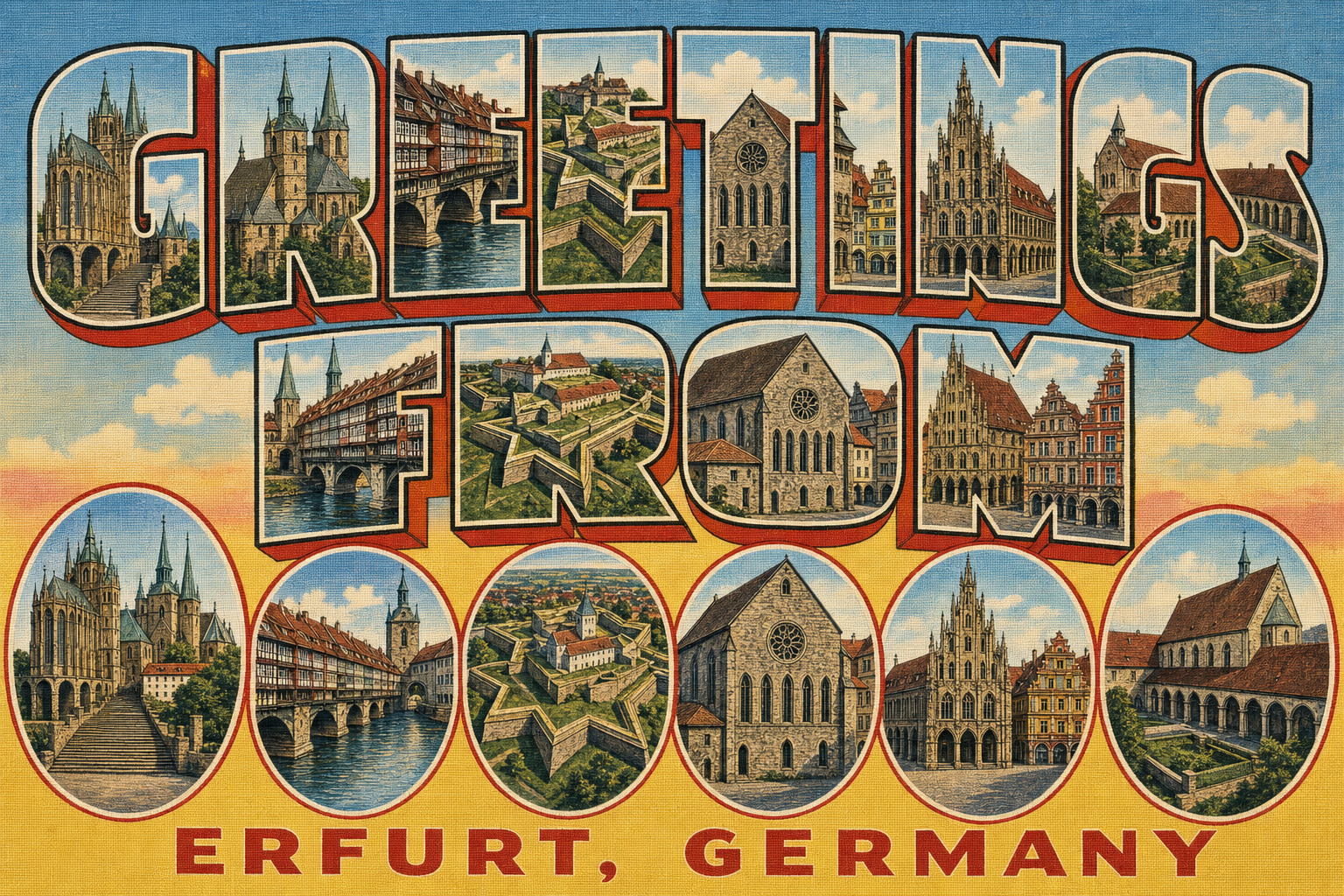
Erfurt is Thüringen’s capital, not Weimar’s prettier cousin and not a day-trip footnote between Leipzig and the forest. The Gera splits through the Altstadt in several arms. The Krämerbrücke carries half-timbered houses straight across the water like a street that forgot it is a bridge. Dom and Severi rise together over a square that still holds a working market. You come for that density on foot — bridge, river, citadel hill, woad-era lanes — and for a city that stays ordinary after the tour buses leave.
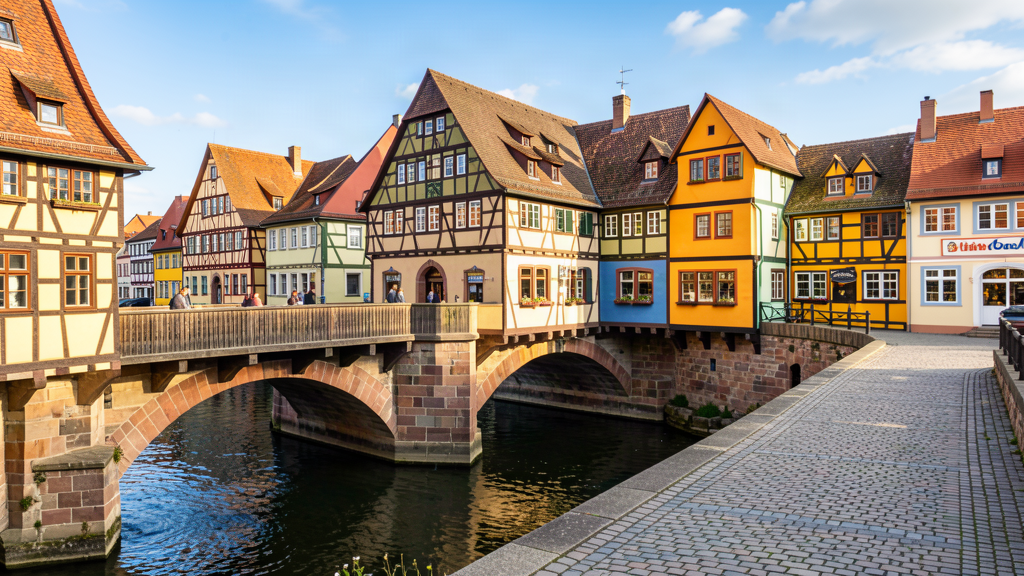
Most first visits collapse into one postcard of the merchants’ bridge and a Bratwurst on Domplatz. Better to treat Erfurt as river town and hill fortress at once: early walk on the bridge before shop doors open, coffee facing the cathedral steps, a climb onto Petersberg when the light softens, evening tables on Michaelisstraße once the day-trip noise thins. Two or three nights beat a hurried afternoon.
Krämerbrücke, Breitstrom, and the Gera underfoot
The Krämerbrücke is the longest continuously inhabited bridge of its kind in Europe. Stone core from the fourteenth century, half-timbered houses packed tight enough that you walk the length without seeing water until a side alley opens. Craft shops, galleries, and small cafés fill the ground floors; people still live upstairs. It is not a museum span. It is a street with a river underneath.
Come early, before the souvenir rhythm hardens. Start from Wenigemarkt or Benediktsplatz, cross once without stopping, then turn back and use the narrow views down to the Gera. The Breitstrom arm below the bridge is the clearest reminder that Erfurt grew as a ford and trading knot — woad dye once made fortunes here — not as a stage set. Ägidienkirche marks one end; the other spills toward Gotthardtstraße. Give yourself the quieter minutes when a shopkeeper is still unlocking and the bridge feels ordinary again.
If you have half a day, loop the water once: Krämerbrücke, river path, then back through the lanes north of the Gera. You only need the bridges that keep putting water beside your walk.
Domplatz, twin churches, and the climb to Petersberg
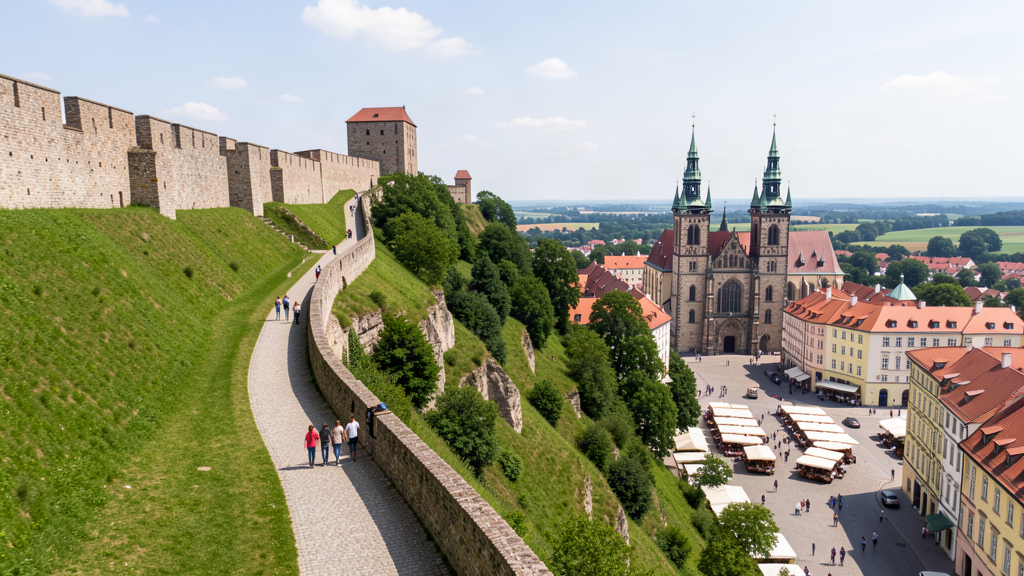
Domplatz is the city’s open room. Dom St. Marien and the Severikirche stand shoulder to shoulder on the raised terrace; steps drop to the square where market stalls set up most days except Sunday — produce, flowers, Thüringer Wurst smoke when the grills are going. Wednesday, Friday, and Saturday markets run fuller; weekday mornings are enough if you only want coffee and local traffic. Café tables along the edge turn the cathedral front into a slow morning rather than a checklist stop.
Climb the steps when the square is busy and you need height. Inside the Dom, medieval glass and the scale of the choir hold more quiet than the plaza below. You do not need a full sacred-history day. Twenty unhurried minutes on the hill are enough.
Petersberg rises right beside Domplatz. Zitadelle Petersberg is one of the largest preserved baroque town fortresses in Central Europe. The walk up is short and steep enough to clear your head. Bastions, casemates when open, and high views over Dom, Severi, and Altstadt roofs explain the military layer without a lecture. Even if you sleep elsewhere, give Petersberg an hour late in the day. The fortress is not a side park. It is the lid on the medieval bowl.
Andreasviertel, Augustiner, and the lanes that stay local
North of the cathedral hill, Andreasviertel keeps a tighter grain — half-timber, small bars, fewer tour groups once you leave the Domplatz funnel. Wander without a map for a stretch; the point is texture, not a famous façade. Augustinerkloster on Augustinerstraße holds the Luther story for those who want it: the monastery where he lived as a monk, and a sober counterweight to bridge selfies. The Old Synagogue on Waagegasse is among the oldest surviving synagogue buildings in Central Europe. Check hours rather than treating it as a casual pop-in.
Fischmarkt and the neo-Gothic Rathaus sit between bridge and Anger if you want civic stone on the way to the shopping spine. Prefer Michaelisstraße and the lanes around Wenigemarkt when evening comes; that is where tables hold after the cathedral square empties. Egapark, out west, is the big garden day if weather allows — take the tram, then return to the Gera for dinner. Erfurt rewards the small radius more than a packed list.
Places to Stay
Sleep by how you want to meet the river and the hill. Bridge-adjacent houses put Krämerbrücke under your feet; the citadel hotel trades lane noise for fortress quiet.
ibis Hotel Erfurt Altstadt, Barfüßerstraße 9, 99084 Erfurt, is the practical budget stay inside the old town ring: simple rooms, predictable chain comfort, and a short walk to Domplatz, the Gera, and the bridge without paying for a view you will only sleep through. Use it when the budget belongs to meals and an extra night.
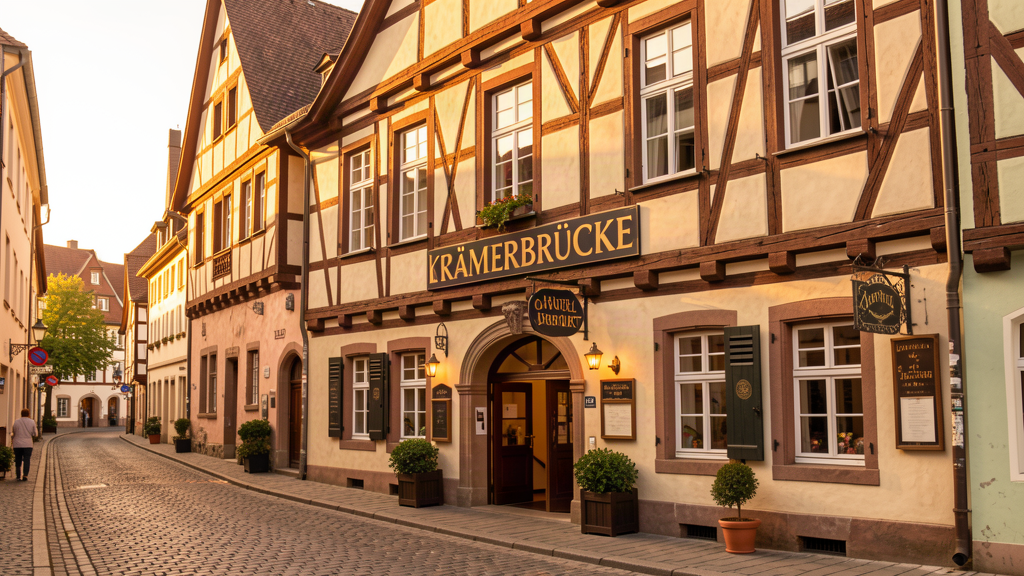
Hotel Krämerbrücke Erfurt, Gotthardtstraße 27, 99084 Erfurt, sits across from Schottengasse at the bridge’s working edge — mid-range house scale, garage when you need it, and the habit of stepping onto the merchants’ span before breakfast crowds form. Book here when the stay should be the river street. Hotel Am Kaisersaal, Futterstraße 8, 99084 Erfurt, is the close alternative a minute from Ägidienkirche if Gotthardtstraße is full — same Altstadt logic, strong breakfast, walk-first location.
DAS KEHRS — Hotel auf dem Petersberg, Petersberg 18, 99084 Erfurt, sits on the citadel itself: modern rooms over the fortress grounds, restaurant PEBERG, terrace light on the city, and the odd feeling that your key card opens the hill. Book when the budget allows and you want evenings above Domplatz instead of in it.
Restaurants / Food
Erfurt eats Thüringer plain sense first — Rostbratwurst, dumplings, regional plates — then café culture on the big square. Reserve dinner rooms on weekends; take the market grill when the line looks local.
Café Hilgenfeld, Domplatz 4, 99084 Erfurt, faces the cathedral ensemble with house-roasted coffee, cakes, and outdoor tables when the weather holds. Come after the market stroll or before the Dom steps. It is the square’s reliable pause without turning lunch into a project.
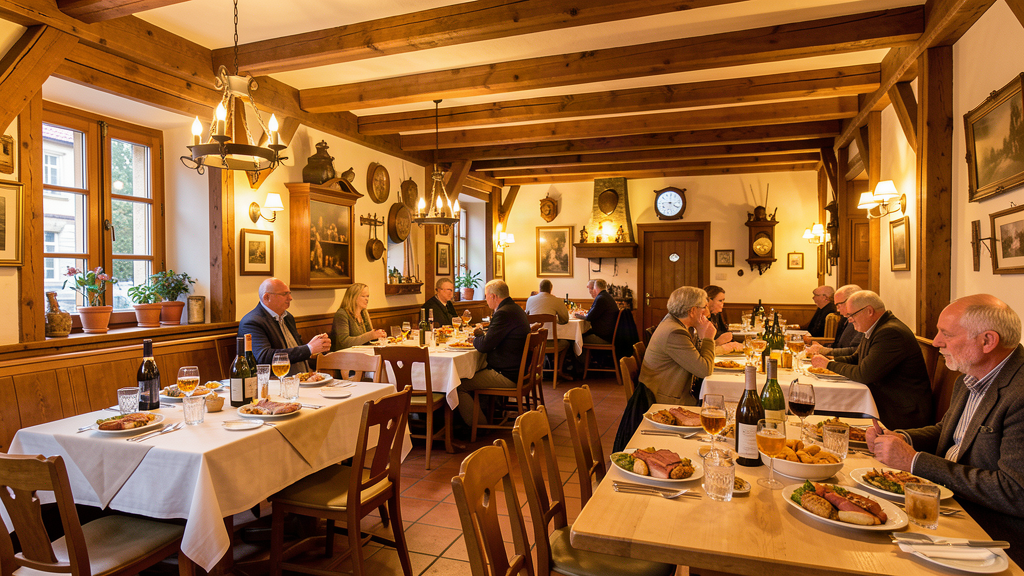
Gasthaus Feuerkugel, Michaelisstraße 3–4, 99084 Erfurt, sits in the historic lane near the bridge — Thüringer cooking in old rooms, dumplings and roasted meats still setting the evening. Useful when you want tradition without a hotel dining room.
Zum Goldenen Schwan, Michaelisstraße 9, 99084 Erfurt, keeps a Thüringer kitchen and house-brewed beer at the same address — brewery-restaurant tempo, beer garden when the season opens, often closed Mondays so check before you walk over hungry. Pair it with a slow Michaelisstraße evening after Petersberg. PEBERG at DAS KEHRS covers the hill when you are already sleeping upstairs.
A simple arc: Hilgenfeld after the morning market, bridge and Gera on foot, Feuerkugel or Goldener Schwan for a proper table, citadel kitchen when the stay is Petersberg.
Getting around without fuss
Arrive by ICE or regional train at Erfurt Hbf — a short tram or about fifteen minutes on foot to the Altstadt core depending on luggage. Trams stitch Anger, Domplatz edges, and outer pieces like Egapark; inside the medieval bowl you barely need them. Erfurt-Weimar airport is small and close; most long-haul visitors still come via Frankfurt or Leipzig/Halle and the train.
The Altstadt is compact and mostly flat along the Gera, steeper toward Petersberg and the Dom terrace. Cobbles reward decent shoes. Cars are a nuisance in the core; use a hotel garage if you must drive, then forget the vehicle until departure. Day trips to Weimar or the Thüringer Wald work by train. Erfurt itself is enough for a full weekend if you stop trying to cover all of Thüringen in one pass.
Check Krämerbrückenfest dates if you visit in June — the bridge and surrounding streets become the state’s big street festival. Shoulder seasons give you the same stones with more room to hear the river.
Why linger
Erfurt is easy to treat as one iconic bridge between bigger names on the map. That misses the Gera running under inhabited timber houses, the twin churches watching a real market, and the baroque citadel still holding the high ground above Domplatz. Walk the bridge early, climb Petersberg late, and eat on Michaelisstraße when the day-trippers have already counted their postcards.
Stay two or three nights if you can. A day-trip gets Krämerbrücke and a sausage. The longer stay gets morning coffee on Domplatz, an unhurried Augustiner hour, Andreasviertel lanes without a checklist, and the citadel path when the roofs go warm and the Gera turns the same colour as the evening brick. That is when Erfurt stops feeling like a stopover and starts feeling like what the ford always was: a Thüringen city that still lives on its bridge.
