
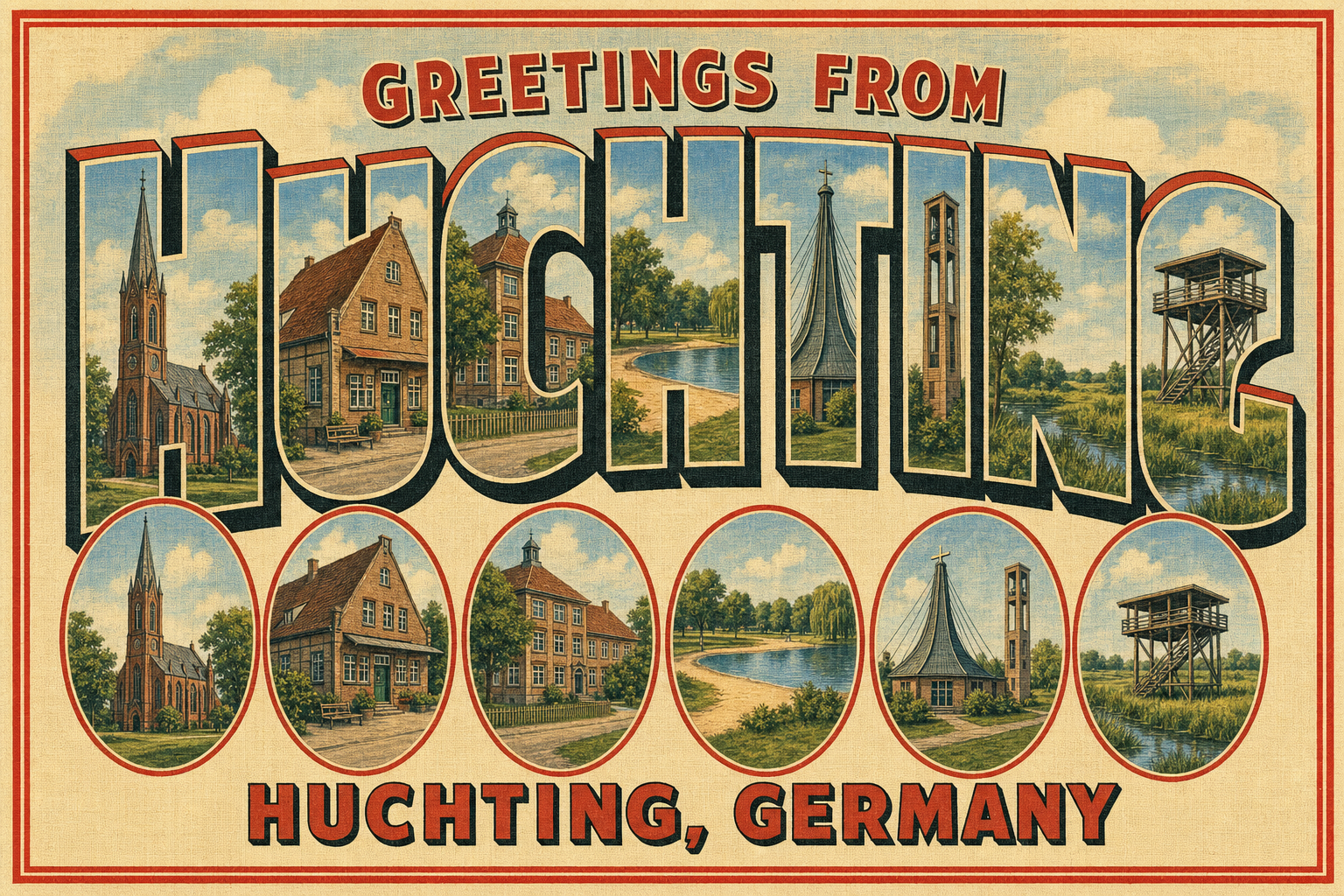
Most people who land in Bremen stay east of the Weser: Marktplatz, Schnoor, a Schlachte beer, then the train home. I keep riding the tram west until the city thins into Kirchhuchtinger Landstraße, leftover farms, and a pocket of trees that still remembers a merchant villa. That pocket is Böses Park — barely half a hectare, Bremen’s smallest park, and still the clearest scrap of old village Huchting on the map.
Huchting sits left of the Weser on the Lower Saxony line. Kirchhuchting, Mittelhuchting, and Sodenmatt lie west of the Ochtum; Grolland is split off by the river and the raised B 75. High-rises, single-family rows, farms, and the Roland-Center mall share the map. A slow day here is mostly green: painted beeches on a flood-safe Wurt, baggersee sand at Sodenmattsee, and the meadow park that grew out of a highway fight.
Böses Park, the Wurt, and thirty-four colored trunks
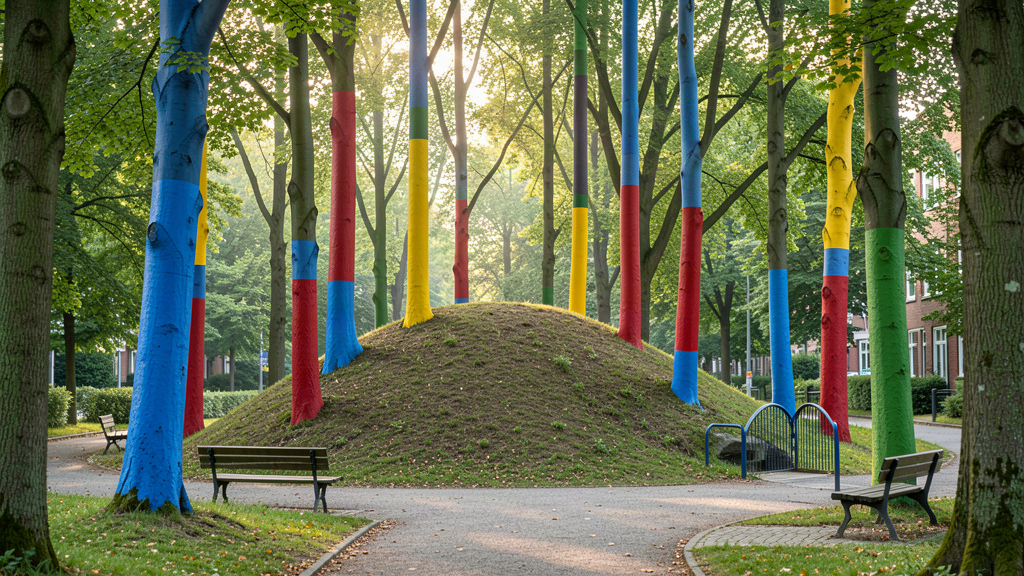
Kirchhöchtinger Landstraße is loud. Step through the curved entrance gate off the Luneplate / Scharhörn block, and the noise drops under closed canopy. Böses Park started around 1900 as a summer landgut — first tied to Dr. Grober, later the Böse family from about 1915. Village Huchting once pulled Bremen merchants out for café days; a few built small parks behind villas. The Böse widow sold to the city around 1960 rather than take a richer private bid, so the plot never became another housing pad. The villa is gone. The Wurt remains: a short artificial rise built against floodwater. The old house platform is under your feet as the path lifts toward the street.
At the back, the beech stand holds a student art project people notice before they know the history — thirty-four trunks painted blue, red, yellow, and green, set into the closed wood so color plays when sun hits. Benches sit along thin paths. Schoolkids cut through toward Grundschule Kirchhuchting. Dogs get a welcome that makes a quiet picnic smarter with fruit than with sausage. The park is more than a century old and still belongs to the block: cut-through, dog loop, short sit under paint.
I start mornings here because the scale fits. You can walk the whole thing in ten minutes and still want to sit. From the gate, it is a short hop to Roland-Center for coffee or tram lines 1 and 8. I prefer turning the other way, toward water and open green, once the painted stems have done their job.
Sodenmattsee and the green center
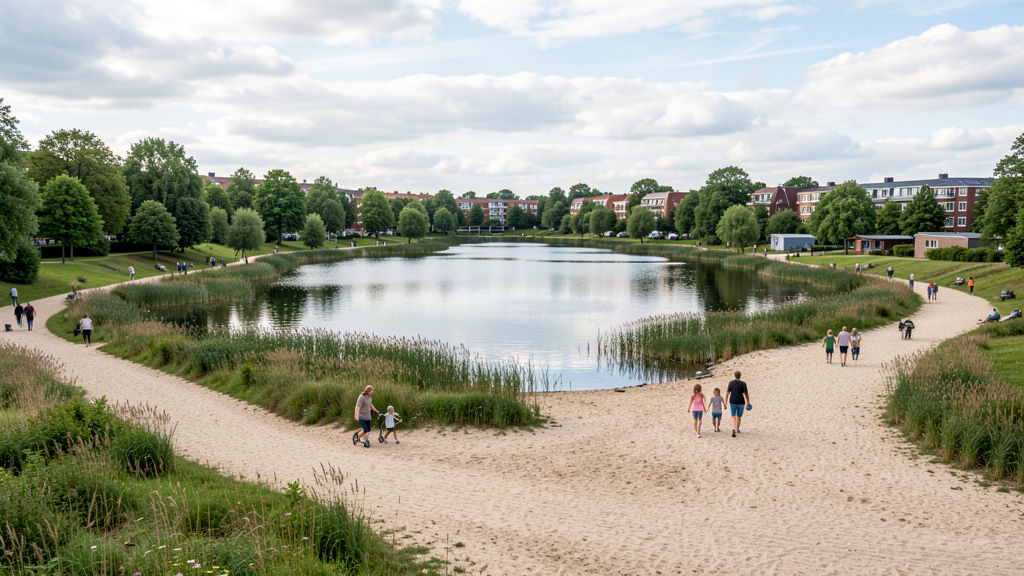
Sodenmattsee is the baggersee left when the B 75 needed fill in the early 1960s. Umweltbetrieb Bremen spent decades turning the borrow pit into Huchting’s green center: sand beach, loop paths, ponds, wet meadows, and a nature-leaning belt toward Mittelhuchtinger Fleet. Warm afternoons fill with local families. Grey weekdays are mostly walkers, bikes, and bird noise.
Swimming weather sits next to quiet biotope edges. Stadtteilfarm Huchting is at Am Sodenmatt 15 — open youth work with animals and garden dirt on the park rim. Recreation here was built for residents first. Bring a towel if the forecast cooperates, and patience at school-out hour. Ordinary water in a dense district is the whole appeal.
Park links der Weser: meadows that beat a motorway
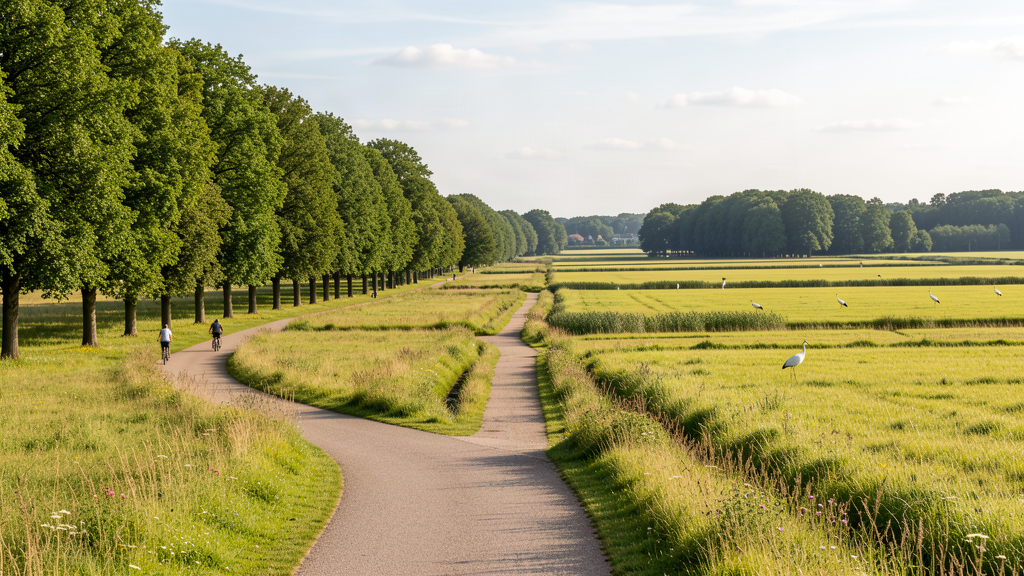
Cross toward Grolland and the map opens. Park links der Weser covers roughly 240 hectares — Bremen’s largest park by area — because neighbors refused an autobahn line drawn through the Ochtum lowland in the 1967 plan. A civic group formed in 1976, lost a name fight with the older Bürgerpark verein, kept going as Park links der Weser, and spent decades stitching paths through city land and working farmland. About fifteen kilometers of walking and cycling routes now run through pasture, fringe woodland, and marsh edges.
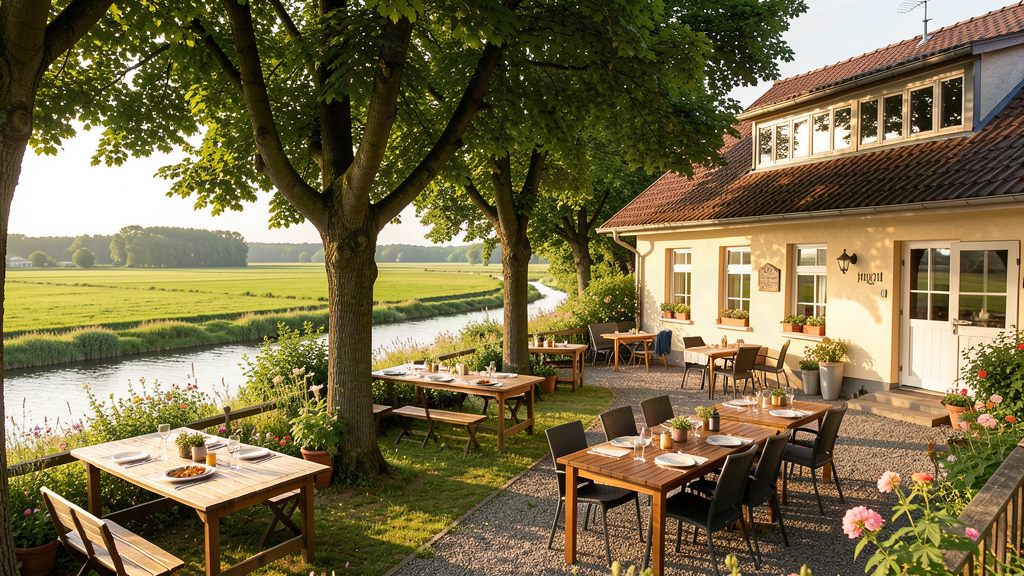
The first through-path from Grolland toward Roland-Center and An der Höhpost came in the early 1980s. The 1994 Landschaftsplan Ochtumniederung locked the frame. On the ground you get English-landscape bones without the palace: meadows as the spine, tree rows as rooms, rest spots instead of follies. Storks and herons show up along the Ochtum if you walk without headphones. In summer you can aim for Hotel & Restaurant Zur Ochtumbrücke — “Spille” to regulars — and, with a boat, tie up at the club landing out front. Most days I stay on foot or bike. The point is distance without leaving Bremen’s western edge.
Grolland started as worker housing for Focke-Wulf and later settled into a calmer pocket north of the park. The B 75 and the river still cut it from Kirchhuchting’s core, so the park paths matter: they are the soft bridge the highway never became.
Kirchhuchting streets and a slow day
Huchting’s unofficial center is Roland-Center — roughly a hundred shops, practical food, tram stops. It is not charming. It is useful. Two weekly markets bring farm produce; specialty groceries match who lives here. Old farm buildings still appear between postwar blocks if you leave the mall radius. I treat Roland-Center as a supply stop: buy fruit for Böses Park, check the tram board, then get back outside.
Tram lines 1 and 8 put Roland-Center within easy reach of the Hauptbahnhof. Buses fill the Sodenmatt and Grolland gaps. Morning: Böses Park while light still catches the painted stems. Midday: circuit of Sodenmattsee, bare feet on the sand if weather allows. Afternoon: Park links der Weser until the legs ask for a table. Evening: fish or a neighborhood plate without racing back to the Altstadt.
Two hours covers the tiny park and the lake loop. A full day earns the meadow miles and a seated meal by the Ochtum. The cathedral will wait. Huchting rewards people who treat Bremen’s left bank as a place to stay, not a blank between airport and old town.
Places to Stay
Hotel Zur Ochtumbrücke (value, river character)
Stromer Landstraße 53A, 28197 Bremen. Family run house the locals call Spille, set on the Ochtum with a serious fish kitchen and garden tables under trees. Rooms are simple and a little dated; the trade is location and walking straight into lowland green. Book here when the meal and the water matter more than a design lobby.
Hotel Robben (mid-range, Grolland base)
Emslandstraße 30, 28259 Bremen. Long running house in Grolland with an à la carte restaurant, quiet enough nights, and fast access to Park links der Weser and the Ochtum cycle paths. Practical parking; meadow mornings without a long transfer from the center. Use it when you want a proper hotel desk and still sleep inside the Huchting map.
unique by ATLANTIC Hotels Bremen (higher comfort, left-Weser hop)
Hermann-Ritter-Straße 110a, 28197 Bremen. Modern rooms and studios on the old tobacco-factory grounds in the Tabakquartier — not inside Kirchhuchting proper, but an easy left-bank base toward Huchting’s parks and a calmer night than the Schnoor edge. Fast wifi and restaurants on the quarter. Choose it for newer comfort when you are willing to tram or bike into Sodenmattsee and Böses Park.
Weekdays keep Böses Park almost private. Sunny weekends stack the Sodenmattsee sand; the big meadow park absorbs people better than the half-hectare grove, so shift the schedule if you hate crowds.
Restaurants and food
Hotel & Restaurant Zur Ochtumbrücke
Stromer Landstraße 53A, 28197 Bremen. North German fish house with eel and seasonal Stint when the rivers cooperate, plus steaks, Schnitzel, Knipp, Sülze, and Labskaus. Maritime rooms inside; garden seats outside in season. I book a late lunch after the park walk so daylight still sits on the Ochtum. Confirm Stint timing in winter — short local window, not a permanent menu line.
Feldschlösschen Huchting
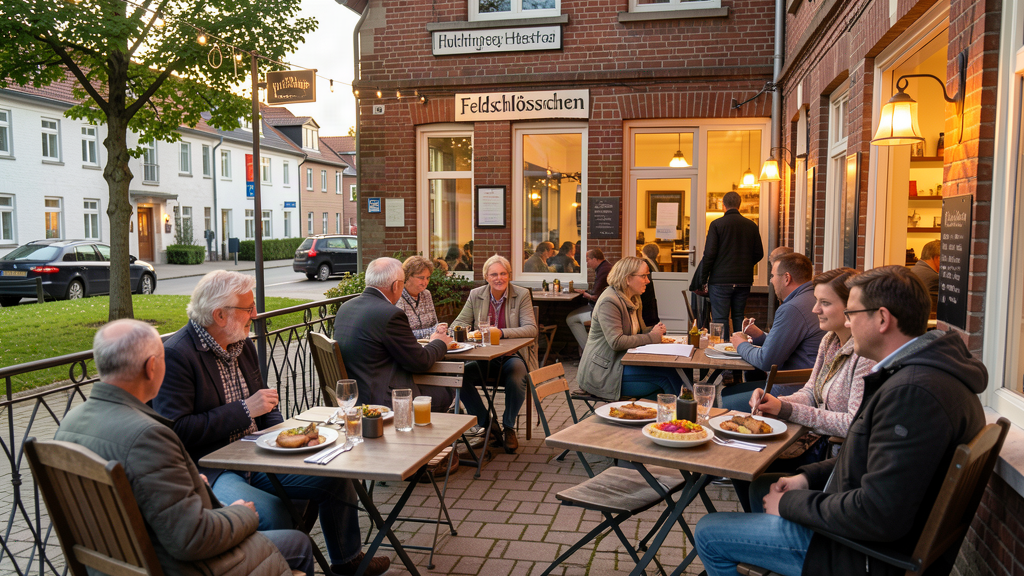
Huchtinger Heerstraße 123, 28259 Bremen. Neighborhood restaurant on the Huchting spine, evenings Monday through Saturday. German plates, regulars, and a room that feels like a district habit rather than a concept launch. Come when you want a full dinner without leaving the Stadtteil for the Viertel’s louder rows.
Kolma Restaurant
Alte Heerstraße 4, 28259 Bremen. Halal certified steaks, grills, and mezze on the Huchting side of town, smoke-free rooms, terrace when weather allows, and easy parking. Useful after a Grolland walk when the group wants to share plates. It draws Stuhr and Delmenhorst as much as local blocks — still easier than fighting for an Altstadt seat on a Saturday.
Weekly markets and Roland-Center bakeries cover breakfast and picnic layers. I pack fruit for Böses Park benches and save the restaurant appetite for the Ochtum or Heerstraße night.
Huchting will not replace a first-time Bremen checklist. It fixes the second visit — the one after the statue — when you want color on real tree trunks, sand left from a road cut, and a park that only exists because people blocked a motorway. Start at the Wurt. Follow the paint. Keep walking until the meadows take over.
