
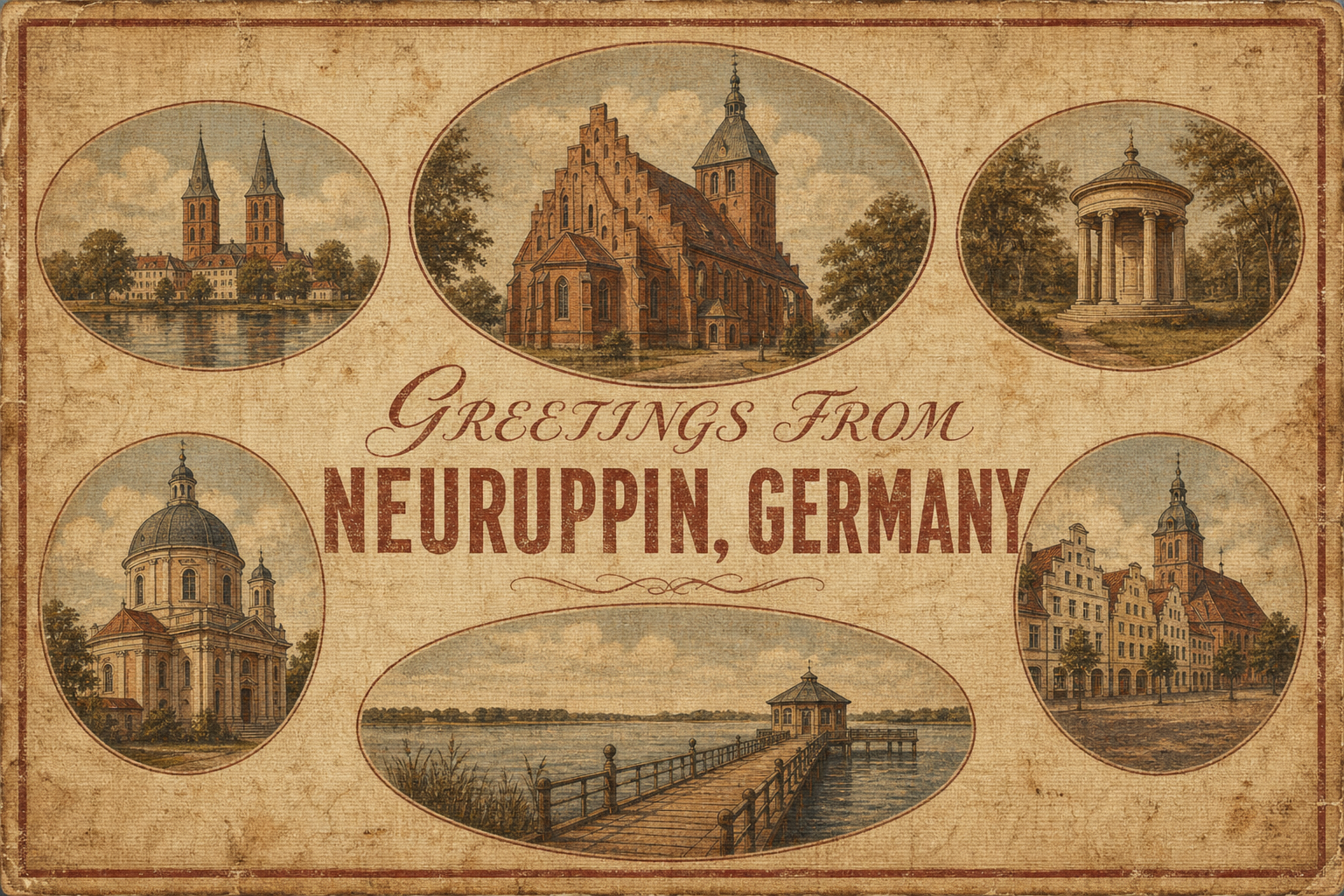
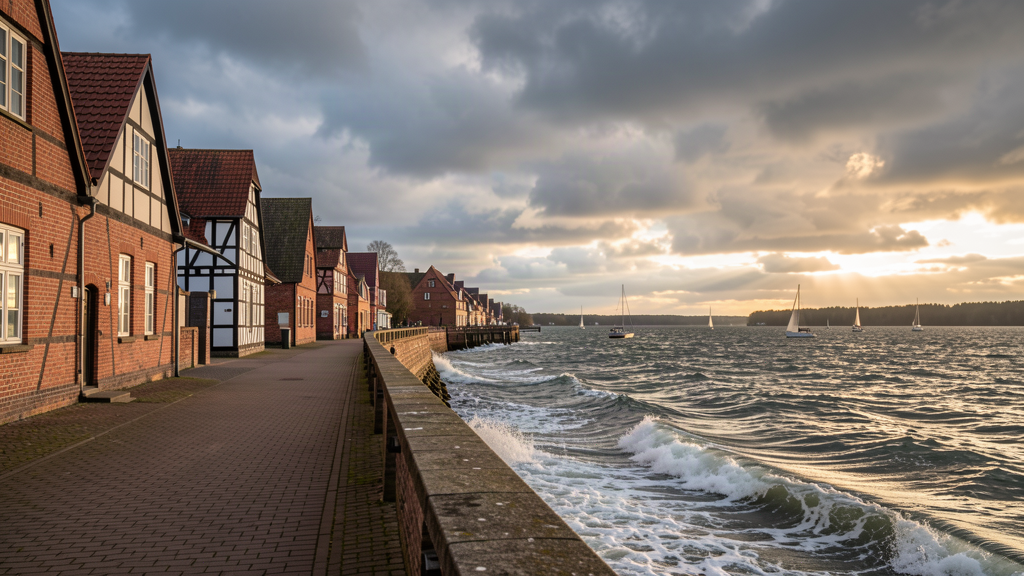
You feel Neuruppin first in the air off the water. Stand on the Bollwerk — the town’s lakeside promenade — and the Ruppiner See stretches longer than the map suggests, a flat blue band running toward reed beds and low pine. Boats knock against their moorings. A cyclist rolls past with a baguette under one arm. Behind you, the twin towers of the Klosterkirche St. Trinitatis hold the skyline, and out on the water a white sail tips and rights itself.
Neuruppin is a classicist garrison town rebuilt after a bad fire, then left to grow into its oversized streets at its own pace. It is not Berlin’s weekend playground. Theodor Fontane was born here. Karl Friedrich Schinkel spent his early years here. Locals still call it Fontanestadt, which can sound like branding until you notice how ordinary the pride is — a pharmacy plaque, a bench with a bronze man in a hat, a museum room you can walk through in twenty quiet minutes.
I came up from Berlin on the RE6, about an hour, and walked toward the lake instead of checking into a hotel first. That was the right order.
After the fire, the streets stayed wide
In August 1787 most of Neuruppin burned. What rose afterward was deliberate: stone houses instead of timber frames, straighter streets, three big public squares sized for light, air, and marching. Fontane later grumbled that the town looked like a suit cut too large for the wearer. He had a point. You still feel the extra space. Karl-Marx-Straße and the neighboring blocks have a Prussian calm that can feel empty at midday and oddly generous at dusk, when the façades pick up a soft yellow and people linger outside cafés.
Don’t race the old town. Start at the Fontane-Apotheke on Schinkelstraße — Fontane’s birthplace, now a small memorial inside a late-classical town house — then drift toward the square behind the parish church for the Schinkel monument. The museum on August-Bebel-Straße ties both men together without turning the visit into homework: portraits, short notes, a Fontane room with enough text to sit with if you want.
What I liked more than any plaque was the ordinary stuff between the landmarks. A bakery queue. Someone watering balcony geraniums. Kids kicking a ball across a square that could swallow a parade. Neuruppin carries its history lightly. You can lean into it or mostly ignore it and still have a good afternoon.
The Bollwerk and the long lake
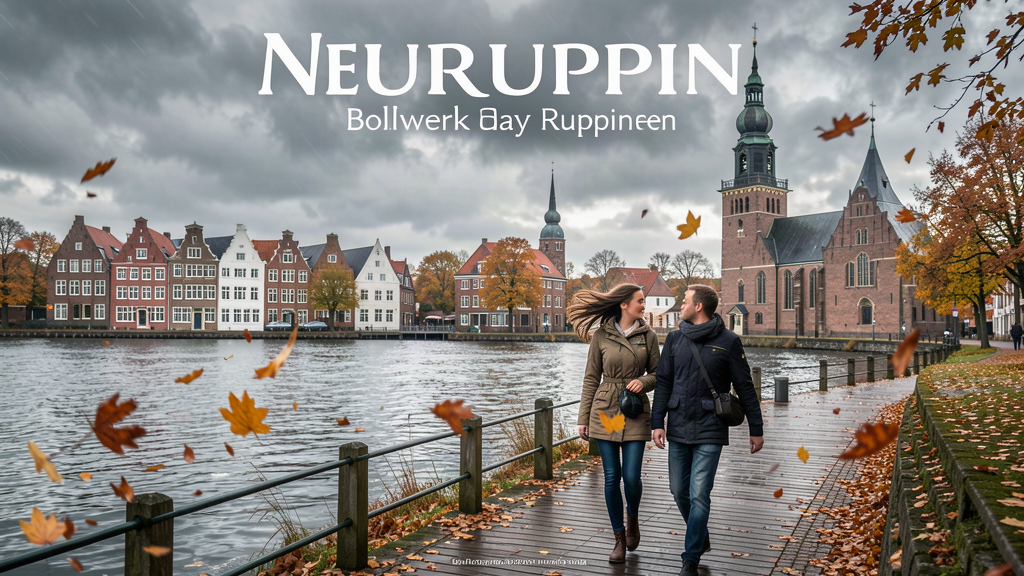
The Ruppiner See is Brandenburg’s longest lake, roughly fourteen kilometers of water that shapes how the town breathes. The Bollwerk and Seepromenade are where most visitors end up, and here the obvious stop is worth it. From the water you get the better view: church towers, pale façades, and the seventeen-meter steel figure of Parzival near the shore. A medieval romance character in a garrison town is an odd fit, and that is part of why it works.
Passenger boats leave from An der Seepromenade 10. A simple round trip is enough if you only have a few hours. With half a day, cruise toward the wooded inlets people call Ruppiner Schweiz. There are no mountains. It is a softer fold of forest and water that feels farther from Berlin than the timetable claims. Bring a jacket. Even in summer the lake throws a cool edge once the boat leaves the promenade.
I walked the shore both ways. North, the path opens toward quieter banks and local swimming spots. South, you stay closer to hotels, ice cream, and terrace talk. Neither route is a hike. Watch for swans near the reeds and the way the light changes when cloud cover slides across the water. On a grey day the lake goes pewter; on a clear evening it holds the last of the sun longer than the streets do.
If you want green without a boat, Tempelgarten sits a short walk inland — a small historic garden from the early eighteenth century, when the future Frederick the Great was still a crown prince stationed here. Forget Versailles comparisons. It is a pocket of paths and quiet benches when your feet want a break from cobbles and water glare.
A day that doesn’t need a checklist
Morning: coffee near the old town, then Fontane’s birthplace and a slow loop through the classicist grid. Midday: lakeside walk, maybe a short cruise if the schedule lines up. Afternoon: the museum, or a brief hop to one of the lakeshore districts — Neuruppin has thirteen Ortsteile along the water, and even a short detour shows how the town dissolves into trees. Evening: back to the Bollwerk for dinner while the promenade thins out.
If you have a second day, rent a bike along the shore, or paddle if you can find a canoe or SUP near the resort end of the promenade. You do not need to cover much ground. Long views, low drama, and a day that stretches a little are the point.
Places to stay
Budget — Gaststätte & Pension Zum Alten Fritz
Feldmannstraße 4, 16816 Neuruppin
A fourth-generation family house with simple rooms and apartments above a proper local Gaststätte. You are not on the water, but you are in a lived-in corner of town, and breakfast tends to be with people who already know the bus times. Good if you want neighborhood noise over resort polish.
Mid-range — Altes Kasino – Hotel am See
An der Seepromenade 11/12, 16816 Neuruppin
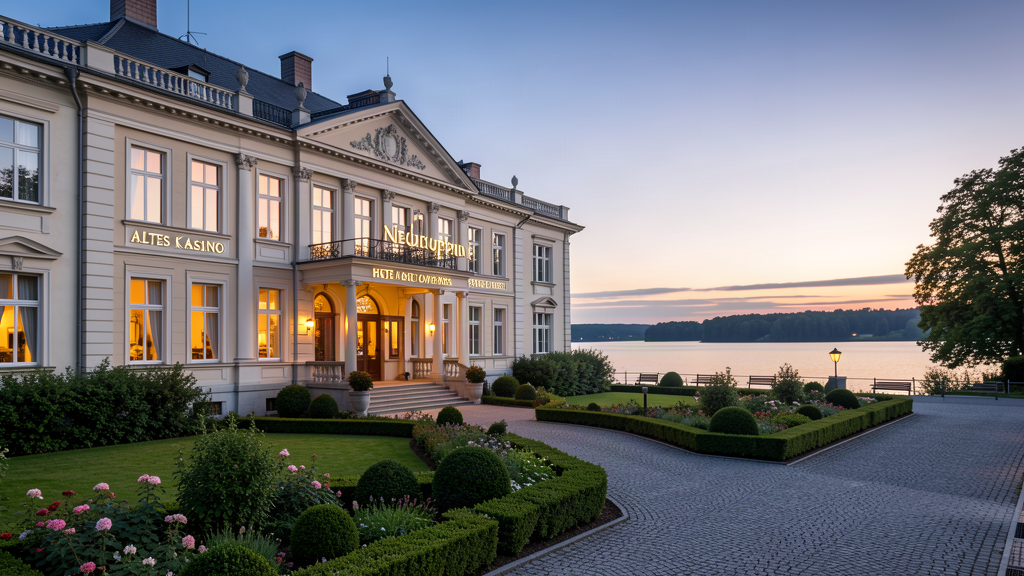
Right on the historic lakeside promenade, a short walk from the monastery church and the Parzival sculpture. Rooms are comfortable without fuss; the real luxury is stepping outside and having the lake already there. The hotel restaurant leans Brandenburg — fish, game, seasonal plates — and the terrace is hard to leave on a warm night.
Splurge — Resort Mark Brandenburg & Fontane Therme
An der Seepromenade 20, 16816 Neuruppin
The full lakeside package: rooms with water or old-town views, several restaurants, and the Fontane Therme with mineral pools and a floating lake sauna. Useful after the train ride, or if you are pairing Neuruppin with a longer Brandenburg lake loop and want downtime built into the base.
Where to eat
Restaurant Parzival (Resort Mark Brandenburg)
An der Seepromenade 20, 16816 Neuruppin
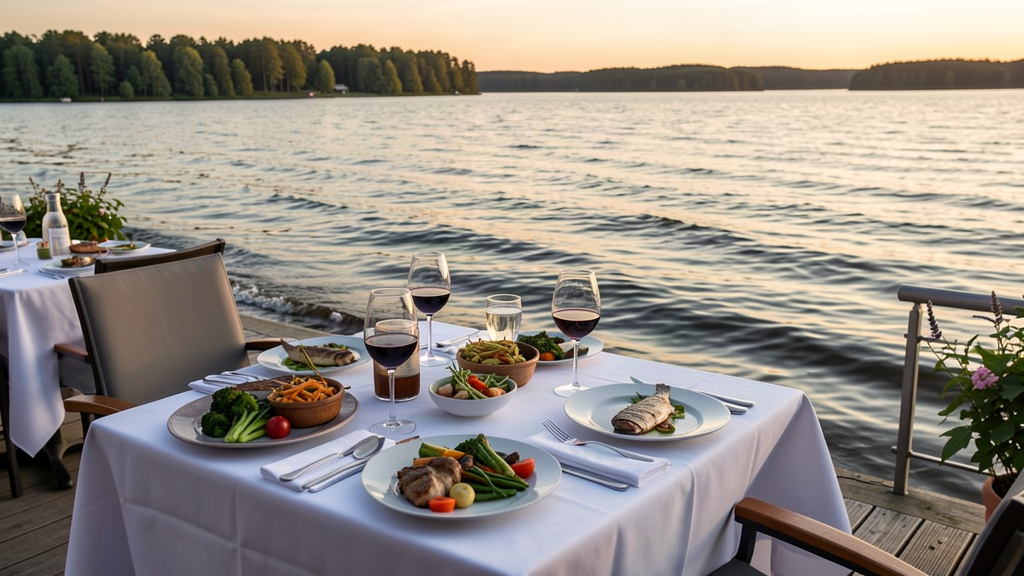
Regional plates with a lake view, open to non-guests when tables allow. Go for fish when it is listed, and leave time to sit afterward. The kitchen draws on market produce and Brandenburg staples without overexplaining the plate.
Restaurant at Altes Kasino – Hotel am See
An der Seepromenade 11/12, 16816 Neuruppin
Mark Brandenburg cooking in the conservatory, the main dining room, or on the lakeside terrace. Fish and game show up often; asparagus and chanterelles when the season says so. Check open days if you are midweek — event bookings can shape the schedule — but a Friday or Saturday terrace table is worth planning around.
Gaststätte Zum Alten Fritz
Feldmannstraße 4, 16816 Neuruppin
House cooking, regulars, and a menu that assumes you came hungry. Schnitzel, seasonal stews, simple salads, a straightforward beer. Stay for the room more than any single dish: wood, low conversation, a family place that has been itself for a long time.
For lunch on foot, duck into a bakery or café on the classicist streets between the church and the lake. The dining scene is small. Competent food in rooms that still feel local is enough.
Getting here and around
From Berlin, the RE6 to Neuruppin West is the cleanest option — roughly fifty minutes to an hour depending on the service — then a walk or short taxi to the Seepromenade. By car, the A24 and B167 drop you into town in about an hour from the north side of Berlin. Once you are here, walk. The old town and lakeside sit close enough that a car mostly gets in the way. Bikes help if you want the longer shore path or the Alt Ruppin district. Boats are for the view more than for getting somewhere.
Before you go
Give Neuruppin a night if you can, two if the weather holds. A lake town works better when you stay put. Walk the Bollwerk early, when the water is still and the promenade belongs to dog walkers. Read a page of Fontane in a café if you like that sort of thing, or skip the literature and watch the light move across Brandenburg’s longest lake. The classicist grid will still be there when you turn inland — wide, a little too large for its own good, and quietly easy to like.
