
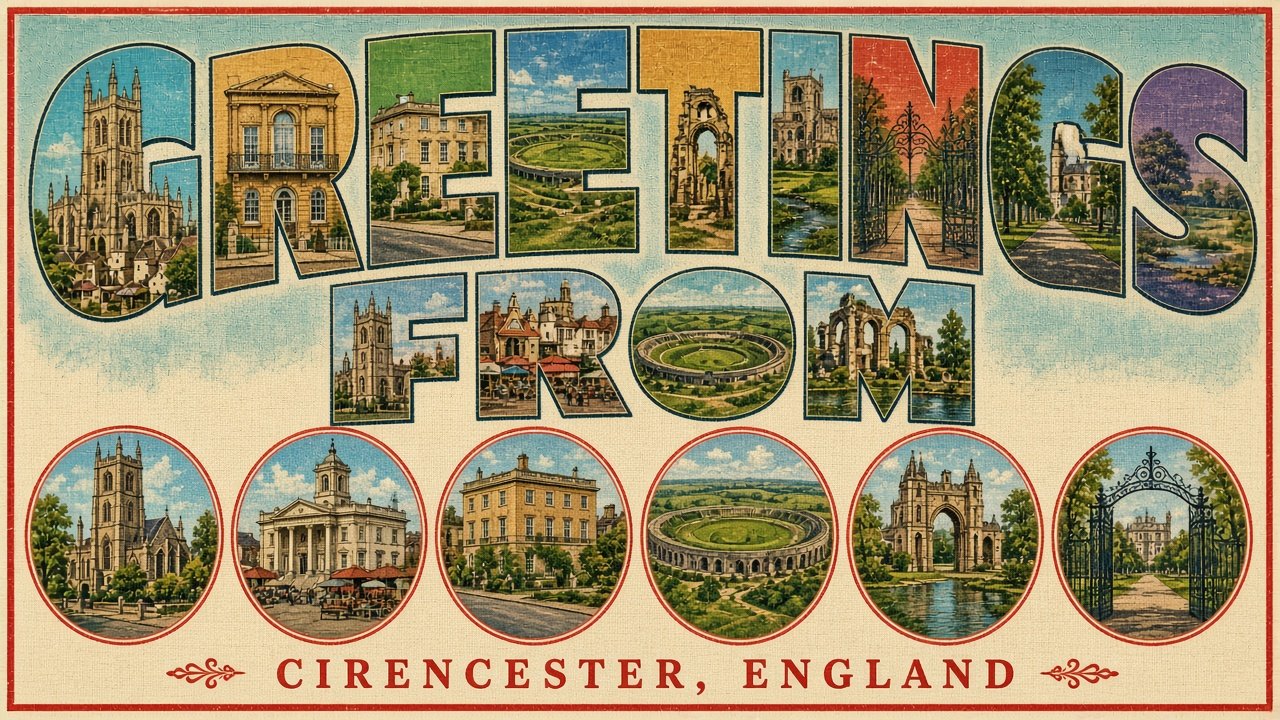
Cirencester calls itself Capital of the Cotswolds. Fair enough if you care about market stone, wool money, and a parish church that still owns the square. I keep starting somewhere less postcard-ready: south-east of all that, where Cotswold Avenue climbs the Querns and grass banks drop into an oval hollow big enough for eight thousand Romans. No ticket booth. Just earthworks holding Corinium’s amphitheatre while dog walkers cut the rim paths.
I would get here before Market Place fills, then walk back through town toward Abbey Grounds and the Norman Arch on the Churn. The amphitheatre is free in daylight. The square is better as a lunch stop than as the whole day.
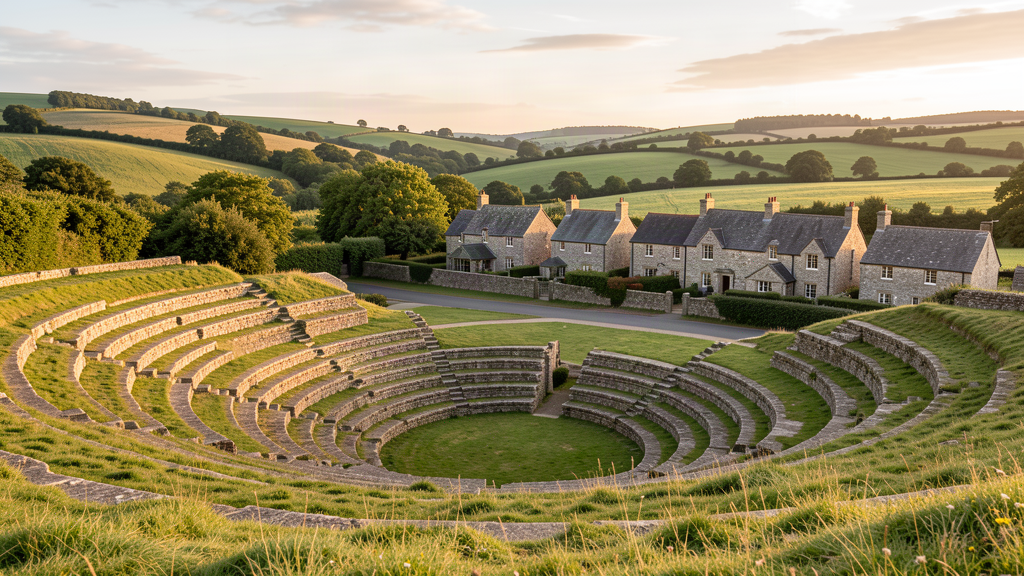
Amphitheatre banks on the Querns
Corinium Dobunnorum was the second city of Roman Britain after London — tribal capital of the Dobunni, junction of Fosse Way, Ermin Street, and Akeman Street. The amphitheatre went up in the early second century on an old quarry floor aligned with the street grid. That alignment is odd; most arenas sat outside the planned lines. Cotswold Avenue, Cirencester GL7 1XW is the practical pin. English Heritage lists the site. Cirencester Town Council looks after the ground day to day.
You will not find freestanding stone seating. You get massive grassed banks, an oval arena floor, entrances still readable as cuts in the earth, and a hillside that once held roughly eight thousand spectators. After the legions left, locals fortified the hollow against Saxon pressure. Later centuries used it as market ground — “the Bull Ring” sticks in local memory, more cattle than baiting — and Civil War shot still turns up in finds. A Neolithic long barrow sits fenced between the amphitheatre and the Waitrose roundabout. The Romans left it alone when they drove the Fosse past.
Walk the upper bank first for the full oval, then drop to the floor. Morning light shows the scale better than any midday photo. Dogs on leads are normal. Nothing to buy on site. A Roman entertainment machine turned into common grass on the edge of a working market town.
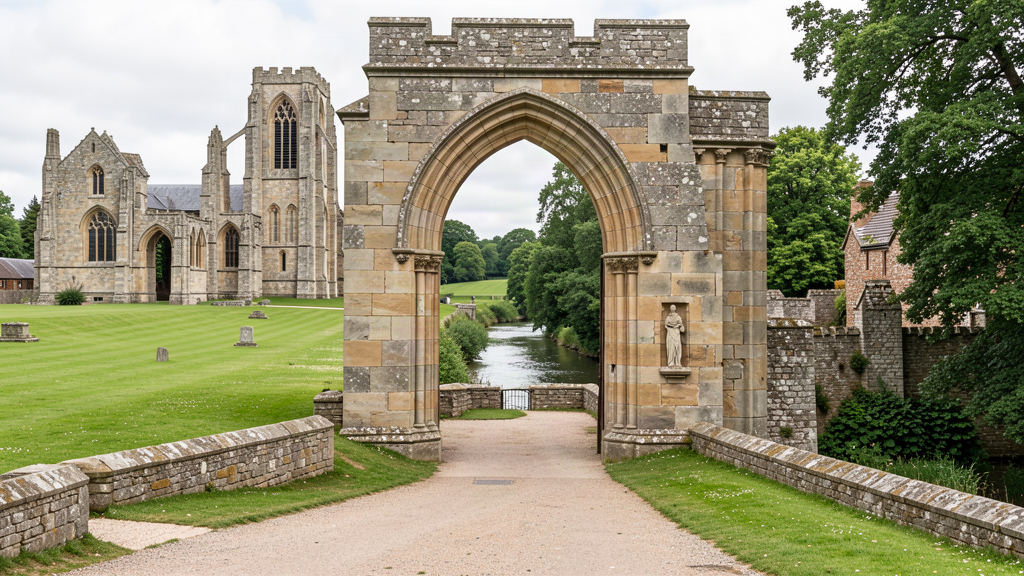
Norman Arch, Abbey Grounds, and the Churn
North of Market Place, behind the parish church, Abbey Grounds open as public park: lake, wildfowl, and the buried plan of St Mary’s Abbey marked in stone on the turf. Henry I founded the Augustinian house around 1117. Wool fairs under the abbot made Cirencester rich and argumentative for centuries. Dissolution under Henry VIII stripped the abbey in 1539. Almost nothing stands above ground except the Norman Arch — Spital Gate — built about 1180 as an abbey gateway and now the oldest standing fabric in town.
The arch sits at the northern edge of the grounds on the south bank of the River Churn. You can reach it on foot from the church, Grove Lane (A435), Corinium Gate, or the Abbey Grounds car park off Dugdale Road. Grade I listed since 1948. Large central carriage arch, smaller pedestrian opening on the outer face. Fishpond lines still ghost the river edge. A short walk through the same park reaches a surviving stretch of Roman town wall under trees rather than under glass.
The Churn is a short Thames headwater, braided and flood-prone. Roman engineers cut channels to keep the growing town dry. I sit by the lake after the amphitheatre climb, then decide whether museum mosaics or Market Place coffee comes next.
Market Place wool stone
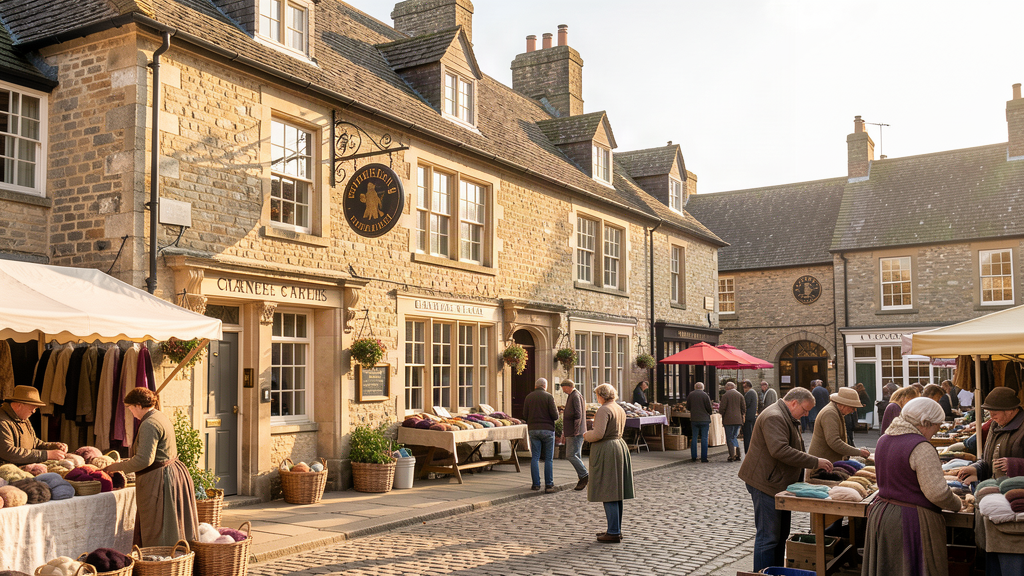
Cirencester’s open Market Place still does the job medieval wool money paid for. The Church of St John the Baptist owns the south side. Guides like to call the tower and south porch one of England’s biggest parish churches — Cotswold stone, abbey-funded porch from around 1480. The interior is worth twenty quiet minutes if merchant brass interests you more than another cream tea.
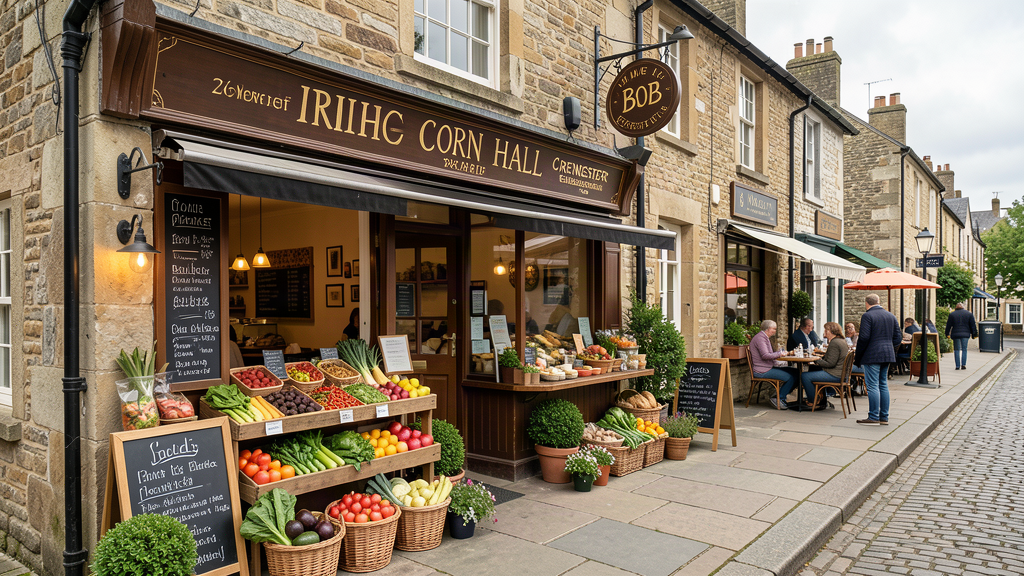
Black Jack Street and the lanes off the square hold independent shops and the butchers-and-bistro economy that still feeds locals on market days. Corn Hall sits on the Place with galleries and Made by Bob’s open kitchen. Cirencester Park, the Bathurst estate, opens west from Cecily Hill — a long flat walk after Roman banks. I skip most of the gift circuit and keep the amphitheatre and abbey grounds as the day’s spine.
Fosse Way still runs through as the A429. That Roman road logic is why Cirencester feels like a hub rather than a single-street village. Coaches stop. So do people who shop the square on ordinary Tuesdays.
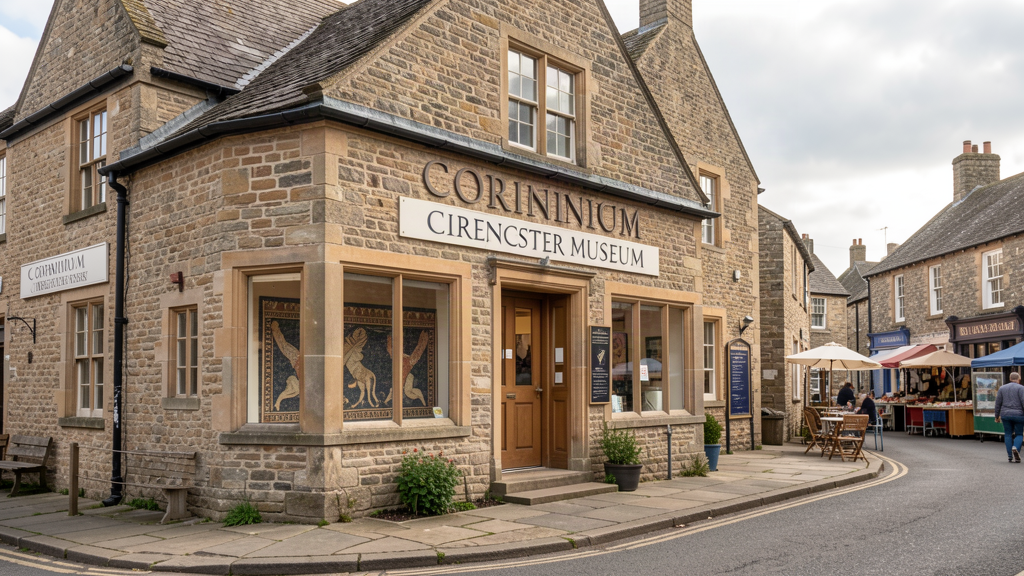
Corinium under glass on Park Street
Corinium Museum, Park Street, Cirencester GL7 2BX, holds the town’s Roman weight: mosaics from local villas and town houses, carved stone, everyday metalwork, and enough context that the amphitheatre hollow makes sense afterward. The Corinium rooms are why I go — Matres reliefs, floor patterns that once sat under hypocaust heat, glass that travelled from Egyptian shores.
Go after the outdoor sites so the museum fills gaps instead of replacing walking. Wet afternoons make it the obvious shelter. A short loop works well: amphitheatre early, museum mid-morning, Abbey Grounds and Norman Arch before lunch on the square. Weekday openings outside half-term stay calmer.
Places to Stay
Corinium Hotel — 12 Gloucester Street, Cirencester, Gloucestershire GL7 2DG
Sixteenth-century merchant house turned small hotel with courtyard restaurant and bar, individual rooms, and a car park entered from Trafalgar Road behind the Gloucester Street frontage. Solid mid-to-budget base when you want Cotswold stone and a short walk to Abbey Grounds without sleeping on the Market Place kerb.
The Fleece — 41 Market Place, Cirencester, Gloucestershire GL7 2NZ
Coaching inn on the square since 1651, Grade II listed beams and fires downstairs, refurbished rooms upstairs, courtyard dining when the weather holds. Mid-range stop when Market Place convenience matters more than a quiet side street. Dog-friendly bar; book food in season.
Kings Head Hotel — 24 Market Place, Cirencester, Gloucestershire GL7 2NR
Larger Market Place hotel with modern rooms, spa, lounges, and all-day dining after a full refit. The upper-end in-town option if you want polish, a proper wine list, and a two-minute walk to the church porch.
Where to Eat
Made by Bob — 26 Market Place, The Corn Hall, Cirencester, Gloucestershire GL7 2NY
Open kitchen brasserie on the square for breakfast through dinner — busy, local, good when you want a proper plate without leaving the Market Place axis. Book for evening. Useful after museum hours.
Jesse’s Bistro — The Stableyard, 14 Black Jack Street, Cirencester, Gloucestershire GL7 2AA
Behind Jesse Smith Butchers in the old stable yard off Black Jack Street, a minute from the square. Local meat from the shop, fish up from Cornwall, AA-rosette cooking in a tight historic courtyard. Book for dinner. Lunch works if you time the amphitheatre morning right.
The Organic Farm Shop Café — Abbey Home Farm, Burford Road, Cirencester, Gloucestershire GL7 5HF
Farm shop and mostly vegetarian café a short drive out the Burford Road — organic produce, simple plates, countryside edge after a full stone-and-mosaic day. Go for lunch when the square feels crowded, or stock a picnic for the amphitheatre banks.
When the weather holds, a sandwich on the amphitheatre rim before ten beats any peak-lunch queue on the Place.
Getting around and leaving room
Cirencester has no mainline station in the town centre. Kemble station sits a few miles west on the Golden Valley line toward Swindon and Gloucester, with bus links into town. Check last buses if you plan a car-free evening. Road access is the A429 Fosse Way and the A417/A419 corridor. In town, park once — Abbey Grounds, Waterloo, Forum, and other signed car parks — and walk. Amphitheatre, Market Place, museum, and Abbey Grounds fit a compact foot loop better than four short drives.
Day tours often treat Cirencester as a toilet-and-church stop between Bibury and Bath. If you arrive that way, peel off to Cotswold Avenue before the timed photo on the square.
A useful loop for me: amphitheatre banks after breakfast, Corinium Museum late morning, Market Place lunch at Made by Bob or Jesse’s, Abbey Grounds and Norman Arch on the Churn in the afternoon, dinner back on the square. Shoulder-season weekdays beat August Saturdays. Leave Bourton and Bibury for other mornings. Cirencester holds as a Roman-and-wool night base better than as a ten-minute coach pause.
Most people reduce Cirencester to the Capital-of-the-Cotswolds tag, a church tower on the Place, and a bag of fudge for the car. I would walk Cotswold Avenue until the Querns hillside opens and the amphitheatre banks cup the old quarry floor. Stand on the rim where eight thousand once watched. Cut back through town to Abbey Grounds and stop under the Norman Arch where the Churn still runs past Spital Gate. That hollow on the Querns is the part I would not trade for another gift shop.
