
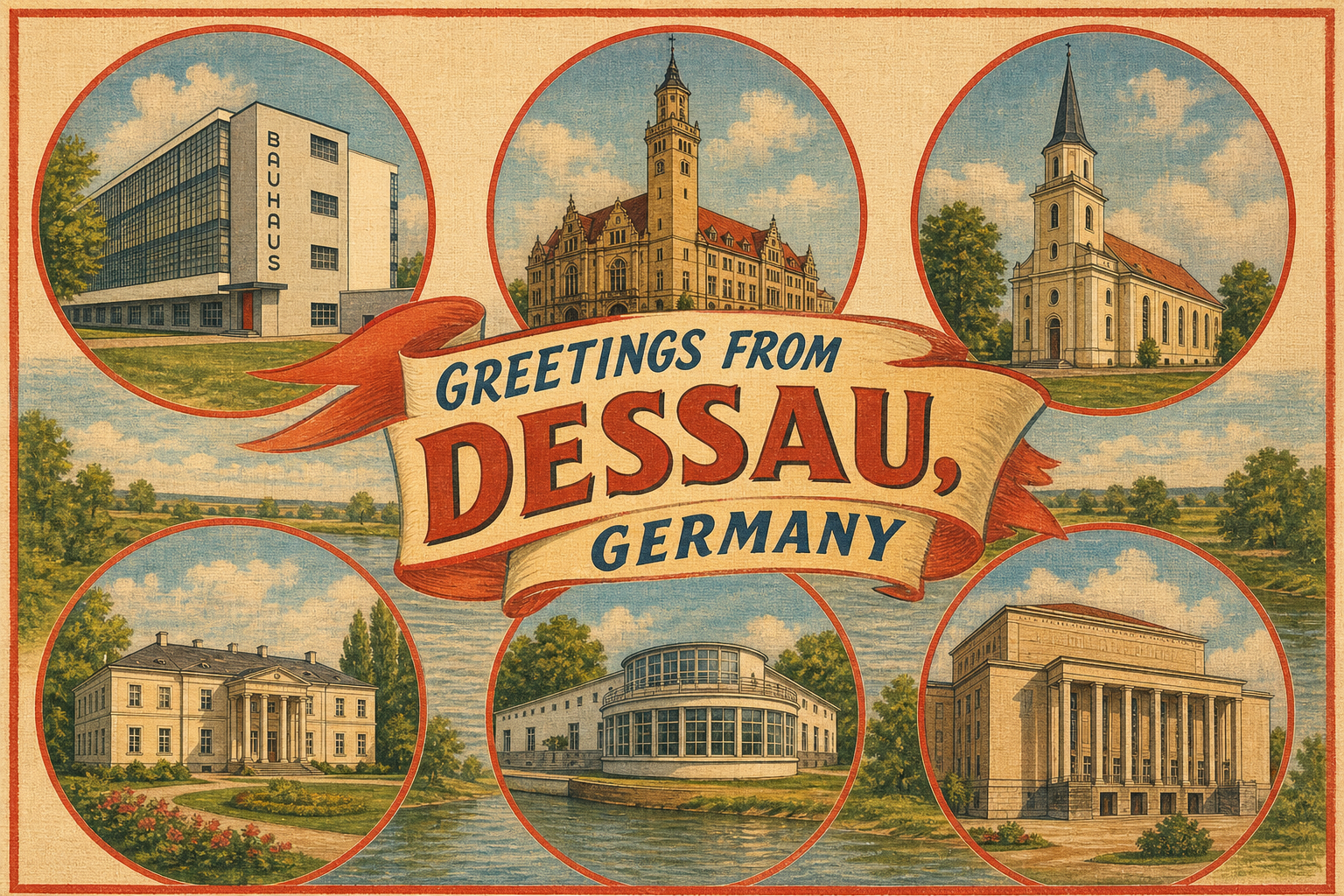
Berlin and Leipzig sit on the rail map like magnets. Dessau-Roßlau gets treated as a Bauhaus checkbox between them — one building, one shot of the vertical lettering, train out. I reverse that. Bags drop near the station, then I walk northwest until white cubes show up between pine trunks. From those Meisterhäuser it is a short arc through Georgengarten and out onto the Elbe dike, where Carl Fieger’s Kornhaus pushes a glass half-circle over the floodplain. Pine shade, classical lawn, river glass: that walk is why I stay overnight in Sachsen-Anhalt instead of flipping through on a day ticket.
You smell resin and damp leaf litter first. Then river wind off the Elbe meadows, and coffee from the kiosk wall at the Masters’ Houses. Bauhaus modernism and the Dessau-Wörlitz Garden Kingdom sit almost on top of each other here. On a weekday morning, the parks still feel like they belong to the people who live next door.
Meisterhäuser first, not as a photo stop
Start at the Meisterhäuser on Ebertallee 59–71. Walter Gropius built three identical semi-detached houses and one director’s house in 1925–26 for the Bauhaus masters — Kandinsky and Klee, Muche and Schlemmer, Moholy-Nagy and Feininger among the first residents. The white volumes sit in a pine grove a few minutes north of the Bauhaus Building. Ateliers face the street with large glass; staircases pull light through horizontal bands. Bombing in 1945 wrecked parts of the estate. Some houses were rebuilt later as deliberate, slightly abstract reconstructions rather than perfect copies. You can feel the gap. That is fine.
I give the pine path twenty quiet minutes before a single picture. Sit once facing a glazed studio wall. Watch how the trunks break the white planes. Then walk to the reconstructed Trinkhalle — Mies van der Rohe’s kiosk set into the garden wall at the Sieben Säulen roundabout. From outside, you mostly see a covered window. Pause there before you buy a ticket or keep walking toward the river.
The Bauhaus Building itself is five to ten minutes south on Gropiusallee 38: curtain wall, workshop wing, the vertical BAUHAUS lettering still doing its job. Exterior access is free; interiors need a ticket. I do the school once with attention, then leave the full museum checklist for a second morning. The living houses in the pines are the better first hour if you want the town, not only the logo.
Georgengarten and the classical counterpoint
From the Sieben Säulen roundabout you step into another century. Georgengarten opens with Roman-ruin columns, long sightlines, and a pale classicist country house — Schloss Georgium on Puschkinallee 100 — that once belonged to Prince Johann Georg of Anhalt-Dessau. The park is the second-largest landscape garden in the Dessau-Wörlitz Garden Kingdom after Wörlitz itself: lawns, orangery, sculptures, and paths that dissolve north into Beckerbruch, a wetter floodplain forest toward the Elbe.
I walk Georgium the way locals do after work — one loop past the palace façade, then a drift toward the arches that frame the wilder ground. The Anhaltische Gemäldegalerie inside holds old German and Flemish painting if the weather turns. The park itself is free and open. Wallwitzburg, a late-eighteenth-century lookout like a miniature keep, gives a raised view over the Elbe meadows when you push into Beckerbruch. That is enough garden kingdom for day one without a bus to Wörlitz.
Bauhaus white and princely green share a few hundred meters of street. Plenty of people photograph one and skip the other. Standing at Sieben Säulen with pine cubes behind you and park lawn ahead is the moment I keep coming back for.
Kornhaus glass and the Elbe dike
North and west, the path drops toward the river. At Kornhausstraße 146, Carl Fieger’s 1929–30 excursion restaurant sits on the dike: brick, low profile, and a nearly circular glass winter garden pushed out over the floodplain. A grain store stood here in the eighteenth century. The name stuck after the trade faded and the site became a day-trip tavern. The Bauhaus-era rebuild is one of the few modern monuments you get to experience sitting down with a plate.
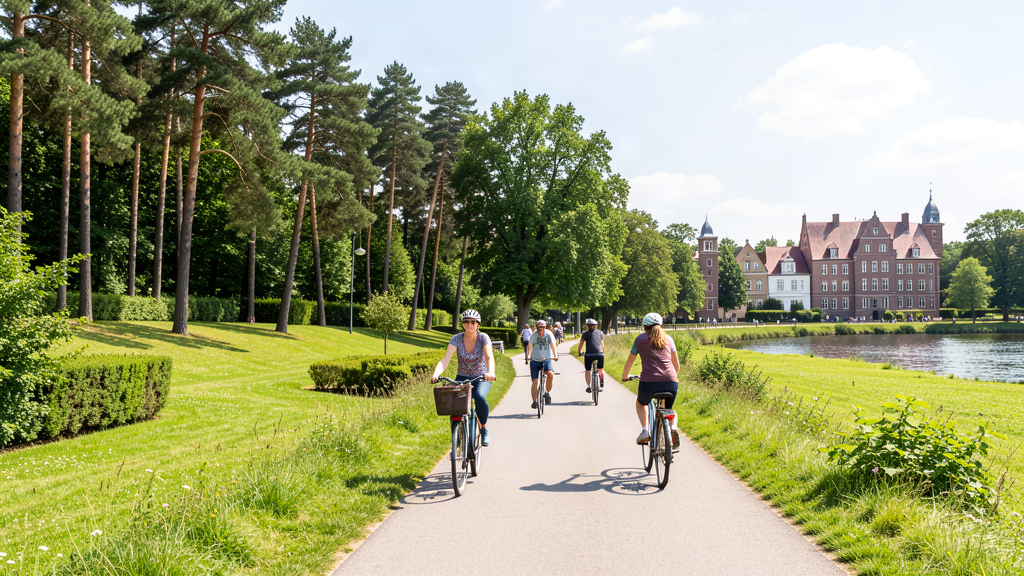
I time the Kornhaus for a late lunch or an early evening drink when the light softens across the Elbniederung. German plates, vegetarian options, cake — solid regional food, no theatrics. If the kitchen is between services, the terrace alone justifies the walk. A nature trail continues into the Middle Elbe biosphere if legs still want ground. I usually turn back through Georgium, because the park reads differently on the return. Ziebigk stays residential and green. Bikes pass, dog walkers use the dike, and the river weather decides whether you linger.
Center, and how the city moves
South of the Bauhaus–Georgium arc, the center gathers around Friedensplatz, the Anhalt Theatre, and the Stadtpark. The Bauhaus Museum Dessau sits on Mies-van-der-Rohe-Platz 1 with a café facing the park. Teehäuschen across on Friedrichstraße is the Mediterranean alternative when museum hours shape the day. Johannbau and the older town fabric sit east of the park for a short pass — Dessau is not a half-timber fairytale, and pretending otherwise wastes a morning. Gropius’s Employment Office remains a quiet exterior stop while interiors cycle through repair.
Dessau Hbf lands you close enough that the Bauhaus Building is a short walk west. Regional trains link Berlin and Leipzig in roughly ninety minutes either way. Inside town, feet and a day ticket cover Meisterhäuser, Georgium, and the Kornhaus loop. Bus line 10 serves the Masters’ Houses stop when rain wins. A car helps only if you add Wörlitz or the Törten Laubenganghäuser on a second full day.
For two nights around the pine houses, the garden hinge, and the Elbe glass, you rarely need more. Winter shortens terrace seats at the Kornhaus — confirm hours before locking lunch outdoors. Event weeks fill rooms. Shoulder seasons keep the dike quieter.
A clean day once bags are down: Meisterhäuser and the pine path early, Bauhaus Building mid-morning if tickets line up, Georgengarten before noon, Kornhaus table when hungry, return through Beckerbruch or the palace lawn. Second morning for the Bauhaus Museum, Törten, or a longer meadow walk. Hold the Berlin or Leipzig connection until you have sat the Kornhaus glass twice. I book one Kornhaus meal and leave the rest flexible.
Places to Stay
B&B HOTEL Dessau (value, Schloßplatz)
Schloßplatz 4, 06844 Dessau-Roßlau
Straightforward rooms on the northern edge of the inner city: free Wi-Fi, practical desks, walk-out access toward Friedensplatz without paying for river views you will stand on during the day. I use it when the budget should go to Bauhaus tickets, garden time, and a Kornhaus lunch.
Hotel 7 Säulen (mid, opposite the Meisterhäuser)
Ebertallee 66, 06846 Dessau-Roßlau
Privately run house directly across from the Masters’ Houses estate — pine air, breakfast toward the white cubes, garden seats when the weather holds. You sleep inside the Bauhaus–Georgium stretch instead of commuting from the center. My default when the walk from pines to Kornhaus is why you came.
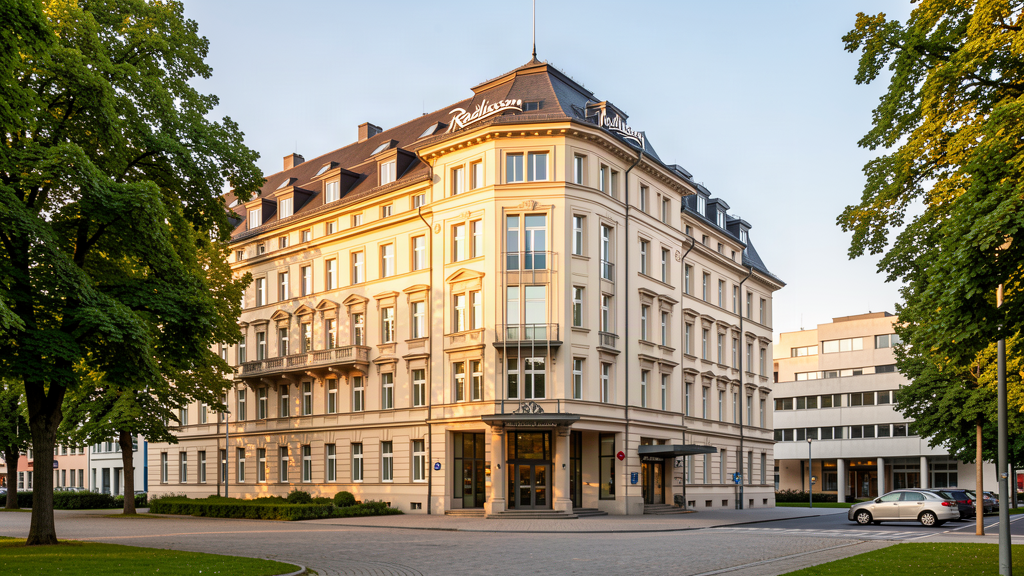
Radisson Hotel, Fürst Leopold Dessau (upper, Friedensplatz)
Friedensplatz 30, 06844 Dessau-Roßlau
Bauhaus-inspired full-service hotel facing the Anhalt Theatre: polished rooms, restaurant and bar, rooftop terrace, wellness when the forecast turns. You pay for quiet service and center logistics rather than waking under the Meisterhäuser pines. Keep the Elbe dike for a dedicated half-day.
Restaurants and food
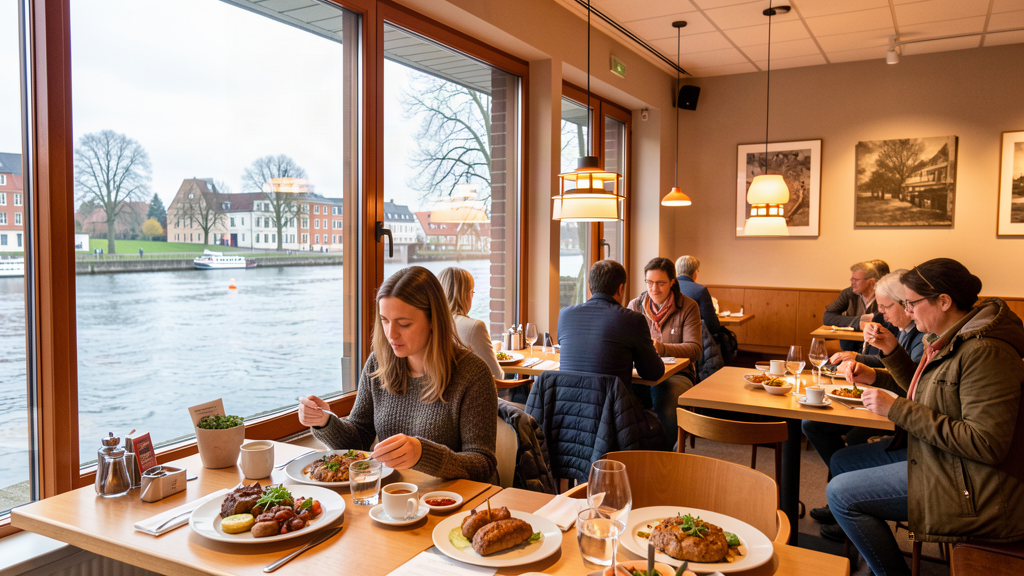
Kornhaus (mid, Elbe dike)
Kornhausstraße 146, 06846 Dessau-Roßlau
Bauhaus excursion restaurant with the glass rotunda over the floodplain — regional German plates, vegetarian options, cakes, terrace and winter garden depending on season. My pick for the meal that doubles as the destination. Weekends fill; go slightly off-peak or book when the sky is clear.
Café-Bistro im Bauhaus (casual-mid, school basement)
Gropiusallee 38, 06846 Dessau-Roßlau
Meeting place under the historic workshop wing — coffee, simple plates, international regulars, foundation-designed interiors with a view back to the UNESCO building. Good after a morning inside the school when you want conversation more than white tablecloths. Check hours the day you land.
Teehäuschen Dessau (mid, opposite the Bauhaus Museum)
Friedrichstraße 15, 06844 Dessau-Roßlau
Restaurant, café, ice cream, and bar-lounge facing the Stadtpark — Mediterranean cooking, long afternoon seats, sundowner pace when the center is your evening base. I use it when the day stayed south of Georgium, and the Kornhaus can wait until tomorrow. Reserve on warm weekends.
Bakeries near the station and kiosk coffee at the Masters’ Houses wall fill gaps when kitchens rest.
Walk the pine grove long enough to feel how the white houses sit between trunks, not on a plaza. Cross from Sieben Säulen into Georgengarten with no camera in your hand. Give the Kornhaus glass an unhurried hour over the Elbe meadows, then stand once more where Bauhaus and the garden kingdom share a street. Two nights of that is enough Dessau-Roßlau. It beats another same-day sprint that only photographs the workshop lettering from a Leipzig-bound platform.
