
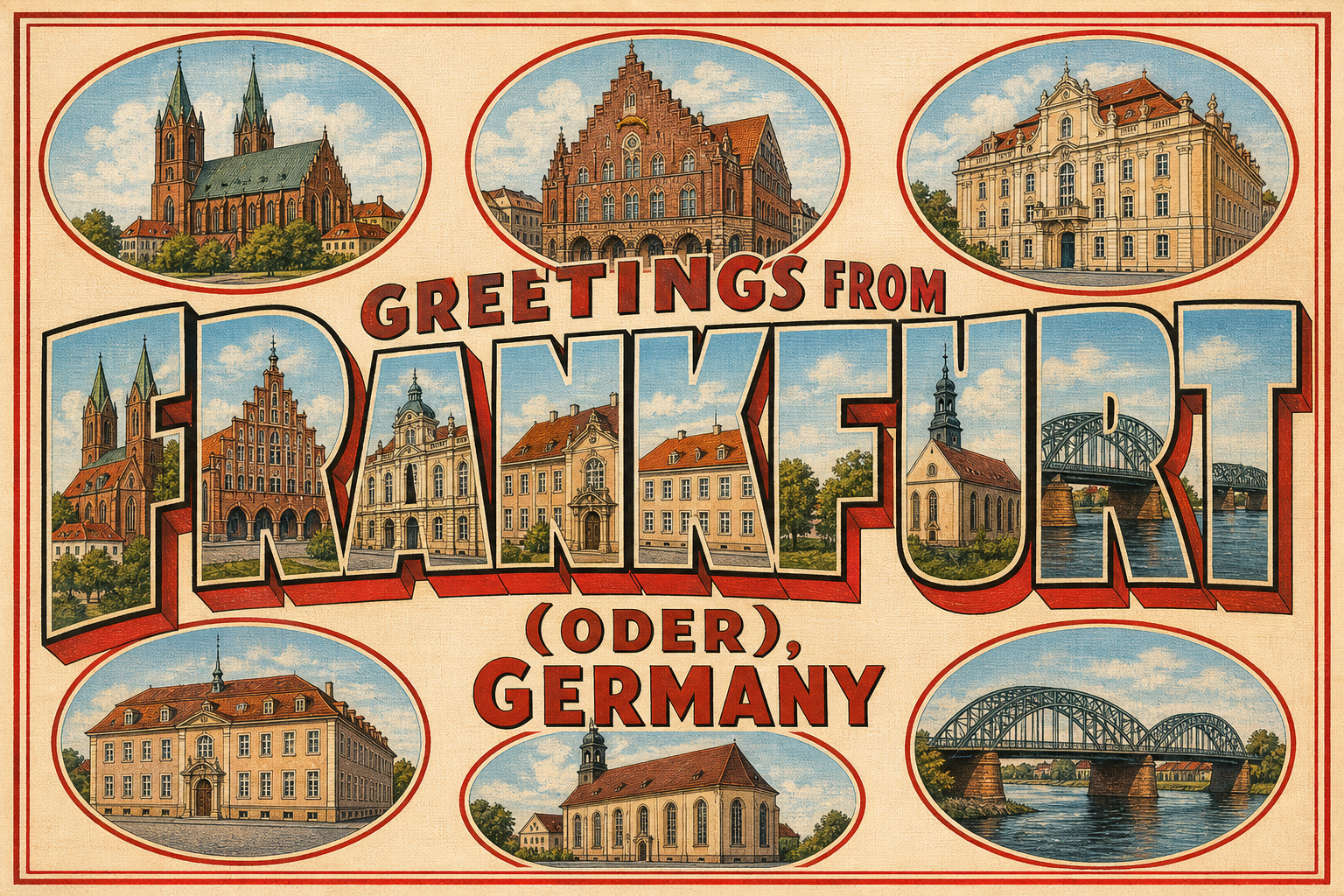
Most travelers hear “Frankfurt” and pack for the Main. I take the RE1 east from Berlin and get off where the river is the Oder, the skyline is lower, and Poland starts on the far bank. Frankfurt (Oder) is a Brandenburg border city of brick Gothic, student bikes, and a sand-dune island between the main current and an old river arm. Locals call it Ziegenwerder. I go there first.
The town name points at a ford. Traders once crossed the Oder at its narrowest point; the bridge and twin city of Słubice handle the same job with less mud. The center still faces the water. One night covers the promenade and a museum. Two nights let Ziegenwerder, the Kleist rooms, and a walk into Poland stop competing for the same afternoon.
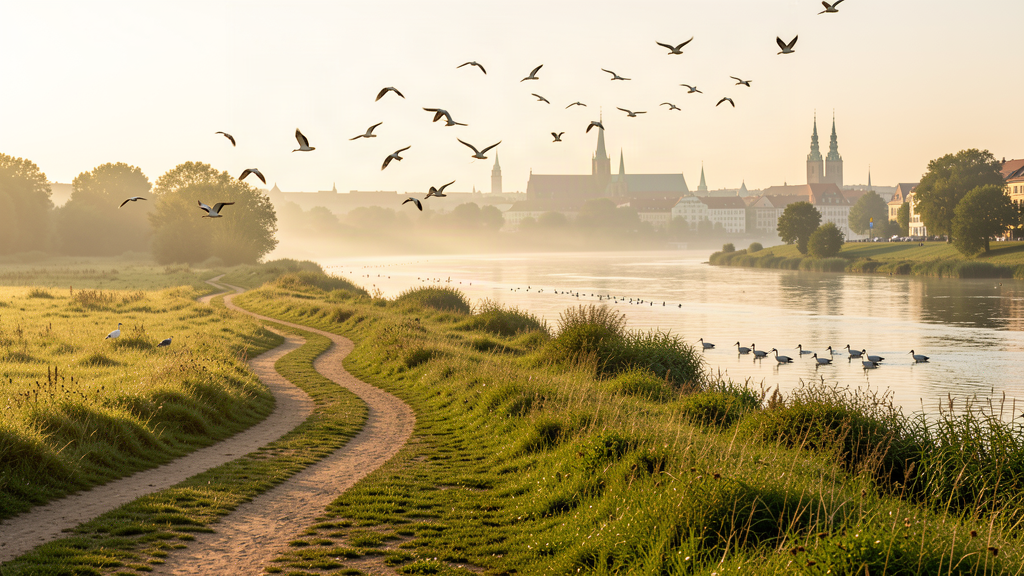
Ziegenwerder before the bridge crowds
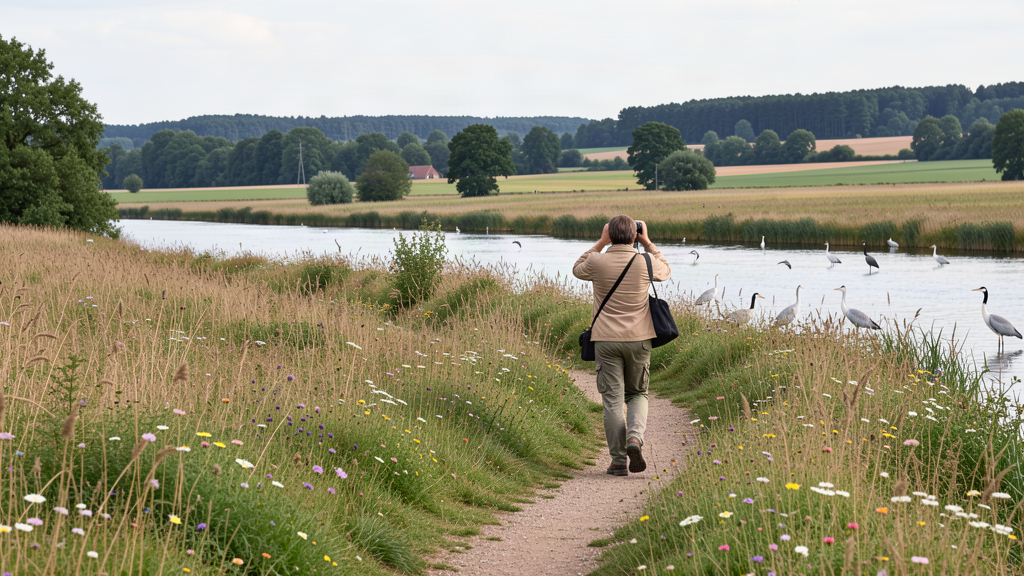
Ziegenwerder sits between the Oder and the Alte Oder — green ground the city never fully paved over. Paths loop through trees and open meadow. Birds take the quieter edges; more than a hundred species use the rougher patches. Walkers share the rest with joggers, Viadrina students, and people carrying bread for a bench. The Europagarten arrived in 2003 for the city’s 750th birthday, and the bank promenade toward Winterhafen came with it. I still treat the island as the main stop and the formal garden as the soft landing afterward.
I cross the small bridges early, when dew is on the grass and the Polish bank looks close enough to shout across. The Oder here is not walled into a concrete trench. You get flood meadow, open sky, and the low line of Słubice without a skyline fight. Bring coffee if the cafés are still shut. The island is better before the lunch strollers show up.
From the north end you slide toward the Kleist-Museum and the river walk. From the south you pick up Fischerstraße and the older fishing-street grain of the town. Either way, Ziegenwerder resets the pace. An hour of bird noise does more for this place than a checklist started at the station mall.
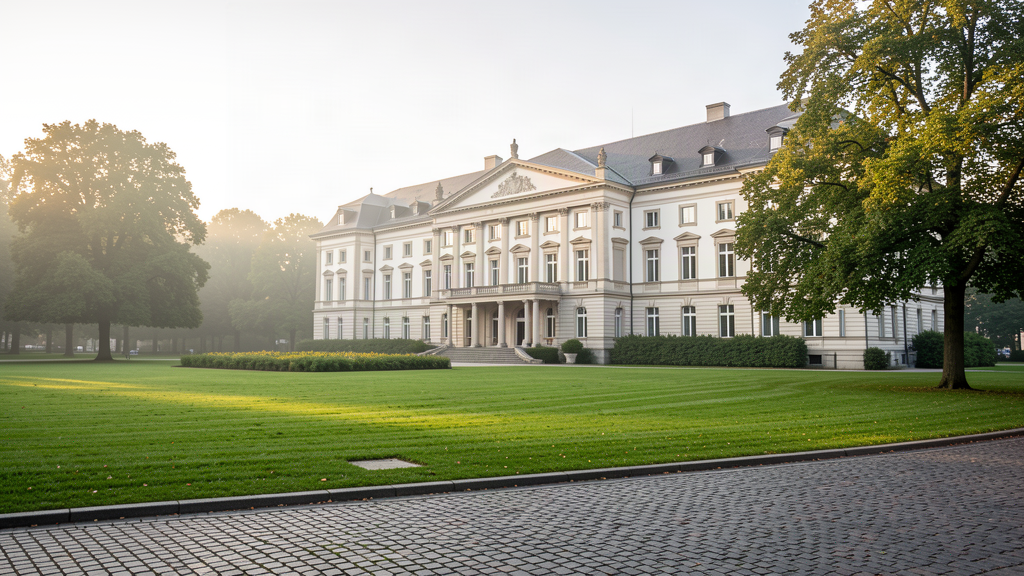
Kleist on the bank, brick on the square
Heinrich von Kleist was born here in 1777. The Kleist-Museum at Faberstraße 6–7 is the only museum devoted to him, split between a former garrison school and a bright modern wing. I go for the rooms and the garden — manuscripts and context inside, the Oder and a bench outside. Hours run Tuesday through Sunday, roughly ten to six; confirm before you build a morning around it. The Oder-Neiße cycle path passes the door.
A short walk puts you at the market square and St. Marien, a large hall church of North German Brick Gothic. The choir windows — tall, colored, old — carry light that makes people go quiet. The tower climb, when open, costs a couple of euros and pays out a view across both countries. I do the interior even when I skip the stairs. War cut hard into this city; the brick that is left feels worked for.
Across the way the historic Rathaus holds rooms of the Brandenburg State Museum of Modern Art, with more BLMK work in the Packhof. Museum Viadrina covers the trade-and-university story when you want labels. I pick one indoor stop on a wet day. The Bolfrashaus on Große Oderstraße hides the German-Polish tourist desk — map, tram tip, and a reminder that this border gets used every day.
Lennépark is the second-oldest public park in Germany, still tended along the old fortress line. Gertraudenpark and the Anger add softer green between errands. Carl Philipp Emanuel Bach’s name sits on the concert hall; he studied law at the old Viadrina. Check the board if you want an evening that is not another dinner. Students from the refounded European University keep the center from going quiet after dark. Polish and German share the same tram without anyone making a speech about it.
Across the Stadtbrücke
The city bridge is about 250 meters of plain usefulness. You walk past the Peace Bell and the boat landing, and a few minutes later the language on the signs has changed. Słubice is not a side exhibit. It is a working Polish town with its own square, churches, and the Collegium Polonicum tied to Viadrina. From the Polish bank north of the bridge the view back at Frankfurt’s waterline is often the better photograph — open floodplain, brick, the Oderturm catching light.
I treat the crossing as part of the day, not a separate trip. Coffee on one side, late lunch on the other. The Wikipedia monument in Słubice is a small sincere oddity if you like that sort of thing. The larger fact is simpler: the ford that named Frankfurt is now a footpath between two ordinary towns. Keep passport habits current, then walk. In summer a boat shows the twin cities from the water; I still prefer the bridge on foot.
Food that fits the river day
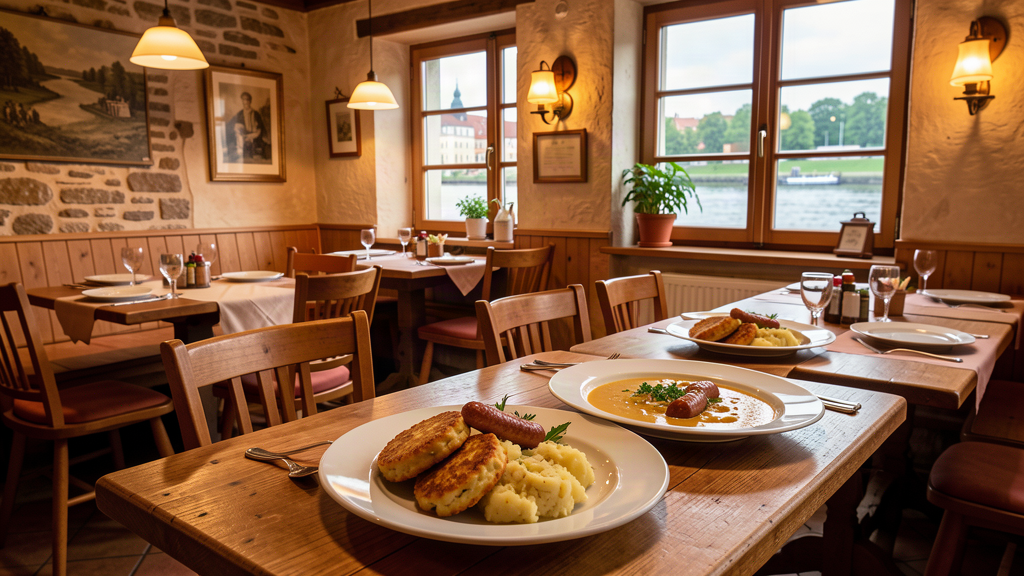
Border cooking here is practical: German plates, potato-forward comfort, fish when the kitchen trusts the season, Polish options a bridge away. I lock one dinner and leave lunch loose near the Holzmarkt or the park.
Frankfurter Kartoffelhaus — Holzmarkt 7, 15230 Frankfurt (Oder)
Regional German cooking with potatoes at the center of the plate, meat and fish beside vegetarian options, terrace on the Holzmarkt when the weather holds. I use it after a Marienkirche and museum loop — solid and local. Book on busy weekends; weekdays you can often walk in.
Restaurant & Café Am Kleistpark — Kleiststraße 7, 15230 Frankfurt (Oder)
Sit-down rooms by the park that carries Kleist’s name, good for a slower evening after the museum garden. Bürgerlich cooking with more range than a snack stop. My pick when I want a proper table and a short walk back through trees.
Hotel & Restaurant Zur Alten Oder — Fischerstraße 32, 15230 Frankfurt (Oder)
House restaurant and beer garden a short walk from Ziegenwerder and the Anger. Regional plates, terrace when Brandenburg is kind. I eat here when the island day ends late and I do not want another cross-town decision. Breakfast upstairs covers the next morning if you are sleeping there.
Bakeries near the pedestrian streets fill the gaps — rolls for the island, cake after Kleist. Oder zander shows up when kitchens are paying attention; order it fresh. I am not hunting trends. I want a table I can reach on foot after bird paths and brick dust.
Places to Stay
Hotel Zur Alten Oder — Fischerstraße 32, 15230 Frankfurt (Oder)
Family-scale three-star near the green belt and the old Oder arm, roughly a kilometer from the Hauptbahnhof. Rooms are straightforward; the win is the quiet-and-central mix, free parking, and the short walk to Ziegenwerder. Budget-to-lower-mid. Best when the trip is island paths and an evening beer garden.
Palais am Kleistpark — Lindenstraße 12, 15230 Frankfurt (Oder)
Jugendstil house on the park, walkable to the center and about seventeen minutes on foot from the station. Mid-range rooms with a calmer feel than a pure business box. I book it when Kleist-Museum mornings and park evenings are the spine of the stay. Breakfast in the bistro covers a slow start.
City Residence Hotel Frankfurt (Oder) — Bahnhofstraße 11, 15230 Frankfurt (Oder)
Practical mid-range almost on top of the Hauptbahnhof — useful if your train is early, or if you are linking Berlin and a Polish onward leg. Center and university are a short walk downhill. Choose it for logistics without giving up the promenade before dinner.
Getting there, and how long to stay
RE1 from Berlin Hauptbahnhof reaches Frankfurt (Oder) in roughly an hour. The station sits above the center; walk downhill toward the river or take a tram if bags are heavy. Trams and buses cover the compact core; validate tickets. The town is flat enough for bikes, and the Oder-Neiße path makes two-wheel days feel natural. A car helps for lake country in the Seenland Oder-Spree; it fights you once you only need the island and the bridge.
One full day: Ziegenwerder morning, Kleist and Marienkirche midday, bridge walk and dinner near Holzmarkt or the park. Two nights are better — one slow island morning, one museum-and-Słubice day with room for Lennépark or a concert. Three days open lake villages or longer cycle stages. The Oderturm still marks the skyline; chase views from the church tower or the far bank instead.
I leave from the path on Ziegenwerder, when the Oder is just moving water and the Polish trees are a darker strip on the other side. The train west heads toward Berlin. The island keeps its slower clock if you still have one more morning left.
