
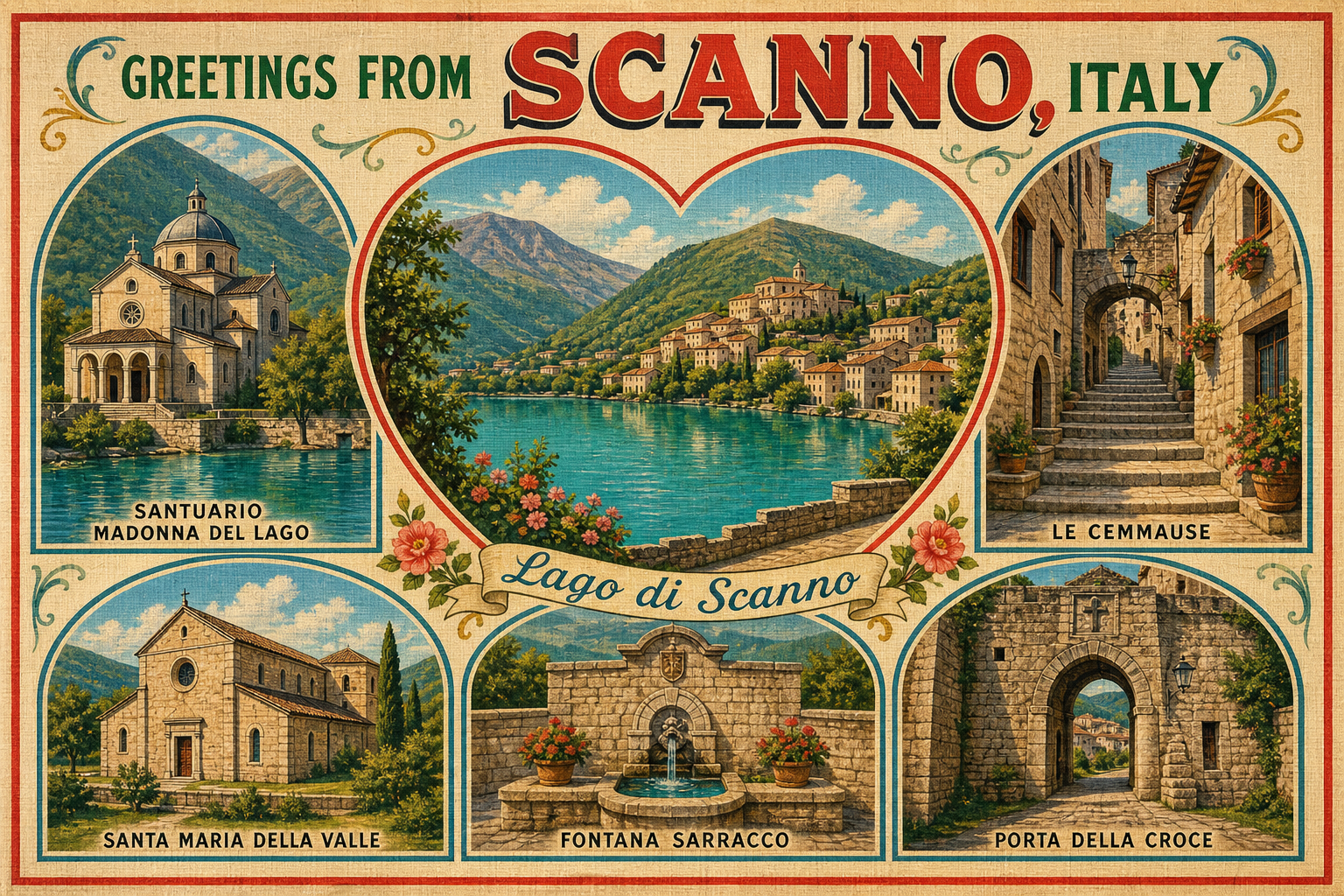
Scanno hangs on a slope above the Sagittario valley: white stone, stairs, arches, narrow doors that never bother announcing themselves. You leave the lake road, climb into the centro, and the air thins a little. Shutters stay half closed at midday. An old woman in black wool crosses a piazza with a shopping bag and does not look at your camera.
I come for the gold. The living kind, still worked in small shops along Via De Angelis and the lanes around Santa Maria della Valle. Scanno’s presentosa is a disk of twisted gold wire with hearts, flowers, or a small cross at the center. It was a betrothal gift long before day-trippers started buying it. You can pick one up in an afternoon. Figuring out why people here still care about it takes a slower walk.
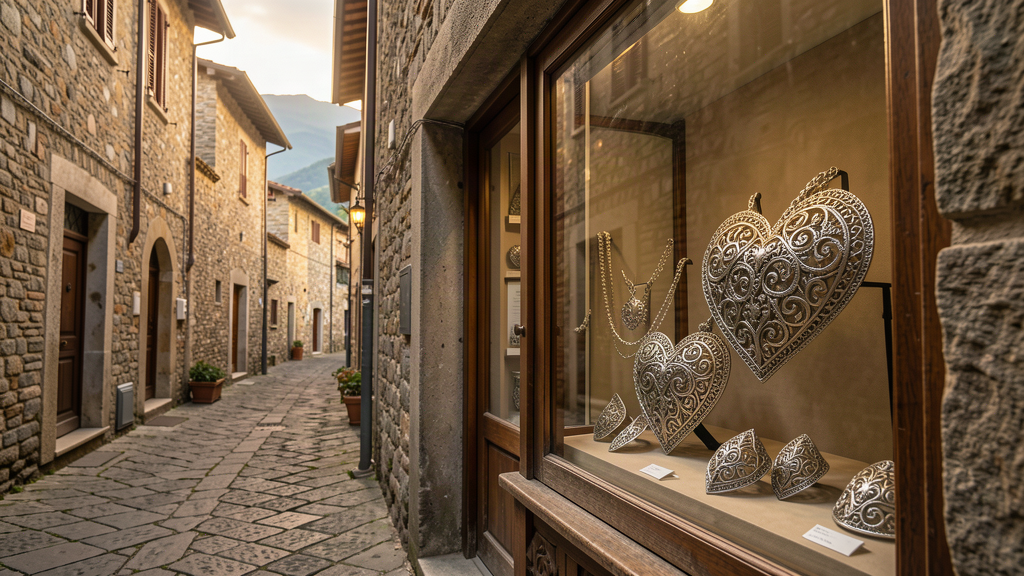
Goldsmith doors and the presentosa
Via De Angelis is short and steep enough that your calves complain before you finish reading the window cards. Several goldsmith families still work here. One long continuous bench is Armando Di Rienzo at Via De Angelis 1, 67038 Scanno AQ, a workshop with nineteenth-century roots. Behind the glass: presentose in gold and silver, monachina earrings, amorini, buttons, and small clusters that look like sugar and weigh like metal.
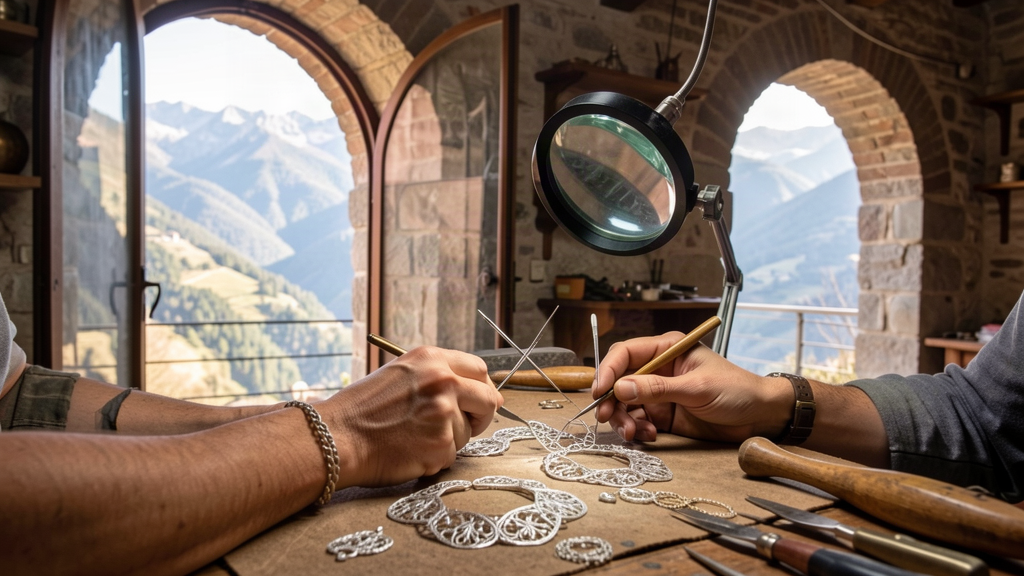
Stand outside first. Filigree is thin wire soldered into open patterns so light passes through the jewel the way it passes through lace. Scanno picked up that craft when pastoral money and Neapolitan taste met mountain patience. A good presentosa has depth: hearts inside a ring, sometimes a tiny cross or floral knot at the center, never a flat stamped disk. Betrothals used to move on that object. Travelers still buy them, and the shop treats each piece like ordinary work.
Other names you will hear, Mancini, Fronterotta, Rotolo, keep the same street-level honesty. Ask for a classic presentosa and a lighter silver version if gold is out of range. These rooms are small. Someone may be finishing a solder while you browse. That is normal here.
Black wool, white stone, Santa Maria della Valle
Some older women in Scanno still wear the local costume on ordinary days, not only for festivals. Dark wool, a distinctive head covering, jewelry that flashes against black cloth. Photographers from Cartier-Bresson to Giacomelli came for that contrast of costume and limestone. You may still catch it near the church doors after mass or on a slow morning errand. Do not chase it. If it appears, it is because someone lives here.
Piazza Santa Maria della Valle is the town’s working front room. The parish church rose in the sixteenth century over earlier fabric: a serious facade, a cool interior when the square is hot. Sit on a step. Delivery vans negotiate angles that should not work. Kids cut through. Nobody is staging the square for visitors; it just keeps doing its job.
From here the centro is a vertical puzzle: covered passages, sudden views between roofs, laundry over alleys that smell of lunch. Climb without a map for half an hour. You will find smaller churches, a viewpoint that opens toward the valley, and stone that holds the day’s heat after the sun has moved. The lake sits below town like a separate appointment. Save it for later. The goldsmiths and the stairs are what Scanno is actually about.
Ju Catenacce and a town that remembers how to walk in pairs
In summer Scanno stages Ju Catenacce, a historic wedding procession. The name points to a bolt or chain latch: from above, the paired line of couples locks together like hardware. A real marriage can sit at the center. Everyone else walks in costume, two by two, through streets that already know how to hold a crowd. The dress, the jewelry, the slow pace belong to the town; nobody is renting a costume for the camera.
You do not need the festival date on your calendar. Knowing the procession exists changes how you read a presentosa in a window and a black skirt on a weekday. A small costume museum opens on posted hours when staff allow. Check the door. If it is closed, walk the streets anyway; they teach most of the same lesson for free.
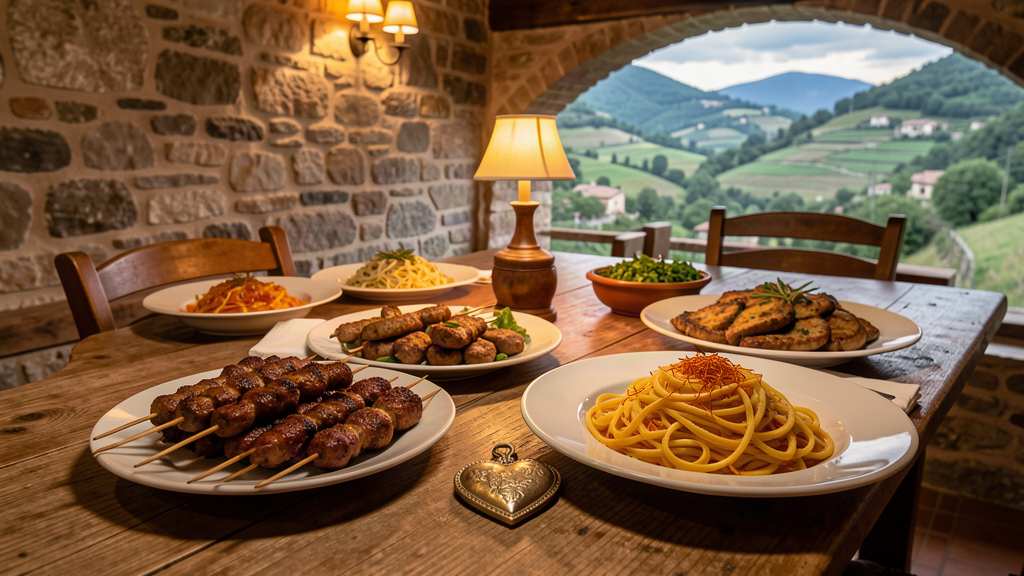
Food that tastes like sheep country
Scanno cooks mountain Abruzzo: pasta alla chitarra, lamb, pecorino, beans, grilled meats, simple contorni. Menus lean on what the valley and the park edges send up. Montepulciano shows up without a speech. Ask what is handmade that day and take the answer.
Trattoria Lo Sgabello
Via Dei Pescatori 45, 67038 Scanno AQ, Italy
A reliable plate of the region: antipasti with local cheeses and cured meat, handmade pasta, grilled courses when you have walked enough stairs. The room fills with people who already know which table they want. Book on weekends and in August.
Ristorante La Porta
Via Ciorla 31, 67038 Scanno AQ, Italy
Handmade pasta from a kitchen that still means it. Abruzzese plates without the tourist-markup attitude. Good when you want a proper sit-down meal a few doors from the old town’s upper lanes. Call ahead in high season; the room is not endless.
Ristorante Gli Archetti
Via Silla 8, 67038 Scanno AQ, Italy
Stone arches, historic-center address, local cooking with a slightly dressed table. Free parking is easier down on Via degli Alpini than in the tight core, so walk up. Useful for a slower dinner after an afternoon of looking at filigree.
Between meals, bars on the main climbs handle espresso and a late bitter. Pecorino and simple sweets travel well if you are hiking into the Parco Nazionale d’Abruzzo, Lazio e Molise the next morning. The lake path wants water and something salty even when the water looks calm.
Places to stay
Sleep in or hard against the centro if you can. Scanno is vertical. A car helps for the lake loop, park trailheads, and the long drives toward Sulmona, Pescasseroli, or the autostrada. Inside the stone maze you will mostly walk and climb.
B&B Albergo Centrale (value, lake road edge)
Viale del Lago 1, 67038 Scanno AQ, Italy
Simple rooms on the approach toward the water, lower rates and easier parking than a pure historic-core address. A short climb puts you in the goldsmith streets. Pick it when the trip splits between lake walks and town hours.
Il Palazzo B&B (mid, eighteenth-century floors)
Via Ciorla 25, 67038 Scanno AQ, Italy
Rooms on the second floor of Palazzo Parente, access from Via Ciorla and the Via Napoli side. Stone underfoot, a host who knows which doors open which days, old town as hallway. Strong middle choice when Scanno is the actual stay rather than a photo stop between Sulmona and the park.
La Dimora di d’Annunzio (higher historic stay, piazza doorstep)
Piazza Santa Maria della Valle 3 / Vico De Angelis 2, 67038 Scanno AQ, Italy
The house where Gabriele d’Annunzio lodged in the 1880s, now a small historic B&B on the church square, steps from the goldsmith lane. Homemade breakfast, parking nearby, rooms like a lived-in townhouse. Spend here when you want the presentosa walk to start at the front door.
A day with the goldsmiths, then the lake
Morning coffee near Santa Maria della Valle, then Via De Angelis while the shops are opening and the light is still kind on the glass. Choose one goldsmith. Look properly. If you buy, buy one thing you will wear, not three that will end up in a drawer.
Late morning for the church and a purposeless climb through covered passages until the roofs open toward the valley. Lunch at Lo Sgabello or La Porta. Early afternoon for the short drop to Lago di Scanno, on foot or a few minutes by car, when you want flat ground after limestone. The lake is beautiful and crowded on summer weekends. Go early or late, then return uphill.
Aperitivo in the centro. Dinner at Gli Archetti if you reserved, or whichever trattoria still has a table. Night is quiet except in festival weeks. Stone holds the day’s warmth. In the morning the filigree will still be in the window, catching whatever light the mountain allows.
With a second day, hinge into park country: hermitage trails, the Sagittario gorges, Villalago, or a longer push toward Pescasseroli if the weather agrees. Sleep again above the lake. Before you leave, walk Via De Angelis once more without buying. The wirework looks different when you already know the weight of a presentosa in your pocket.
