
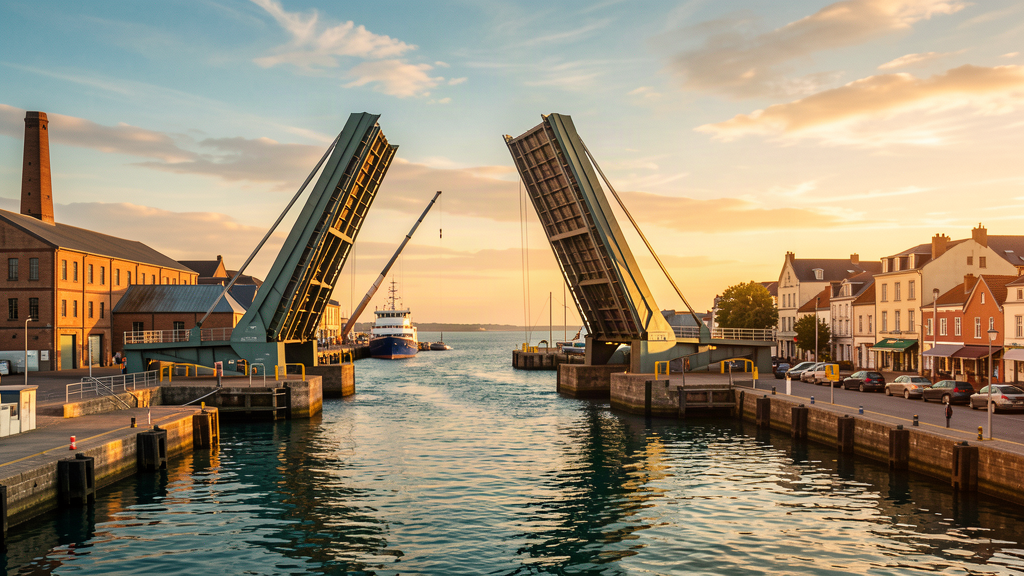
The first time the bascule bridge rose in front of me, I was halfway across with a baguette under one arm. Horn near the lock. A few people stopped without much fuss. Then the roadway tilted up so a workboat could slip through the basin. In Saint-Nazaire this is not a show. It is Tuesday. It is how you get home if you live on the little island still called Petit Maroc, the old seed of the city, stuck between estuary light and the working port.
Most people drive past on the way to La Baule’s beach or Nantes’s bigger squares. I get it. This town rebuilt after wartime ruin and never sanded every corner smooth for postcards. You get a neighborhood that still acts like an island, a concrete U-boat pen used as a cultural roof, shipyard cranes on the skyline, and a habit of waiting while water traffic outranks cars.
Petit Maroc, still half an island
Petit Maroc sits beyond the locks, a pocket of streets that once held the fishing village before the deep-water port and the liners remade everything. Locals still argue gently about the name. One story ties it to Breton sailors on the Morocco runs; another just shrugs and says the place has always felt slightly elsewhere. Either way, when the lift bridge or the lock gates move, the quartier becomes a temporary island again. Windows face water. Gulls own the roofs. You hear engines before you see them.
Walk Avenue de la Vieille Ville and Rue de l’Écluse without a plan. Low houses, workshops, a few cafés that open when shipyard shifts allow. Kids bike in loops while a tug noses past the quay. Stand near the East lock long enough and someone will tell you which vessel is coming through and whether you have five minutes or twenty. That chatter is more useful than any map I carried.
I like Petit Maroc in late afternoon, when the estuary goes metallic and the bascule bridge does its thing again. Tour buses mostly skip this stretch and head for the base. If you only photograph the concrete and leave, you miss the human scale that makes Saint-Nazaire feel lived-in instead of staged.
Under the roof of the base
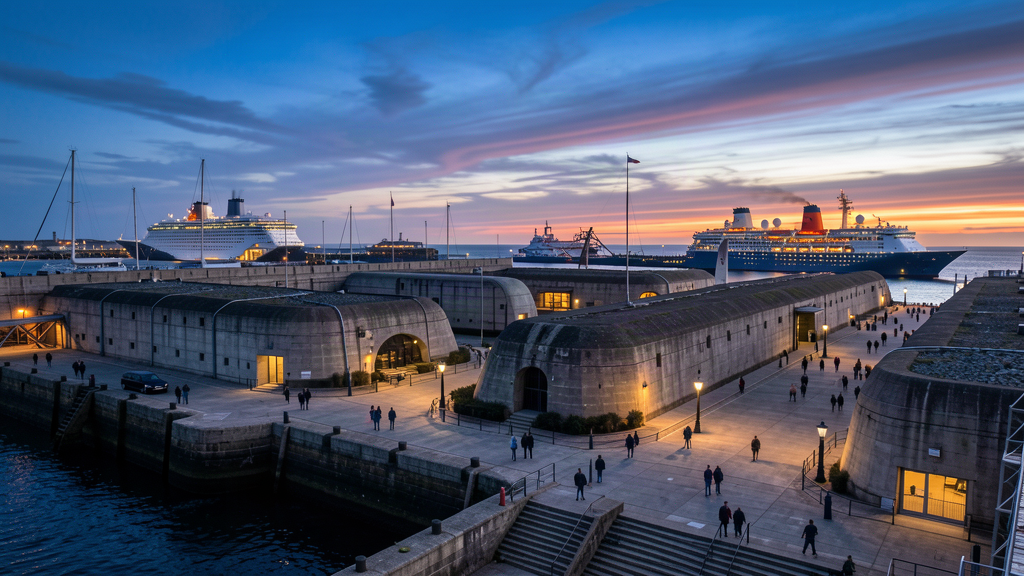
The submarine base is hard to ignore: a gray cliff of wartime engineering on the waterfront, thick enough to shrug off bombs that leveled much of the old center. For years it sat there as an awkward relic. Then the city folded it into the Ville-Port project. Museums, music, exhibitions, and ordinary foot traffic now move through a structure built for secrecy and steel.
Escal’Atlantic sits inside those pens like a memory of another Saint-Nazaire, the one that sent liners toward the Americas and later launched giants like the Queen Mary 2 from the Chantiers de l’Atlantique yards still working nearby. You walk gangways, cabins, and engine-room echoes even if naval history is not your thing. Carpet where there used to be damp concrete. A sense of departure even though you never leave the pen.
Next door, the Espadon, a postwar French submarine you can board, is tighter, colder, more honest about how little room a crew had. Go late when school groups thin out. Corridors force you sideways. Bunks stacked close, a galley the size of a closet, sound dying against metal.
Outside, LiFE and the VIP venues keep the base from freezing into pure museum. Some evenings the same roof that once hid U-boats throws light and bass into the port. Industry and leisure share one waterfront here, and the mix can feel strange in a good way. You do not have to resolve it.
A rebuilt center with softer edges
Bombing erased much of the prewar heart, so the modern center can feel abrupt at first: wide streets, postwar blocks, shopping galleries with names that nod to liners and blue ribbons. Give it a morning. Markets still set up with Atlantic fish and Loire produce. People meet under ordinary awnings. The sea is never far; follow the coast west toward Saint-Marc-sur-Mer and the “city of many beaches” claim starts to hold.
If you want a pocket that escaped the worst destruction, drift along Rue Villebois-Mareuil. Small gardens, ornamental façades, a quiet stretch that almost feels smuggled in from another century. Not a theme street. Just a fragment that survived. Walking it after the base’s concrete mass is a useful reset for the eyes.
Further out, the shipyard cranes are part of daily weather. You may not get inside the Chantiers, but you feel their pull: buses of workers, a skyline that changes when a hull advances, café talk that still measures time in launches and contracts. Ships are still the point. Nothing about that is staged for visitors.
Eating where the locks and the center meet
Food in Saint-Nazaire runs practical more often than precious, which suits a port. Start, if you can, back on the island side.
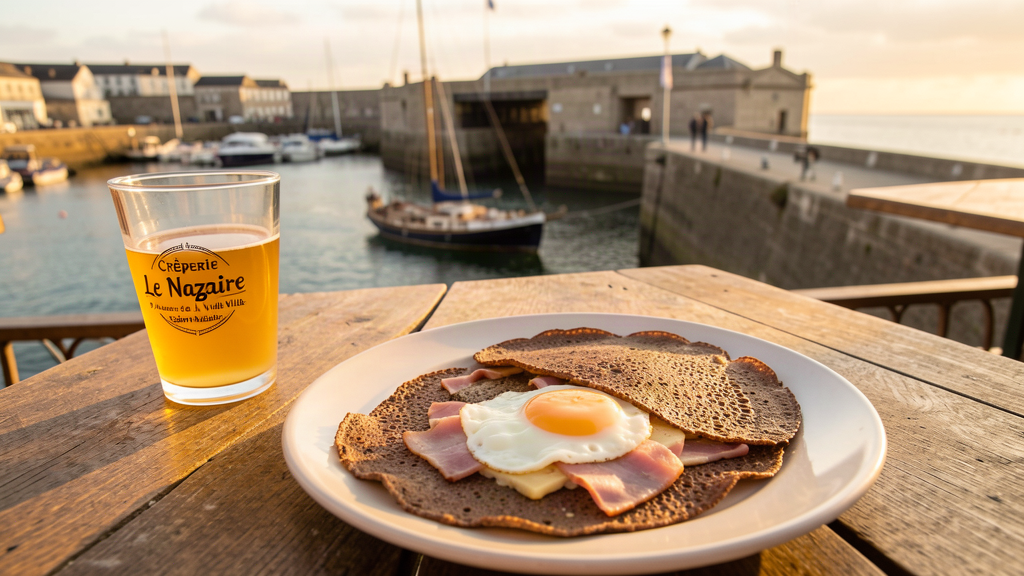
Crêperie Le Nazaire
9 Avenue de la Vieille Ville, 44600 Saint-Nazaire
Buckwheat galettes with IGP flour, crepes that taste homemade rather than tourist-formula, and a room that fills with people who live nearby. Sit if the bridge schedule strands you; nobody rushes the cider. Order something simple and watch the Petit Maroc light change through the window.
Au Bon Accueil
39 Rue François Marceau, 44600 Saint-Nazaire
A traditional French table that takes the market seriously: fish handled cleanly, sauces without drama, a wine list that behaves. Lunch still has a beginning and an end. Come when you want careful cooking without Nantes prices or coastal resort performance.
Brasserie de l’Océanis
1 Rue Michel-Ange, 44600 Saint-Nazaire
Seafood-leaning brasserie energy: oysters when the beds cooperate, mussels, plates that taste of the near Atlantic rather than a freezer truck. Useful after a base visit when you want something straightforward and salty.
Between meals, duck into a corner bar near the station for a demi and half-overheard shipyard talk. Some of the best flavor in town is just that: other people’s conversations.
Places to stay
Pick based on what you want outside the window: cranes, trains, or sand.
Budget-friendly — ibis Styles Saint-Nazaire Centre Gare
2 Boulevard de l’Atlantique, 44600 Saint-Nazaire
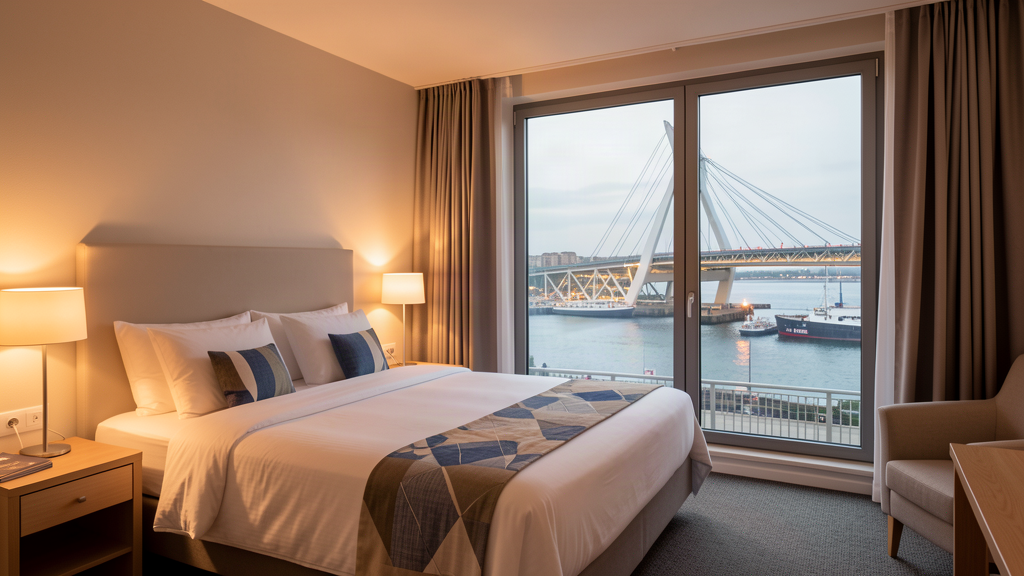
Right by the SNCF station, clean and predictable, easy if you arrive by TGV and plan to walk the center and port. Rooms are compact; the win is location and less car dependence. Good base for an early market run and a full day between Petit Maroc and the base.
Mid-range — Brit Hotel Saint-Nazaire Centre
Place de la Gare, 4 Rue du Commandant l’Herminier, 44600 Saint-Nazaire
Still central, a step up in breathing room, handy for rail travel and evenings in town. Close to the rebuilt shopping spine and a short ride or purposeful walk from the waterfront museums. Useful if you want a proper desk and breakfast that does not feel like an afterthought.
Splurge / sea edge — Best Western Hôtel de la Plage
37 Rue du Commandant Charcot, Saint-Marc-sur-Mer, 44600 Saint-Nazaire
Out in Saint-Marc-sur-Mer, where the beach curves and Jacques Tati once filmed vacation absurdity, this is the stay for salt air and evening walks on wet sand. About ten minutes from the working center, farther in spirit. Book here if your days can end with tide sounds instead of lock horns. Then return to Petit Maroc in the morning when the bridge starts its rounds again.
Getting around without turning it into a project
The train station anchors the new town; from there, buses and bikes cover a surprising amount. Petit Maroc rewards walking, with the caveat that a raised bridge rewrites your timetable. The base complex is compact once you are on site. For Saint-Marc and the western beaches, bus or car saves frustration.
If you drive, port parking fills when a big show lands at the base. Leave extra time and treat bridge delays as part of the visit. Bring a layer even in summer. Estuary wind does not care about the forecast.
A slower way through
Spend one morning on Petit Maroc with no museum ticket in your pocket. Wait for the lift bridge on purpose. Talk to whoever is also waiting. Eat a galette. Then walk into the base while your eyes still hold ordinary domestic scale, so the concrete feels like a chapter rather than the whole book. Late day, ride or drive to Saint-Marc for a swim or a long look at the horizon liners once aimed for.
Saint-Nazaire does not do cobblestone perfection. Locks open, cranes swing, bascule spans rise, crews change shift. The city rebuilt and kept working. Stand on Rue de l’Écluse when the roadway goes up, bread still warm, and you get the place without needing a brochure. Water first. Street second. People who know how to wait for both.
