
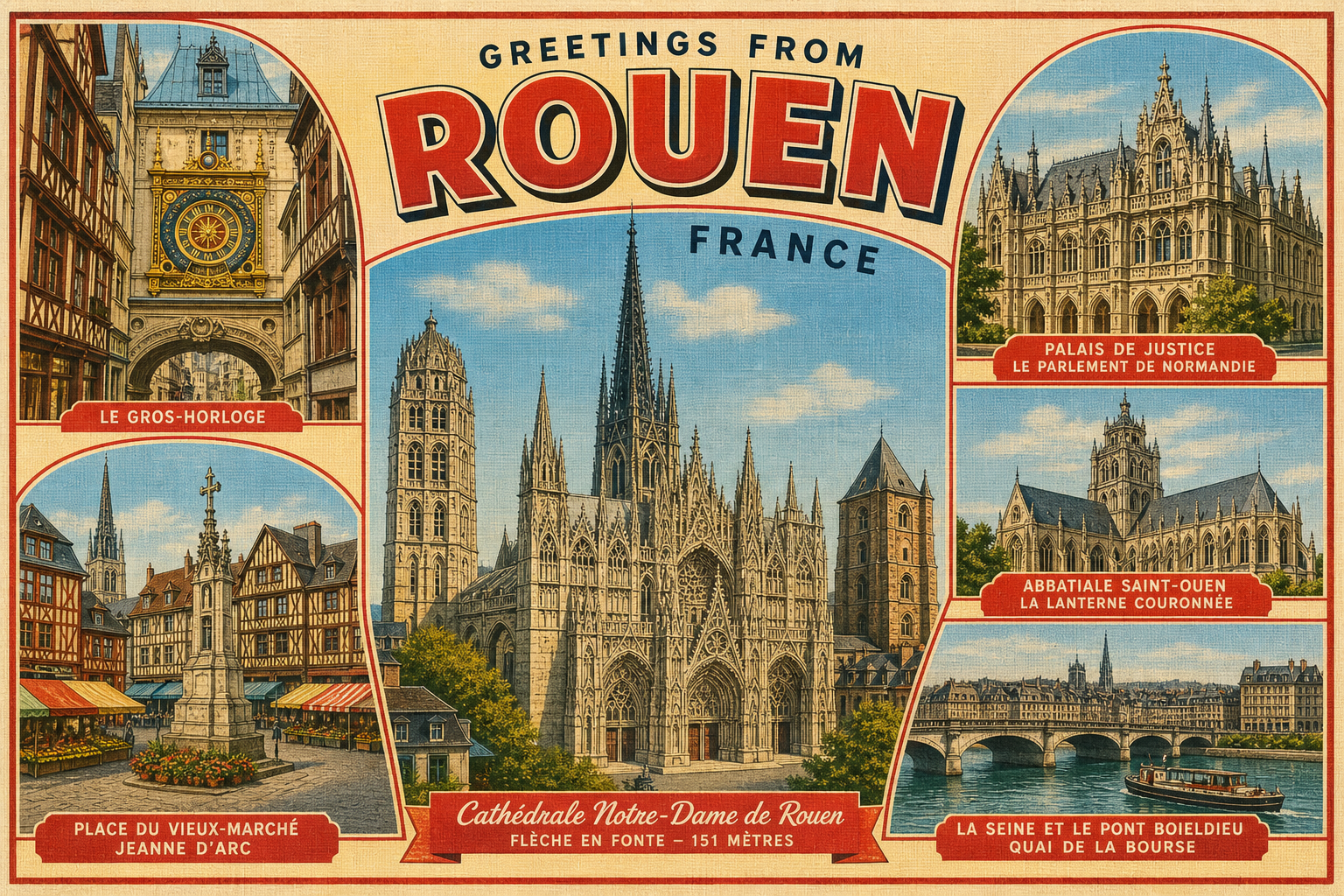
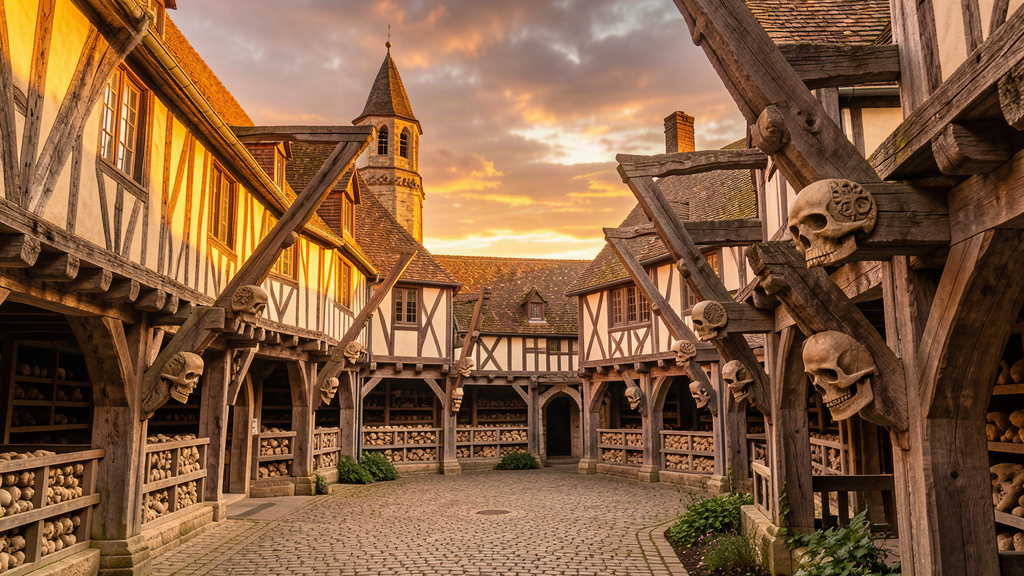
I did not start at the cathedral square. I cut east of the spires, past the flamboyant stone lace of Saint-Maclou, and pushed open the gate into the Aître Saint-Maclou. A square courtyard. Half-timber galleries on four sides. Carved skulls, bones, and gravediggers’ tools in the wood above your head. The street noise thinned. A couple of students crossed with sketchbooks. For a minute Rouen stopped being a checklist of Gothic facades and felt like a quieter room the city still keeps for itself.
That is the cut I came for. Rouen sits on a bend of the Seine in Seine-Maritime, about an hour from Paris by train when the schedule behaves. Old capital of Normandy, more steeples than any brochure needs. Most visitors lock onto Notre-Dame, Monet’s canvases, and Joan of Arc on Place du Vieux-Marché. Fair enough. What held me longer was the stuff between those stops: a plague-era burial court under carved beams, a mill-stream street that still smells of damp stone, market bags swinging past half-timber that never made the postcard rack.
The courtyard that still holds its dead
The Aître Saint-Maclou began as a parish burial ground in the fourteenth century, when plague forced the city to make room for the dead in a hurry. Later centuries wrapped the yard in timber galleries that once held ossuary remains upstairs. The carvings are not subtle. Skulls. Crossbones. Spades. A danse macabre mood cut into oak, then left to weather. You do not need a long audio guide. Stand in the middle. Look up. Notice how ordinary the light is on the cobbles while the beams keep their hard subject matter.
I went early, before tour groups found the door. It is a restored heritage site now, open and cared for, but it still reads as urban memory rather than a stage set. Sit on a bench if one is free. Let the courtyard reset your pace before you rejoin the shopping streets. When you leave, turn once at the gate. Death carved in wood on one side, bakery bags and bike bells on the other. Rouen holds both without apology.
Cathedral light without the coach choreography
Notre-Dame de Rouen will pull you eventually, and it should. The west front is a pile of vertical stone that never quite settles into one reading. The Tour de Beurre rises fat and pale. Inside, the nave runs long and cool. Monet painted the facade in shifting weather until the building went almost abstract; standing in front of it on a grey Norman morning, you understand why he stayed with the problem.
I try not to arrive at noon with every day-tripper off the Paris train. Late afternoon softens the stone. Early weekday mornings empty the square enough that you can hear shoes on the pavement. Walk the north side streets after, where the cathedral’s bulk becomes a neighbor instead of a monument. Rue Saint-Romain runs like a half-timber canyon. Laundry still appears in upper windows. A bookshop door sticks. This is the Rouen that continues when the facade selfies end.
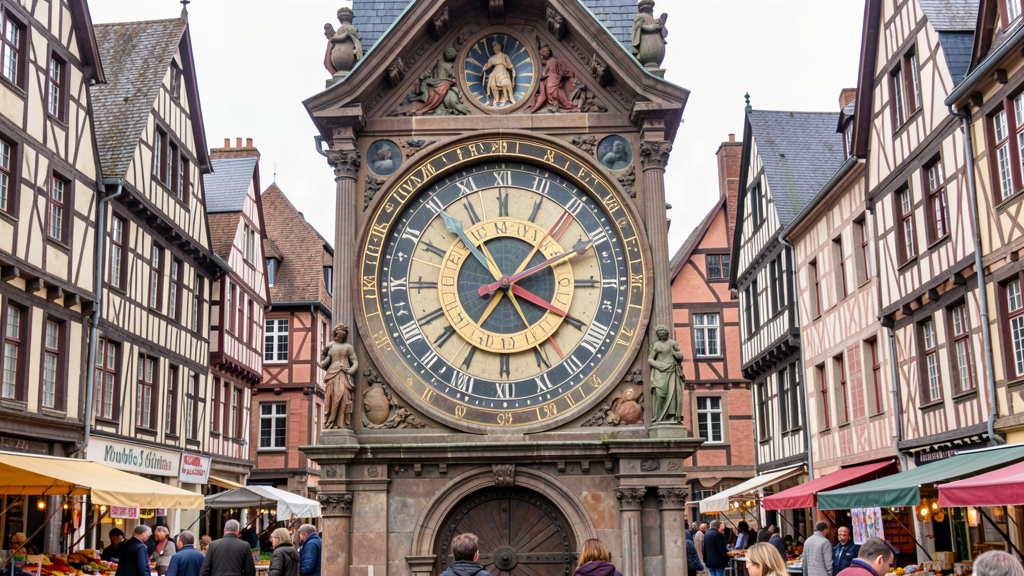
The Gros-Horloge is the other magnet: a Renaissance clock straddling a pedestrian arch on one of France’s early car-free streets. Walk under it once for the postcard, then again without looking up, just to feel how the street funnels people between market and cathedral. Use the arch as a hinge between neighborhoods. You do not need to make a ceremony of it.
Rue Eau-de-Robec and the wet edge of the old town
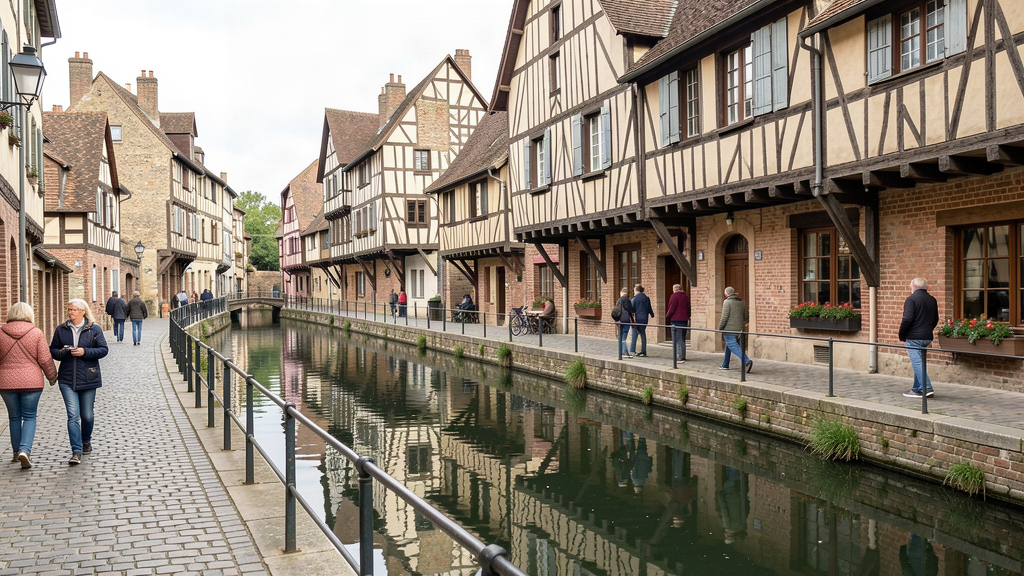
East of the cathedral core, Rue Eau-de-Robec follows the line of a covered stream that once powered mills and workshops. Water still threads the street in places. Facades lean in with the usual Norman timber geometry. Antiques, small museums, and ordinary shops mix without anyone trying too hard to theme it. On a quiet stretch you hear the water before you see it.
I walked it in light rain, paving slick and timber darker. A delivery scooter took a tight turn. Someone carried flowers in brown paper. If the cathedral square is the public face, Robec feels like a side room still in daily use. Duck into cross streets when a window pulls you. You do not need to exhaust the lane. One water-edged street is enough to pull old Rouen off the main steeple shot.
Seine air and the market square
The Seine is wide here, industrial in stretches, lined with bridges and working edges rather than a tidy promenade. Cross toward the left bank when you want sky and a longer view back to the spires. I like the quais in early evening, when commuters replace tour circuits and the light goes flat and silver. Normandy wind comes up the river. Dress for it. Grab a simple coffee and watch a real regional city move.
Place du Vieux-Marché carries heavy history: Joan of Arc was executed here in 1431. The modern Église Sainte-Jeanne-d’Arc anchors the square with a sculptural roof that divides opinion. Around it, half-timber restaurants and the daily market keep the space in ordinary use. Produce, cheese, fish when the stalls are on. I prefer market hours to pure memorial mood. Buy fruit you will actually eat. The history is under your feet either way. When the stalls thin, notice which terraces fill with French conversation and which wait for menus in four languages. Pick the ones that sound like lunch, not a show.
Places to stay
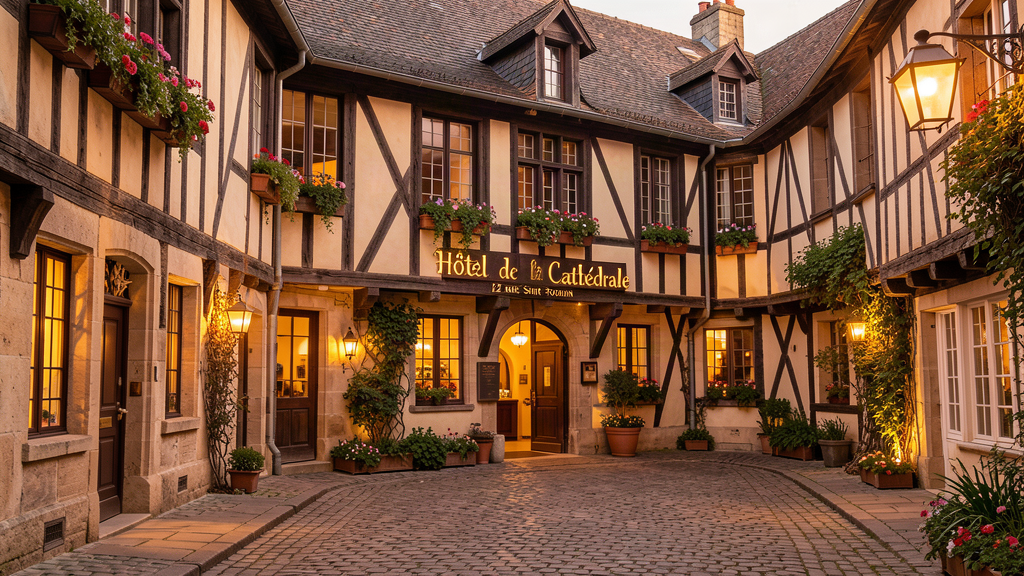
Courtyard calm by the cathedral — Hôtel de la Cathédrale
12 rue Saint-Romain, 76000 Rouen
A long-running smaller hotel in a half-timber pocket where you walk straight into the stone lanes. Rooms vary; courtyard-facing ones are the prize after a day of street echo. Not fancy. Practical character if you care more about location than spa gloss. Stairs and older bones come with the address.
Boutique mid-range near the clock streets — Hôtel Paulette
12-14 rue de la Champmeslé, 76000 Rouen
Renovated rooms with a clearer decorative hand, still inside the walkable center near Gros-Horloge and the cathedral. Modern comfort without drifting to a river chain. Double glazing helps on livelier nights. Easy on foot to both the market square and the Robec side.
Historic heavyweight — Hôtel de Bourgtheroulde, Autograph Collection
15 place de la Pucelle, 76000 Rouen
A sixteenth-century town palace turned five-star stay, courtyard and all, a short walk from Place du Vieux-Marché. You pay for stone, service, and a building that had a life before key cards. Good for a one-night treat, or if you want quiet luxury between museum hours. Step outside, and you are still in the old street pattern.
Where to eat
Dame Cakes
70 rue Saint-Romain, 76000 Rouen
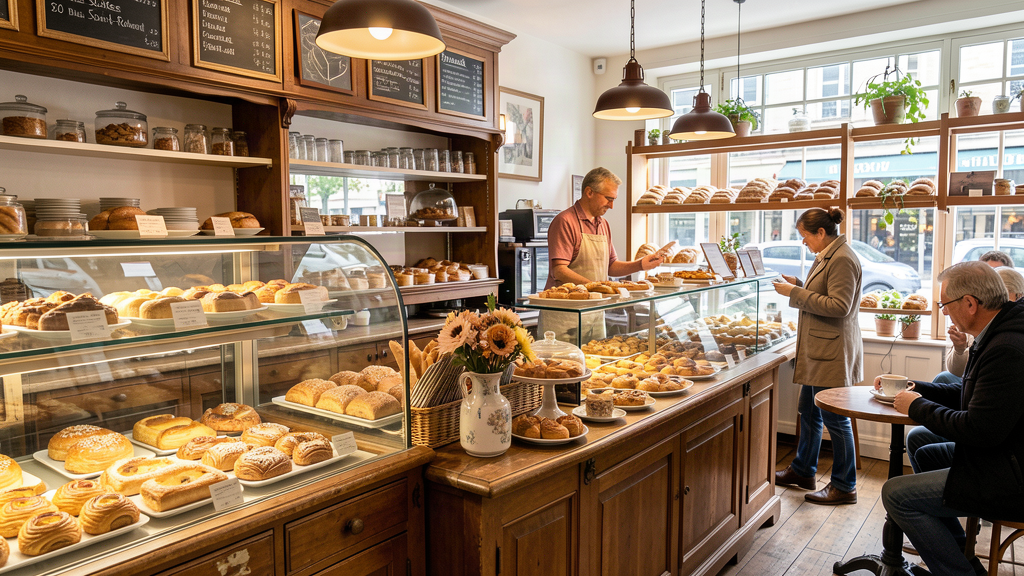
A refined tearoom and light-lunch stop on one of the best walking streets in town. Pastries, savory plates, a calmer room when your feet are done with stone. I come between the cathedral and Aître, not for a grand dinner. Better tarts than you need. A proper pause that still feels local.
Le Bistrot d’Arthur
27 rue Cauchoise, 76000 Rouen
Traditional plates, warm room, bistro rhythm where butter and sauce still mean something. A few minutes from the market square without the square’s full tourist blast. Book when you can. Order something Norman without forcing apple-and-cream into every course.
La Marmite
3 rue de Florence, 76000 Rouen
A quieter gourmet address near Place du Vieux-Marché when you want a proper dinner without a pageant terrace. Seasonal cooking, attentive service, a room that stays steady rather than loud. Come when you have the evening free.
For a special-occasion swing, Gilles Tournadre’s Restaurant Gill still anchors high cooking here; book ahead. For everyday fuel, follow office workers at lunch and trust the shorter French-only slate.
A day that keeps the beams in mind
One full day works off an early Paris train. Two nights are better if you want museums and a slow Robec morning.
Start at the Aître Saint-Maclou when it opens, while the courtyard is still mostly yours. Walk the Saint-Maclou flanks, then drift toward the cathedral late morning. Lunch off the main square if the terraces look like a waiting room. Afternoon on Rue Eau-de-Robec, or into the Musée des Beaux-Arts if rain settles in. Early evening toward the Seine for air. Dinner at Arthur or La Marmite. Night walk back under the Gros-Horloge when the shops are shut, and the timber goes dark.
Summer stacks day-trip density around the cathedral and the clock. Shoulder seasons give you back the courtyards. Winter is honest: wet stone, early lamps, fewer people in the Aître, which may be when the carvings hit hardest.
I left Rouen with damp shoe edges from Robec and the Aître’s skulls still stuck behind my eyes. The cathedral is what the world already knows. The burial court is what the city keeps in plain sight without raising its voice. Same bend of the Seine. The market bags keep swinging either way.
