
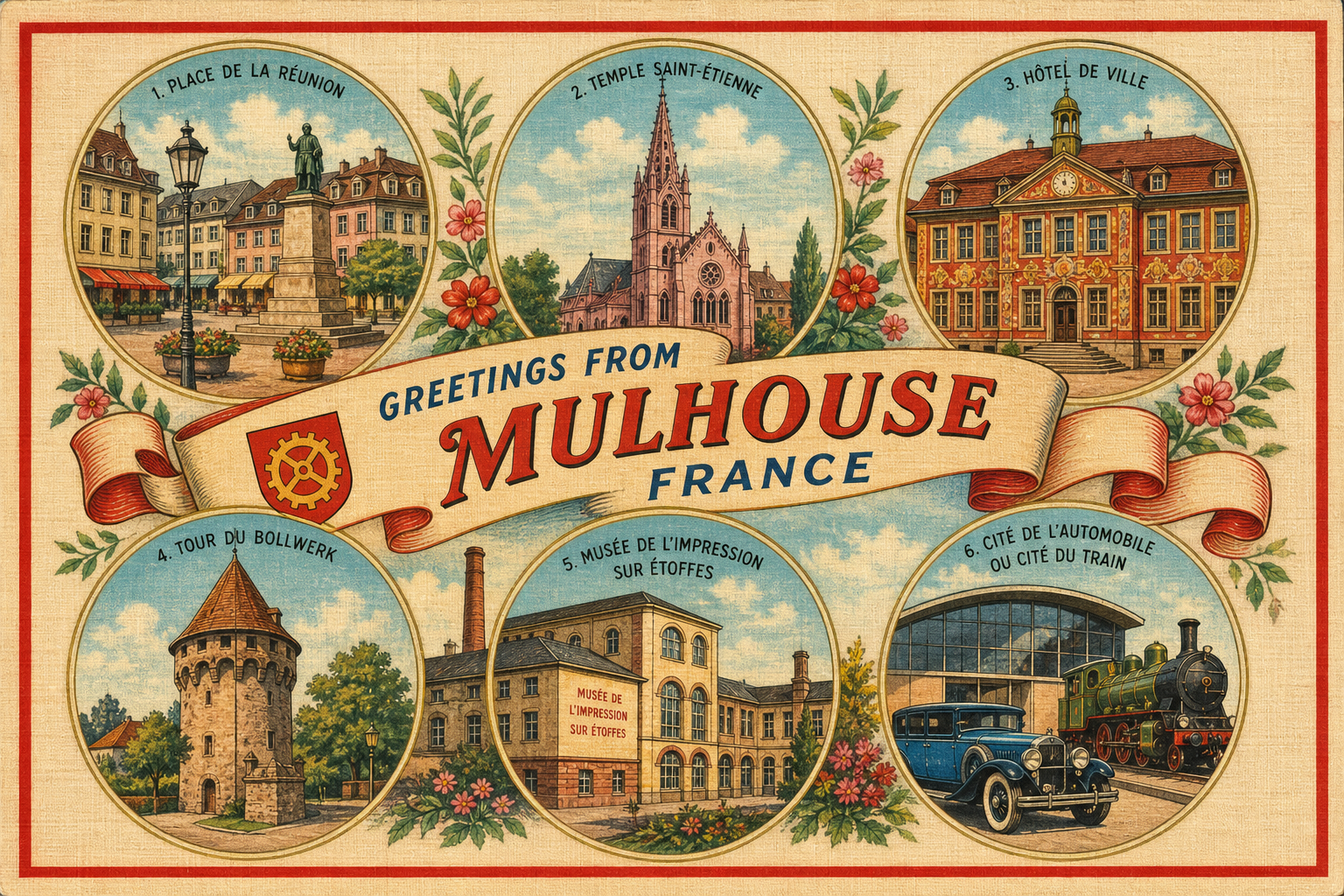
Most people who pass through southern Alsace aim for Colmar’s canals or Basel’s border polish. Mulhouse sits between them with a different job description: a working city that made its money in cloth, machines, and rail, and still wears that history without staging it too hard. I like it best when I stop treating it as a layover and start with printed fabric.
The Musée de l’Impression sur Étoffes is rooms of pattern, dye, and industrial patience — not a pretty-object museum in the postcard sense. On a quiet afternoon the light falls across sample books like old ledgers: practical, dense, a little obsessive. Outside, trams and lunch crowds move around a pink-sandstone square that empties and fills again. That combination is what keeps me here.
A city that printed its way forward
Mulhouse grew rich on textiles. You feel it before you memorize the dates — shop façades, factory edges, locals talking about “the museums” as ordinary civic furniture. The Musée de l’Impression sur Étoffes at 14 Rue Jean-Jacques Henner holds millions of cloth samples and the tools of a trade that once employed whole streets. Go when you have time to slow down.
I walk the rooms looking for repeats that still show up in market bags and kitchen curtains. Some patterns look almost modern. Others are pure 19th-century appetite: roses, geometry, borders that would exhaust a contemporary designer. Closed Monday and Tuesday in the usual local way; afternoons are the reliable window. Get a slow coffee nearby instead of stacking three more museums out of guilt.
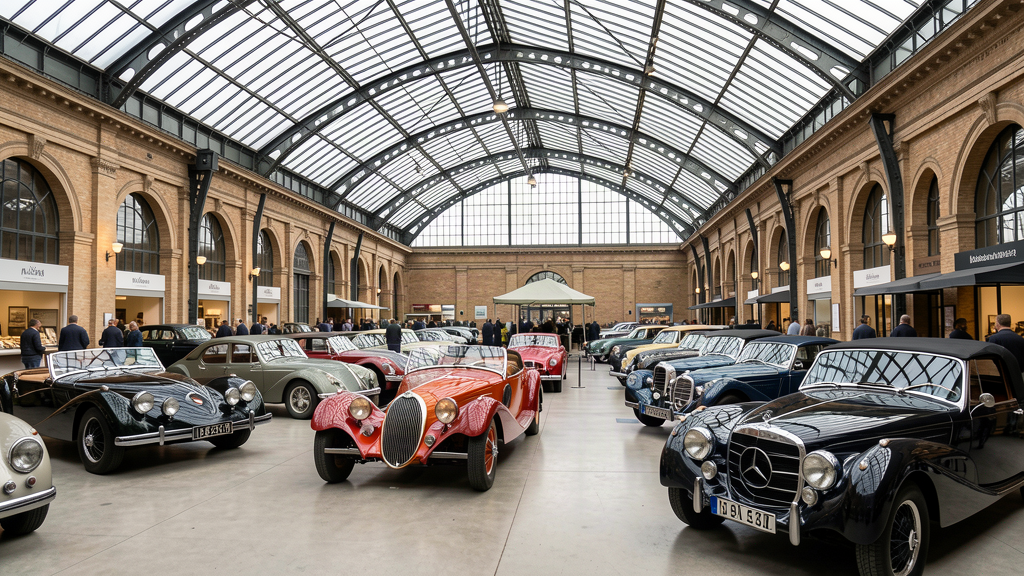
If you want machines after cloth, Mulhouse will oblige. Cité de l’Automobile and Cité du Train sit farther out and can swallow half a day each — excellent, and a bit much if you try both. For a first visit, I keep those campuses optional and stay closer to the center, the Rebberg, and the canal market.
Place de la Réunion without the hurry
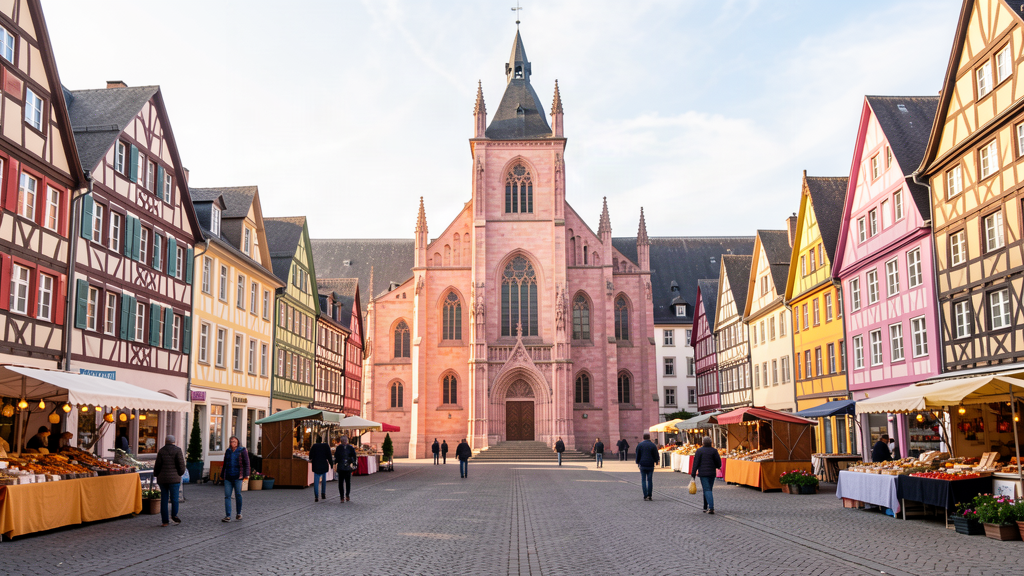
The historic core gathers around Place de la Réunion. The Hôtel de Ville’s painted façade and the tall Temple Saint-Étienne give the square height you notice from side streets before you fully arrive. Midday can feel transactional — errands, scooters, someone arguing gently about parking. Early evening softens it. Pink sandstone picks up whatever light the sky is offering. Stay longer than you planned.
The lanes off the place are short and useful: bakeries, pharmacies, shops that have not chased trends. This is not half-timbered storybook Alsace. It is denser, more 19th-century municipal pride mixed with older bones. Duck a block when a tour group clumps for a photo, then come back. Treat the square as a hinge between walks, not the main event.
From here the center is walkable in a loose star. Streets toward the station keep a commercial pulse. Toward the old Franciscan side, things tighten into quieter façades and dinner addresses. You do not need a clever route — just comfortable shoes and a willingness to turn around when a street goes dull.
Up the Rebberg for air and villas
When the center starts to feel flat in the literal sense, climb the Rebberg. The hill south of downtown holds villas, garden edges, and residential calm that makes the city feel larger than its tourist map. Locals talk about the Belvédère the way other towns talk about a favorite overlook: not secret, just the place you take visitors when you want them to understand the layout.
Walk up if your knees allow it. The grade shows how Mulhouse stacks green space above the industrial floor. Views open toward the plain and, on clearer days, the suggestion of the Vosges. The Parc Zoologique et Botanique is nearby if you want structured green time; I am happier on an unscripted villa street with a bakery bag.
Even if you eat downtown, walk the hill once. It shifts Mulhouse from a museum stop off the autoroute to a place people live above the tram lines.
Food worth sitting down for
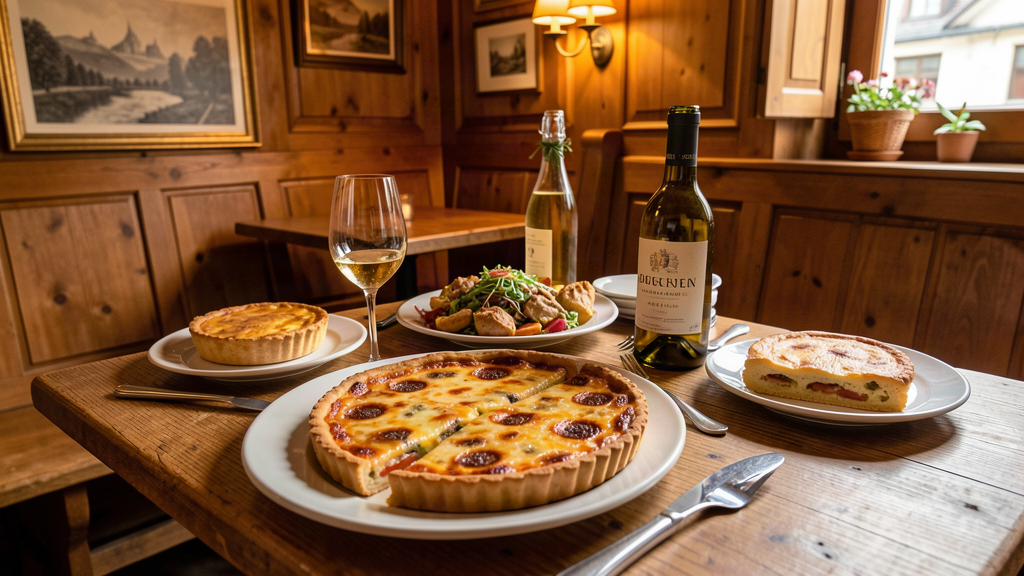
Alsace cooking shows up here with less costume than in the postcard towns. You still get choucroute, flammekueche, and enough pork to require a walk afterward — plus kitchens that cook for office workers and Saturday families rather than pure theater.
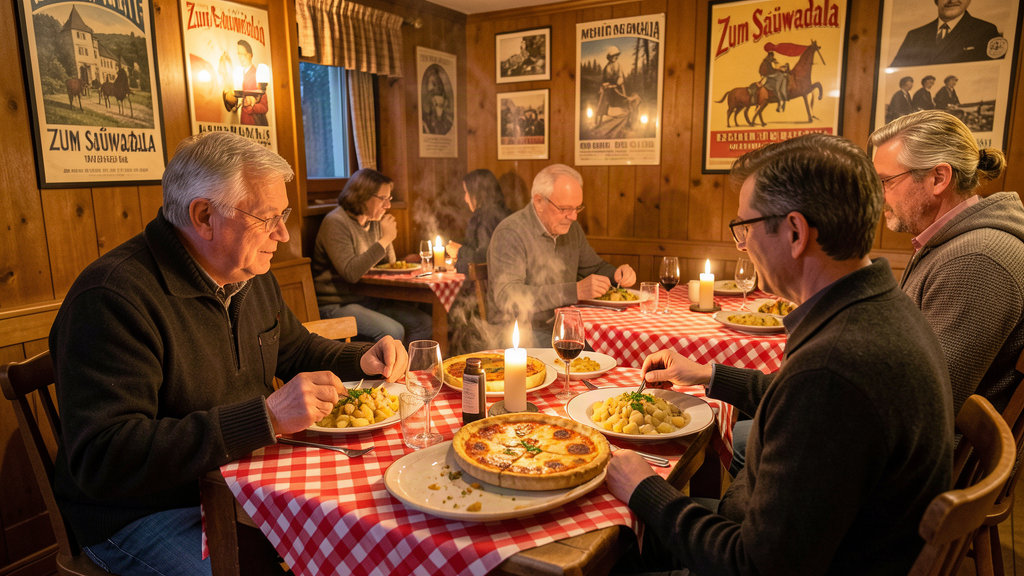
Zum Saüwadala
13 Rue de l’Arsenal, 68100 Mulhouse
A straightforward Alsatian room near the center. Order without overthinking: tarte flambée to share, choucroute if the weather has any chill, a pichet of local white. Busy in a local way at peak times — come early or book.
Chez Auguste
11 Rue Poincaré, 68100 Mulhouse
Closer to a polished neighborhood cantine than a heavy regional stage set. French bistro with care: cleaner lines, seasonal specials, a room that works for a longer lunch. Good when you want Mulhouse without another platter of garnishes.
Il Cortile
11 Rue des Franciscains, 68100 Mulhouse
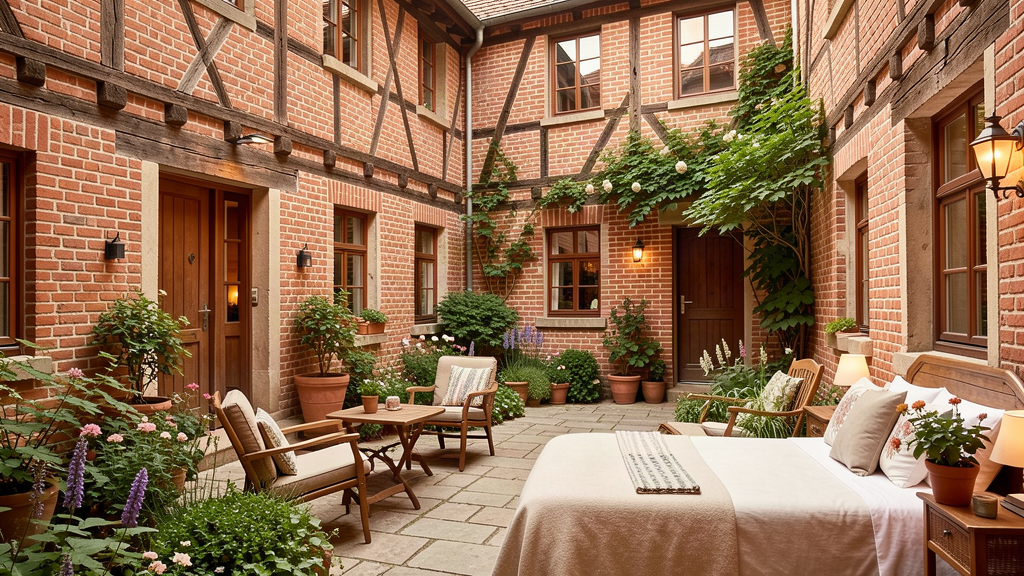
For a night after sandstone and sample books when you want a kitchen with more range. Mediterranean lean, Italian accent, a courtyard that matters in warm months. A splurge relative to winstub logic — book ahead. Order less if the walking day already ran long.
Between sit-down meals, do what Mulhousiens do: the Marché du Canal Couvert on Tuesday, Thursday, or Saturday morning around 26 Quai de la Cloche / Avenue Aristide Briand. Big market, more grocery than souvenir. Cheese, produce, roast chickens, conversations you only half catch. Buy what fits on a bench. A market morning and a museum afternoon usually beats three ticketed halls in a row.
Places to stay
Three price bands, all workable if you use the tram.
Budget — Kyriad Mulhouse Centre
15 Rue Lambert, 68100 Mulhouse
Simple chain comfort a short walk from the old center and the Arsenal streets. Clean bed, walk to dinner, no car required. Fine if the room is mostly shower-and-sleep.
Mid — Hôtel du Parc – Centre Ville
26 Rue de la Sinne, 68100 Mulhouse
More breathing room than pure budget, still a practical city hotel. Easy base for Place de la Réunion loops and evening meals. Ask for a quieter room if you are a light sleeper.
Treat — Hôtel Bristol
18 Avenue de Colmar, 68100 Mulhouse
Full-service near Porte Jeune: easier logistics with luggage, a proper desk, restaurant downstairs on a tired night. Walk or tram to the historic core. Competent more than boutique, and a location that makes museum days less fiddly.
A simple two-day rhythm
Day one. Late morning at the Musée de l’Impression while your eyes are fresh. Lunch near the center — Chez Auguste if you can get a table. Afternoon on Place de la Réunion and the lanes around it. Early evening toward the Rebberg for air and a view. Dinner near Rue de l’Arsenal, or Il Cortile if this is the splurge night.
Day two. Canal Couvert market if the day matches (Tue/Thu/Sat). Coffee and fruit. Then one large technical museum only if you genuinely care about cars or trains; otherwise the historical museum on the square, a slow Rebberg loop, or a short hop toward village Alsace. Leave room for a second pass through a street you liked yesterday.
With a third half-day, wine villages and the Vosges beat another indoor ticket. Once you know the center, Mulhouse works well as a hub.
Getting around without fuss
Gare de Mulhouse is a real junction: TGV links, Basel close enough to feel, trams outside. Station to Place de la Réunion is walkable with light bags, or one short tram hop with a heavy suitcase. Center streets walk easily; the Rebberg is the main grade. A car helps for Cité de l’Automobile and village detours, and gets in the way if you only stay downtown.
French is the daily language; German and Alsatian edges show up in shops. English works in hotels and some restaurants and thins in market queues. Mornings belong to bakeries and the market. Many small restaurants close hard between lunch and dinner — plan or go hungry at 3 p.m.
Practical notes
Mulhouse sits in Haut-Rhin, Grand Est, near the Swiss border and the soft start of the Vosges. Pack a layer even in summer. December brings markets and damp cold. Shoulder seasons are kinder for museum rooms. August can thin some kitchens, though a city this size rarely leaves you without options if you eat a little earlier.
I keep coming back to those pattern books more than to any single façade. Fabric is the civic story here, and the museum makes Mulhouse specific. Colmar has the water; Strasbourg has the cathedral skyline. Mulhouse has cloth, machines, a pink square, and villas above the tram lines. Give it two nights if you can. One night turns it into a stop between trains. With two, there is time for the Canal Couvert before noon, coffee after the dye vats, and a walk up the Rebberg when the center has already said what it needed to say.
