
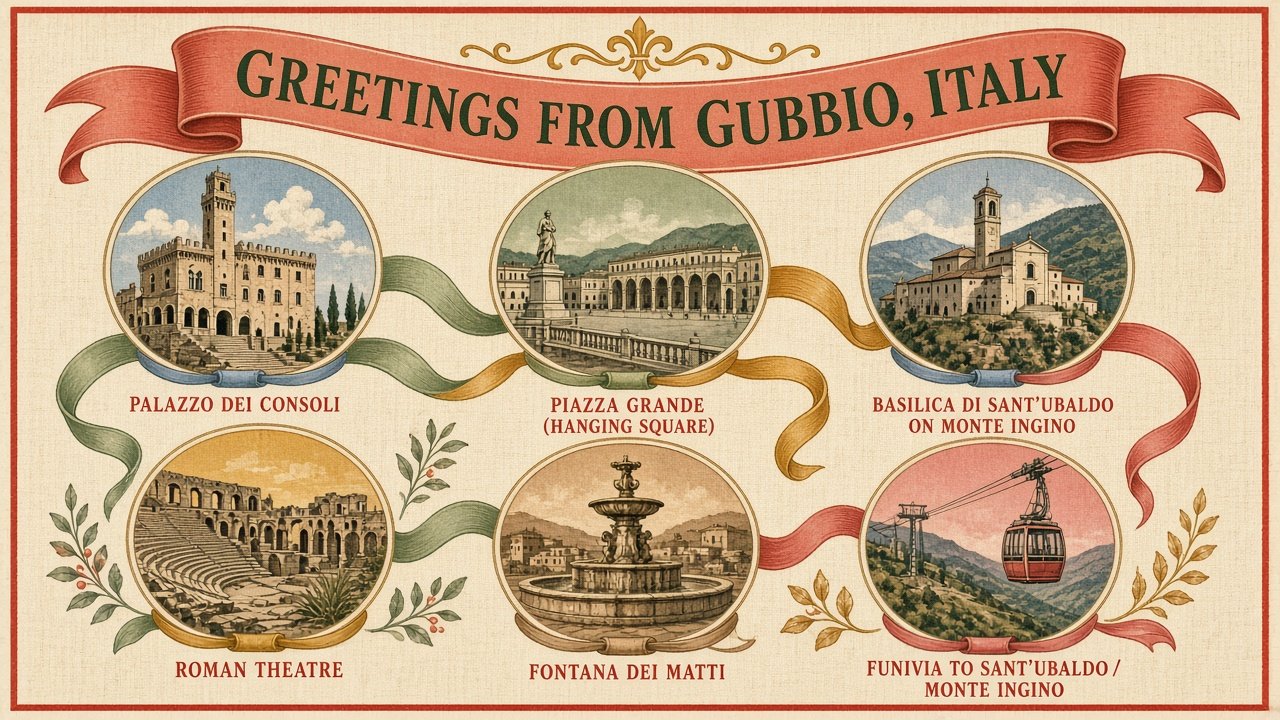
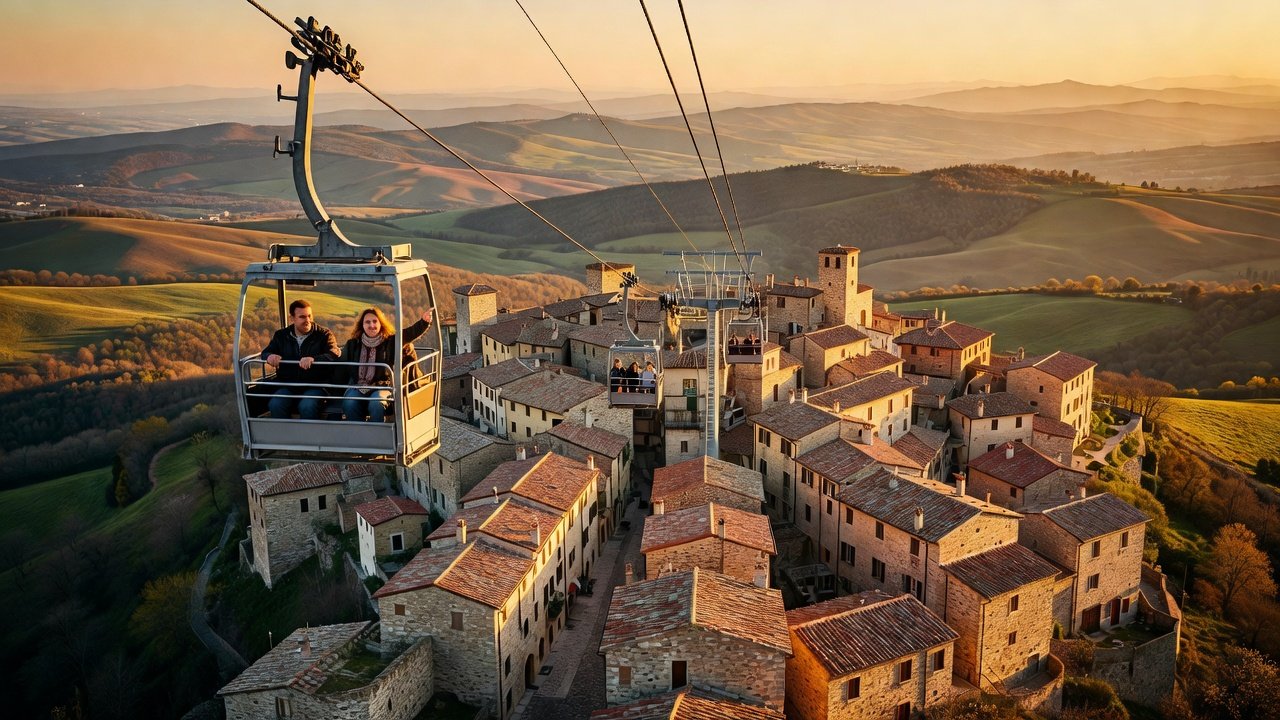
Gubbio stacks itself against Monte Ingino in gray limestone that never quite runs out. The streets climb in steps. Roofs pitch the same way. From the plain you see the whole ridge town at once, then you lose it the moment you enter the first lane and the walls close in.
I came for the funivia more than the postcard piazza. Not the sleek glass cabin kind. Open metal cages. You stand. The cable jerks. The valley drops away under your shoes and the town shrinks into towers and hanging stone.
Gray stairs and the hanging square
Start lower than the tourist photos suggest. The Roman theatre sits outside the tight medieval core, open to grass and sky — Gubbio was already old when these alleys were still being argued into shape. Walk up from there and the town tightens: arches, dark doorways, ceramics in cream and cobalt.
Piazza Grande is the pause. It is a hanging square, a platform between buildings rather than a hole cut for parking. Palazzo dei Consoli rises on one side in pale stone, tall enough that your neck notices. The view spills the other way over roofs toward the plain. Locals cut across with shopping bags. Someone rolls a suitcase over uneven flagstones and winces. Sit on the edge if the wind allows. The square works better when you treat it like a living room, not a stop on a list.
Via dei Consoli runs like a stone throat through the older fabric. It is not charming in the soft Tuscan sense. Gubbio is harder: colder color, steeper grade, less performance. You hear your own footsteps. You smell woodsmoke when the season turns. Ceramic workshops still show plates and pitchers without turning the whole street into a gift mall.
If you want quiet, climb side lanes toward the Duomo and the ducal palace rather than looping the same three shopfronts. Morning beats late-morning buses. Evening beats both, when the stone holds residual heat and the cages on the mountain stop for the night.
Open cages up Monte Ingino
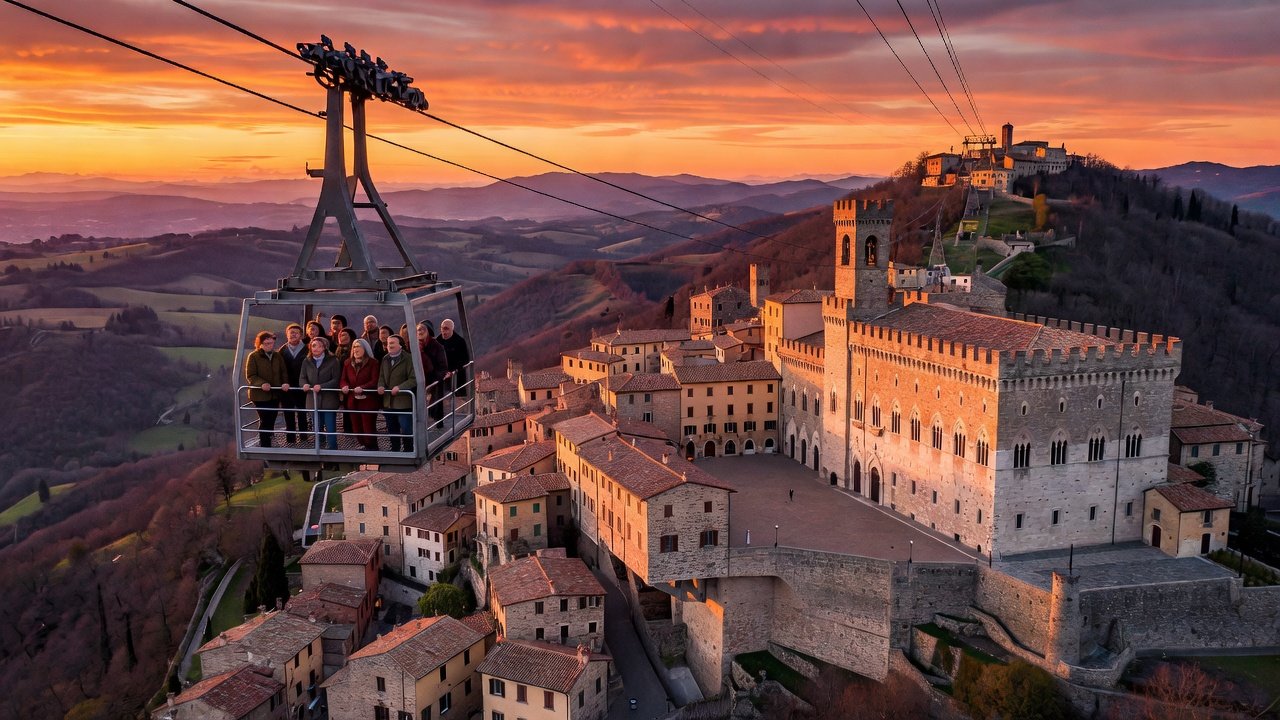
The Funivia Colle Eletto leaves from Via San Girolamo. You buy a ticket, step into a small open cage with whoever else fits, and stand while the cable pulls you up Monte Ingino toward the Basilica di Sant'Ubaldo. It is short. It feels longer the first time the ground falls away and there is nothing between you and the drop but painted metal and habit.
Sant'Ubaldo keeps the town's patron and, more dramatically, the three tall wooden ceri tied to the May race. Even outside festival week the basilica feels like a working shrine rather than a museum wing. People come up to look, to light something, to eat a sandwich on a wall with the Appennine ridges laid out below. On a clear day the plain is a dull green quilt. On a hazy day Gubbio itself is the only sharp thing.
You can walk down if knees and weather agree. Walking up is a different sport. I prefer the cage one way and feet the other when the trail is dry. Check funivia hours before you build a day around them; mountain machinery keeps its own calendar.
May 15 is another country. The Corsa dei Ceri sends teams racing huge wooden ceri through the streets and toward the mountain in a blur of color, shoulder, and noise. If you come for it, book months ahead and accept crowds as the cost of watching the town at full volume. Any other week you get the gray stone, the emptier square, and the cable humming overhead without the crush.
Truffles, crescia, and plates that stay local
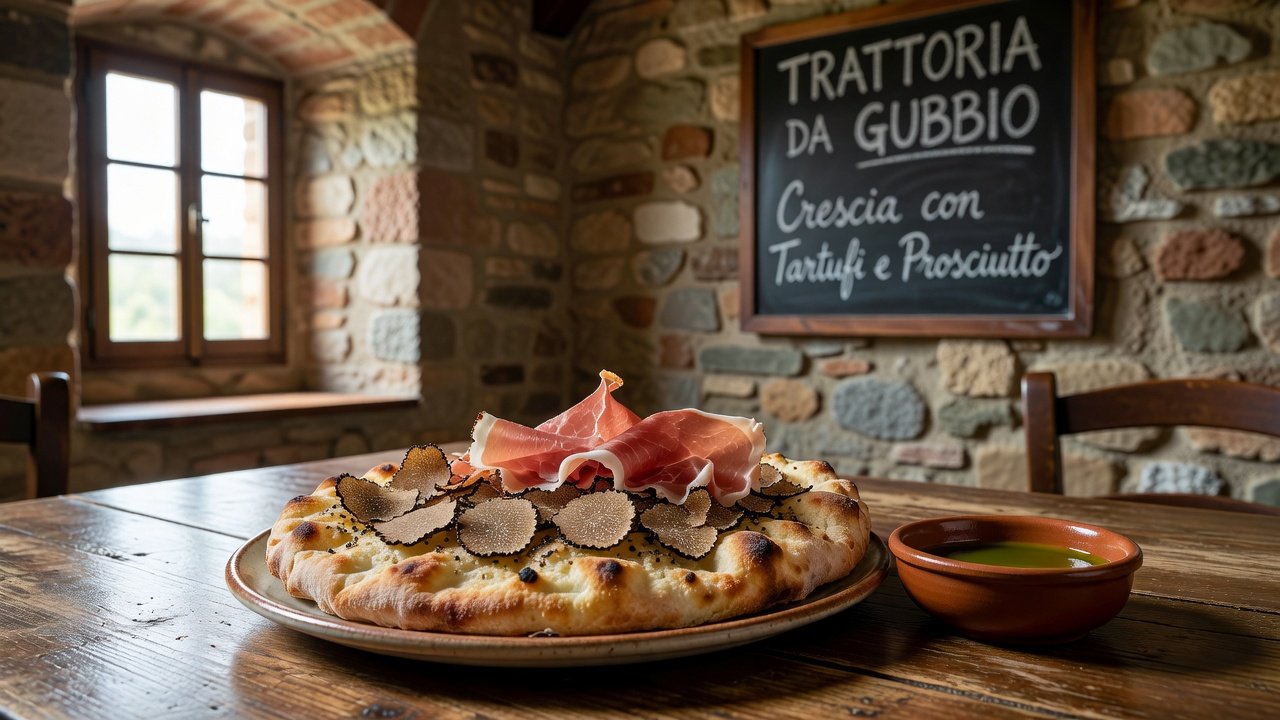
Umbria feeds you from the woods and the farm more than from the coast. Around Gubbio that means black truffle when the season says so, game, lentils, pecorino, thick soups, and crescia — the local flatbread that shows up stuffed or beside cured meats like it has always belonged on the table. Regional reds pour without needing a lecture. Ask what is in season and stop performing knowledge you do not have.
Meals here can feel a little serious without going stiff. Stone rooms. Cloth washed a thousand times. A server who would rather you order one good pasta than photograph five.
La Cresciamia Via Cavour 23, 06024 Gubbio PG, Italy
Crescia is the house language: filled, shared, eaten with your hands a little more than etiquette class prefers. Taglieri of salumi and cheese, brustengo when it is on, simple plates that taste like someone in the kitchen actually lives here. Good for a midday stop when a full white-tablecloth lunch would slow the climb. Go early or expect a wait when weather pulls everyone indoors.
Taverna del Lupo Via Giovanni Ansidei 6, 06024 Gubbio PG, Italy
The classic name in town, wolf legend and all. Frescoed rooms, Umbrian cooking with truffle when the woods cooperate, a pace that suits a long dinner after the funivia. Book for dinner, especially weekends and any week that smells like festival. Everyone already knows it. Still worth the reservation if you want the plate to match the stone outside.
Ristorante dei Consoli Via dei Consoli 59, 06024 Gubbio PG, Italy
Tied to the hotel of the same name on the old street that feeds the hanging square. Useful when you want dinner without a scavenger hunt: regional pastas, grilled meats, local bottles, a room that understands tired walkers. I like it after a late descent from Ingino when cooking a plan feels like too much ambition.
Between meals, stand at a bar for espresso and whatever savory square is under the glass. If a shop is weighing tartufo or selling a small jar of sauce that does not look designed for airport luggage, buy that before another ceramic bell.
Places to stay
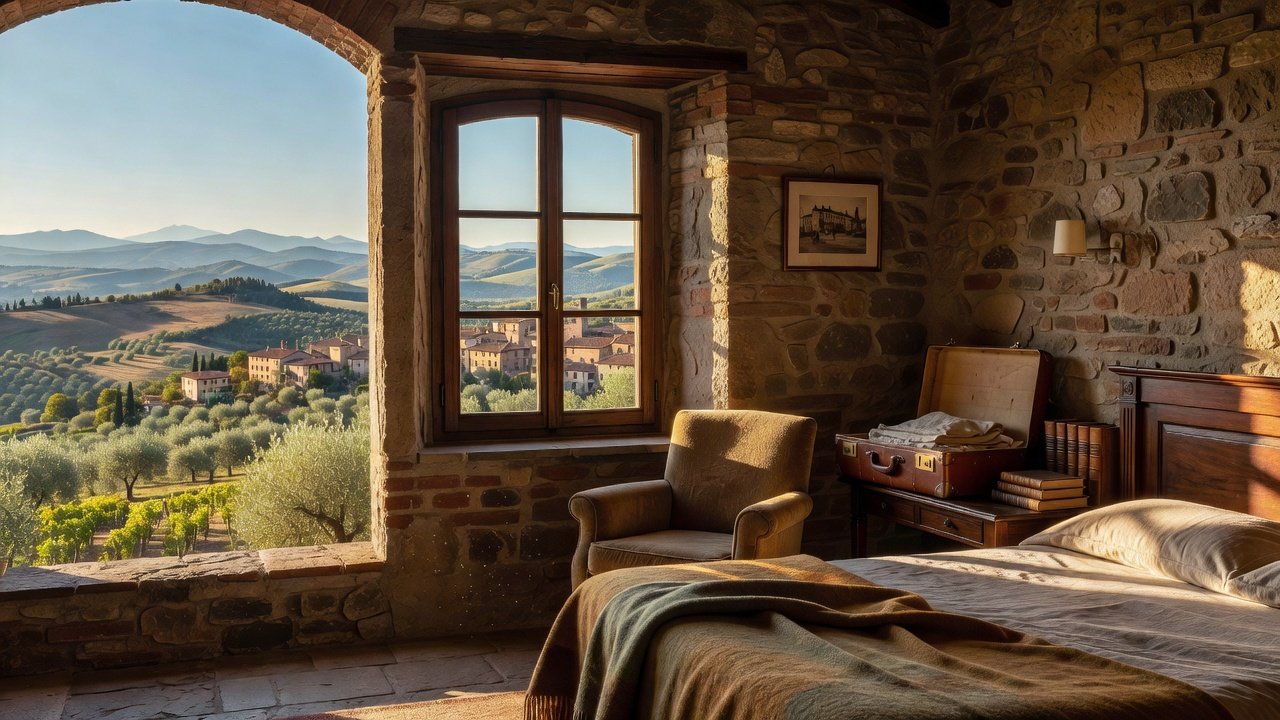
Sleep inside the gray core if you want bells, slopes, and night quiet broken only by someone dragging a suitcase. Sleep in the old monastery hotel on the edge if you want spa water and a softer landing. A small B&B near the vescovado keeps you central without a full hotel machine.
Al Vescovado 7 — budget to moderate Largo del Vescovado 7, 06024 Gubbio PG, Italy
Small B&B in the historic center near the bishop's palace, a short walk from Palazzo dei Consoli and the Duomo side of town. Rooms feel residential rather than corporate; breakfast can migrate to the hanging garden when summer allows. Practical if you parked once and intend to move on foot.
Hotel Gattapone — moderate Via Beni 11, 06024 Gubbio PG, Italy
A compact historic-center hotel close enough to the main stone arteries that you can walk out and be in the story within minutes. Views catch pieces of the old town rather than a parking lot. Bags and slopes are part of the deal; ask about parking before you commit to a tight alley arrival after dark.
Park Hotel ai Cappuccini — moderate to splurge Via Tifernate 55, 06024 Gubbio PG, Italy
A former Capuchin monastery turned hotel and spa just outside the densest medieval knot. Cloister calm, serious breakfast, a pool and spa when the gray streets have taken enough out of your knees. You trade pure alley immersion for recovery. A short walk or quick hop still puts you back under the Consoli tower for evening light.
Two nights beat one. One night turns the funivia into a ride and the square into a photo. Give yourself a slow morning, a cage up the mountain, a long lunch, and an evening when Piazza Grande belongs mostly to people who live here.
Getting there and moving around
Gubbio sits in northern Umbria, province of Perugia, off the main Florence–Rome tourist conveyor. A car is the honest tool from almost anywhere: Assisi, Perugia, the Adriatic side, or the hill towns farther south. Trains do not drop you in the piazza; buses exist and punish tight schedules. From the dual carriageways, follow signs and prepare for the final approach to turn vertical.
Park outside the tightest ZTL core and walk. The historic center is stairs, shins, and patience. Wear shoes that forgive limestone polished by centuries of other people's errands. The funivia base on Via San Girolamo is walkable from the center if you are already committed to hills.
I would not glue this town to Rome as a checkbox. What works is local — theatre grass, hanging square, open cage, truffle steam, gray evening stone.
Gubbio does not soften itself for you. Stand in the cage, hold the rail if you need to, and let the ride up Monte Ingino put the ridge town somewhere you still feel in your legs once you are back on the plain.
