
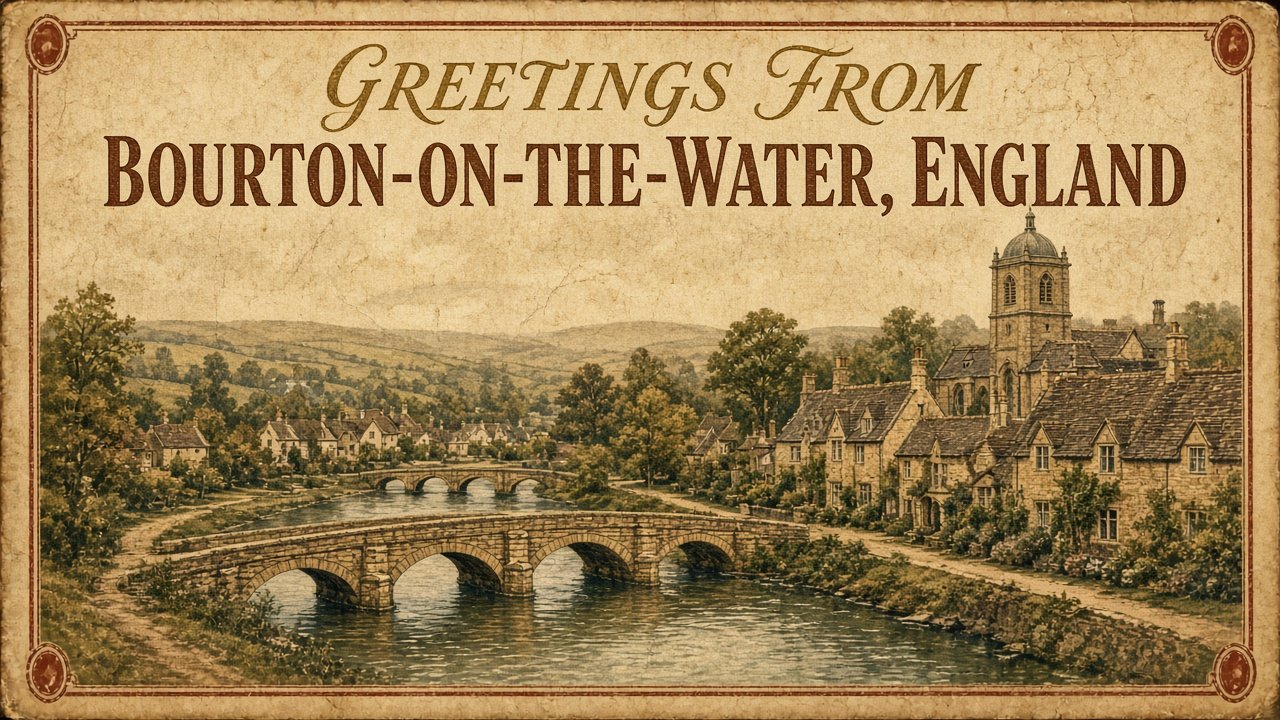
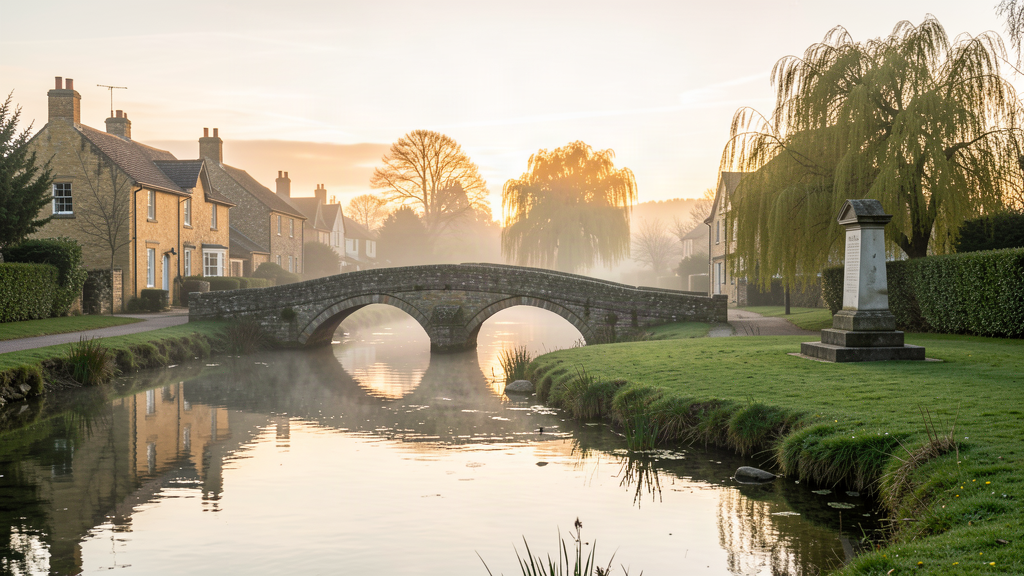
Bourton-on-the-Water arrives as honey stone, ice cream, and coach doors on the village green. Fair enough — the Windrush really does run through the middle of the street, and five low bridges really do step across water shallow enough for paddling ducks. What I keep coming back for starts at the western end of that green. Mill Bridge of 1654 carries ordinary traffic over the old ford line, and the war memorial watches the river enter the open lawn.
If you only have one free morning before another Cotswold stop, walk the bridges west to east before ten, then leave the postcard strip for Greystones Farm and the Salmonsbury meadows. The green is better when delivery vans own the High Street and the selfie lines have not formed.
Mill Bridge and the western green
Bourton sits in a Cotswold valley on the River Windrush, a Thames tributary that rises toward Cutsdean and meets the main river at Newbridge in Oxfordshire. In the seventeenth century the stream was pulled tighter through the settlement to power mills. The Old Mill at the western entry still marks where the water drops before it spreads under the arches.
Mill Bridge — also called Broad Bridge — is the earliest stone crossing still in use here, built in 1654 where a ford once stood. It is a Grade II road bridge near the war memorial and the Motoring Museum, low enough that you feel the deck more than any dramatic span. Stand mid-arch early and the green opens east along the Windrush. Willows hang over clear water. Cotswold stone banks hold picnic grass that fills hard by midday. Most day-trippers start at High Bridge for the photograph. Mill Bridge is where the river actually enters the village scene. The Motoring Museum occupies the Old Mill on Sherborne Street (GL54 2BY) — useful on a wet hour, not required if bridges and meadows are the point.
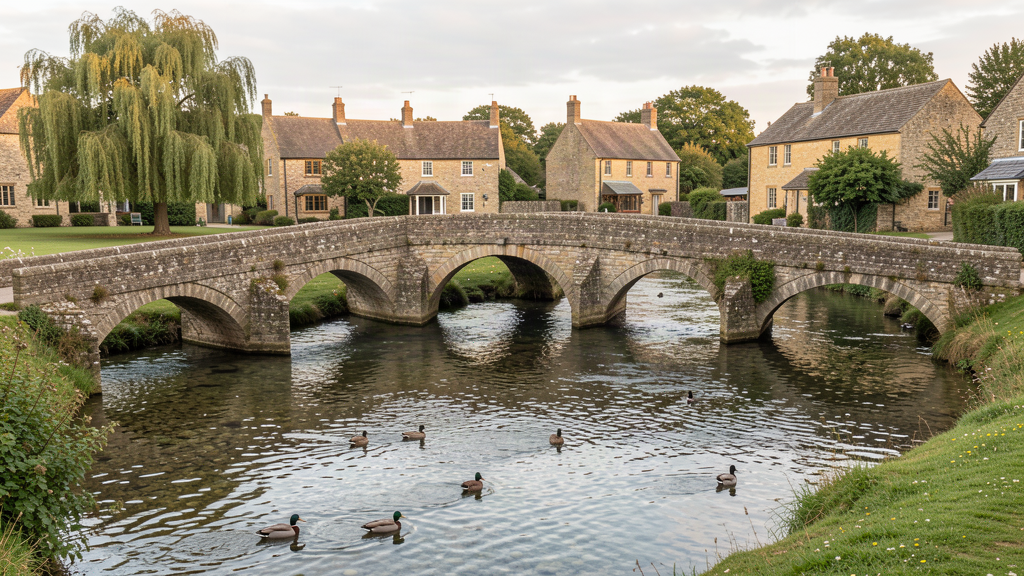
Five arches along the Windrush
East of Mill Bridge the green becomes a short linear park. High Bridge (1756) is the classic low foot crossing most people mean by “Venice of the Cotswolds” — a nickname for bus tours, easy to ignore once you have walked the stone. Paynes Bridge (1776) and New Bridge (1911) sit close together farther along. Coronation Footbridge (1953) closes the eastern end where an older wooden crossing once stood.
None of them are high. That is the point. The Windrush here is a shallow, clear run over stone and weed, crossed for carts and feet rather than drama. Walk the north bank, cross, return the south, and you cover the tourist core without a plan. Ducks outnumber people before ten and after five. High summer can jam the green solid. Weekday mornings and shoulder seasons still feel like a working village green with water through it. August Bank Holiday locals still play football in the river — a century-old habit, not a staged show.
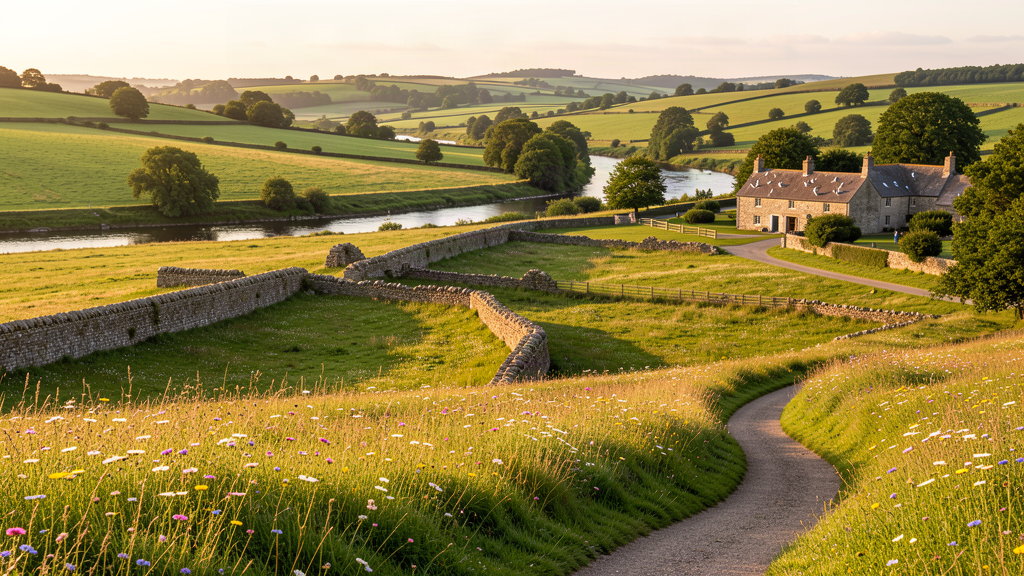
Greystones Farm and Salmonsbury meadows
Leave the bridges east toward Greystones Lane (GL54 2EN). Greystones Farm is a Gloucestershire Wildlife Trust reserve a short walk from the center — wildflower meadows (SSSI), the Rivers Eye and Dikler, farm buildings used by swallows and bats, and the ramparts of Salmonsbury Camp, a Scheduled Monument from Neolithic and Iron Age use of the same ground.
There is no car park on the farm; park in the village and walk out. The Oxfordshire Way runs through on its long line from Bourton toward Henley. Paths cross meadow and river bank rather than gift-shop frontage. Otter and water vole inhabit the same corridor that once held open-field strips before enclosure straightened the Eye for drainage. This is the Bourton coach itinerary’s skip — the agricultural and prehistoric edge behind the honey-stone strip.
A longer loop can continue toward Wyck Rissington, or northwest along the Windrush and Eye toward Lower and Upper Slaughter — roughly four miles for the full pair, or a shorter out-and-back to Lower Slaughter alone. Do one Slaughter if legs allow. You do not need every Cotswold name in a single afternoon.
Model Village without the full souvenir list
Behind The Old New Inn on Rissington Road sits the Model Village: a 1:9 stone replica of 1930s Bourton, Grade II listed, started by the inn’s landlord in the 1930s and finished around 1940. Local craftsmen used Cotswold stone. Miniature shrubs stand in for full-size trees. A stream stands in for the Windrush. Inside the model sits a model of the model. Odd, specific, and worth forty minutes if you like craft more than another cream-tea queue.
Use it as a map of the real streets afterward — High Street, Victoria Street, Sherborne Street, Station Road. Station Road once held a railway stop on the Cheltenham–Oxford line until 1962; tourism filled the gap. St Lawrence’s Church sits slightly off the riverside axis with its distinctive tower. Gift frontage lines the green. Buy what you need and keep moving toward water or meadow.
Places to Stay
Chestnuts Bed & Breakfast — High Street, Bourton-on-the-Water, Cheltenham GL54 2AN
Three-hundred-year-old listed house on the High Street overlooking green and Windrush — rooms from four-poster to twins, breakfast included, river views in some rooms. Practical mid-to-budget base when bridges and early walks matter more than full hotel polish. Central enough that you park once and walk.
The Mousetrap Inn — Lansdowne, Bourton-on-the-Water, Gloucestershire GL54 2AR
Independent nineteenth-century freehouse with rooms a short walk off the pure green strip — craft beers downstairs, comforting plates, eleven individually done rooms upstairs. Mid-range stop when you want a proper pub evening without sleeping on the busiest riverside corner. Book the restaurant in season.
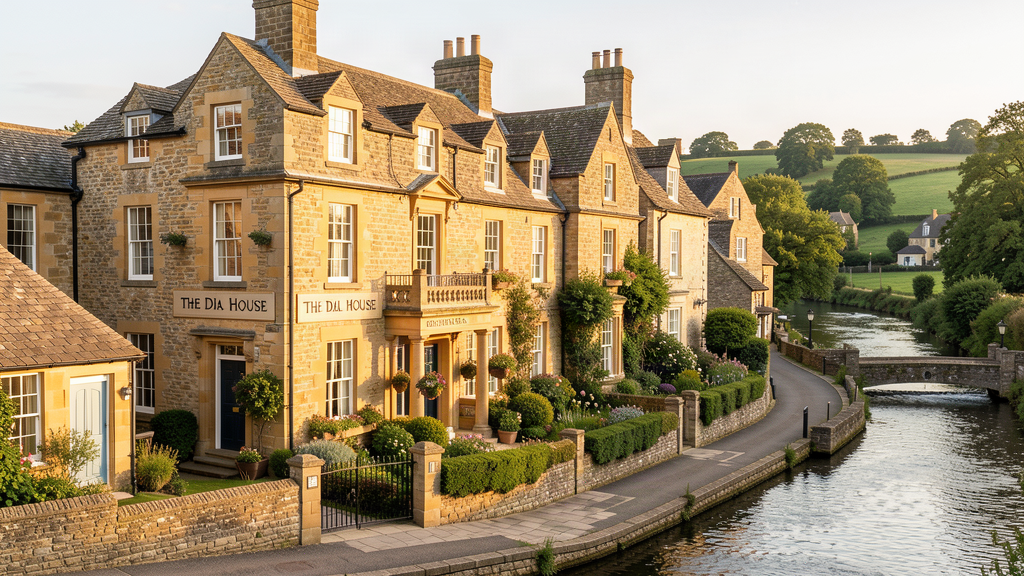
The Dial House — High Street, Bourton-on-the-Water, Gloucestershire GL54 2AN
Boutique hotel in honey stone on the High Street with gardens behind, full restaurant and bar, rooms for longer Cotswold nights rather than a quick B&B. Choose it when dinner and a short walk home matter as much as the Mill Bridge morning.
Where to Eat
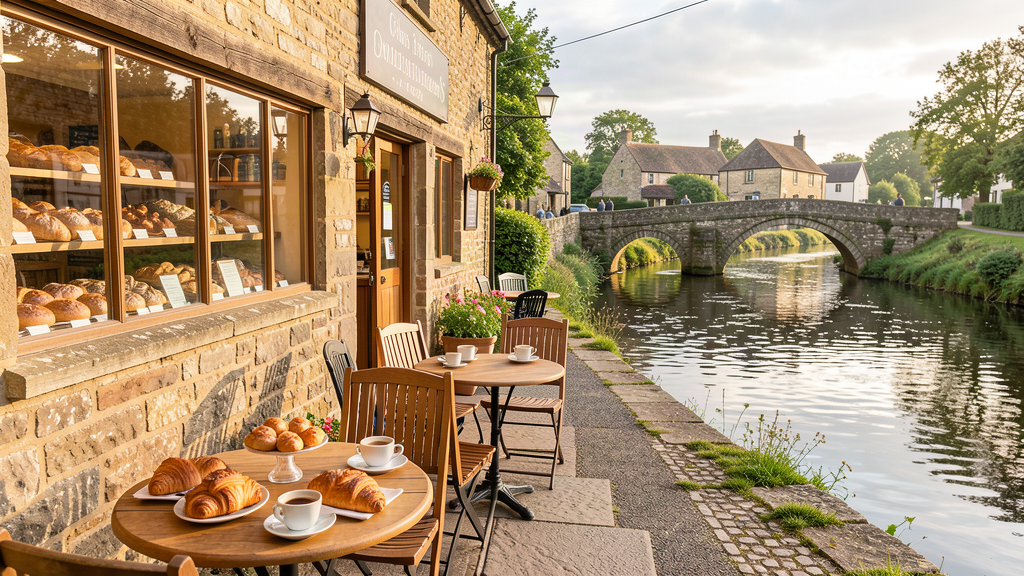
Bakery on the Water — 1 Sherborne Street, Bourton-on-the-Water, Gloucestershire GL54 2BY
Artisan bakery and café right on the Windrush near Mill Bridge and the Motoring Museum — bread, pastries, breakfast, lunch, riverside terrace. Go early for coffee and something baked before the green fills; dog-friendly and walk-in. Useful after a Greystones loop or before the Model Village.
The Old New Inn — Rissington Road, Bourton-on-the-Water, Gloucestershire GL54 2AF
Eighteenth-century inn with refurbished bar and restaurant, seasonal British plates, beer garden, and the Model Village in the grounds. Lunch and dinner midweek; Sunday roast service. Practical after the miniature streets or as an evening table when you want classic inn food without leaving the village edge.
The Mousetrap Inn — Lansdowne, Bourton-on-the-Water, Gloucestershire GL54 2AR
Same address as the rooms: independent freehouse plates and local ales away from the densest ice-cream strip. Good evening stop after a Slaughter walk; book when the village is full. For a more formal High Street dinner the same night, The Dial House restaurant covers the upper end at High Street, GL54 2AN.
When the weather holds, a sandwich on the green before ten beats a peak-lunch queue on the bridges.
Getting around and leaving room
Bourton has no active station. The nearest useful rail is often Moreton-in-Marsh (London and Oxford direction) with the Pulhams 801 bus into the village in roughly half an hour; the same corridor links toward Cheltenham. Road access is the A429 Fosse Way between Cirencester and Stow-on-the-Wold. In season, park once — Rissington Road and other signed village car parks — and walk. Mill Bridge, the green, Greystones, and the Model Village fit on foot better than as four short car hops.
Buses thin outside peak hours — check last services before a car-free evening. Day tours drop hard in summer. If you arrive by coach, peel off toward Greystones before the next timed photo stop.
A useful loop: Mill Bridge and the five arches after breakfast, bakery coffee on Sherborne Street, Greystones and Salmonsbury late morning, Model Village or Lower Slaughter after lunch, dinner at The Mousetrap or The Old New Inn. Shoulder-season weekdays beat August Saturdays. Leave Stow, Bibury, and Broadway for other mornings. Bourton works better as a night base and river-and-meadow day than as a ten-minute stop on a five-village bus.
Bourton gets reduced too easily to a Venice nickname, a bridge selfie, and a cream tea on the green. Walk Mill Bridge where the 1654 stone replaces the ford. The war memorial faces the Windrush entry, and High Bridge still feels like a working crossing before the arches fill. I would keep east until Greystones Lane opens onto Salmonsbury meadows, buy bread on Sherborne Street, and eat it where the water still smells of limestone and willow. The coach lists and the Iron Age rampart share the same village; the stretch of Windrush between Mill Bridge and the farm is the part I would not skip.
