
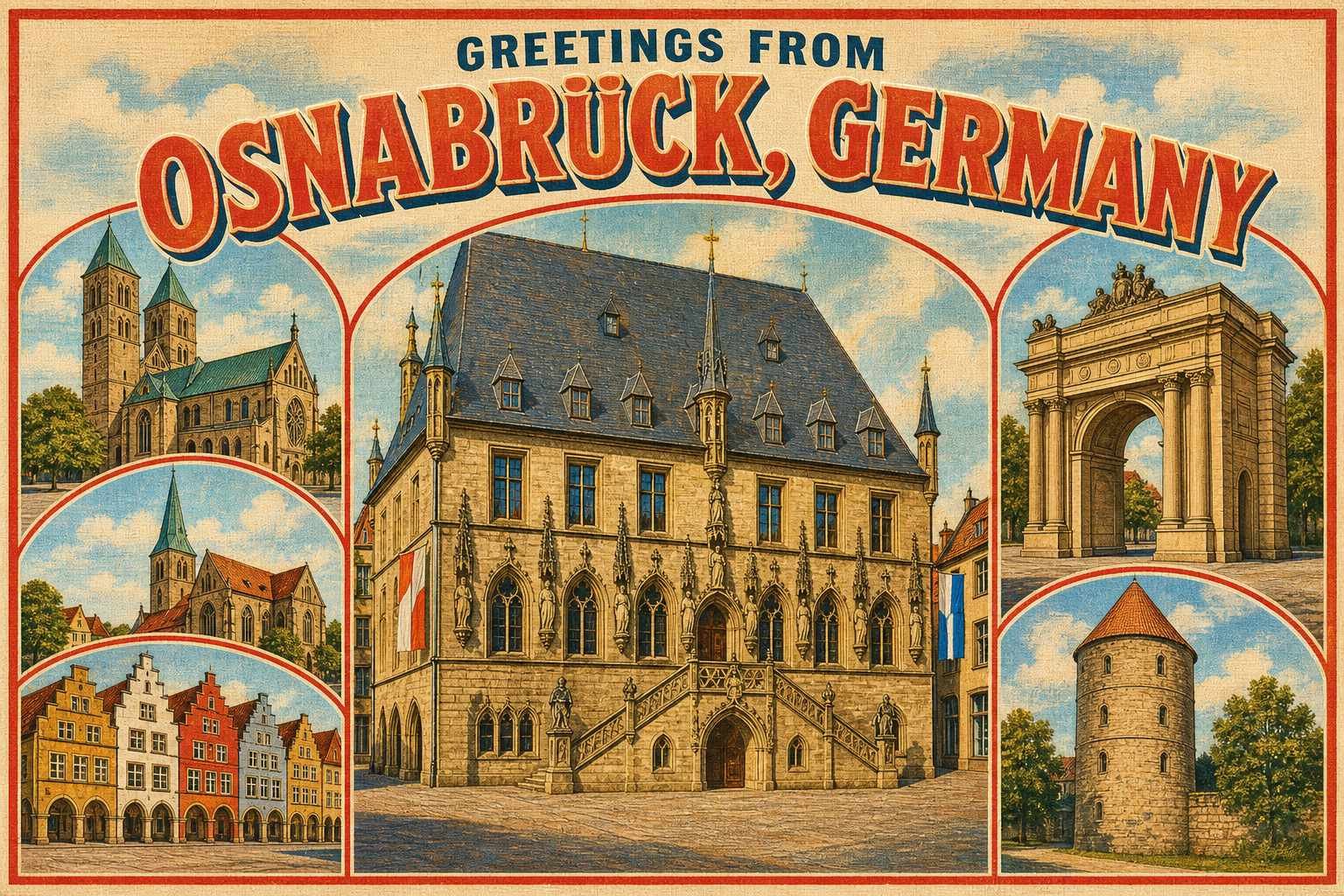
Most people file Osnabrück under “Peace City” and move on — Münster’s quieter twin on the Westphalian Peace circuit, a stop between the Ruhr and the North Sea. Fair if your only errand is the Friedenssaal plaque photo. Thin if you like a working Niedersachsen city that still runs on a river, a Saturday market, and two medieval cores that never quite merged into one postcard.
I start on Domhof when the crates are still wet, cross the Hase on the low footbridges locals call Öwer de Hase, then let Heger-Tor lanes pull me toward Markt and the Rathaus oak. Market noise, river light, civic stone. That is the sequence I keep coming back to.
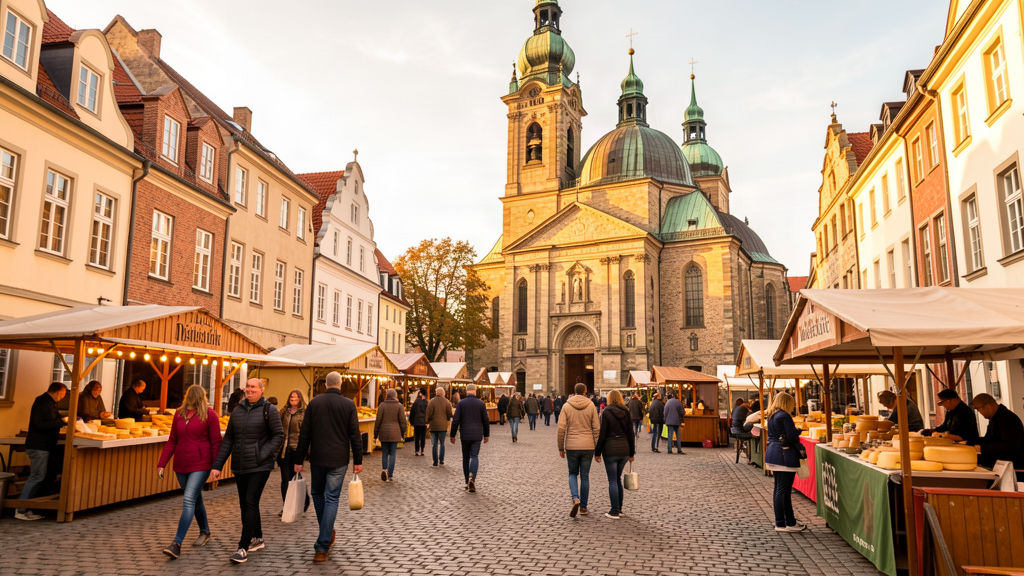
Domhof stalls, Dom St. Peter, and the Saturday that still belongs to the city
Osnabrück sits in western Lower Saxony on the River Hase, between the Wiehen Hills and the northern tip of the Teutoburg Forest, inside the UNESCO Geopark TERRA.vita. Charlemagne planted a bishopric here around 780; the name likely ties to an old river crossing more than the cute “ox bridge” folk story. Two medieval centers grew side by side and never fully fused: the cathedral quarter around Dom St. Peter, and the civic Altstadt around Markt and the Rathaus. You feel the split in your feet when you leave Domhof for Hasestraße.
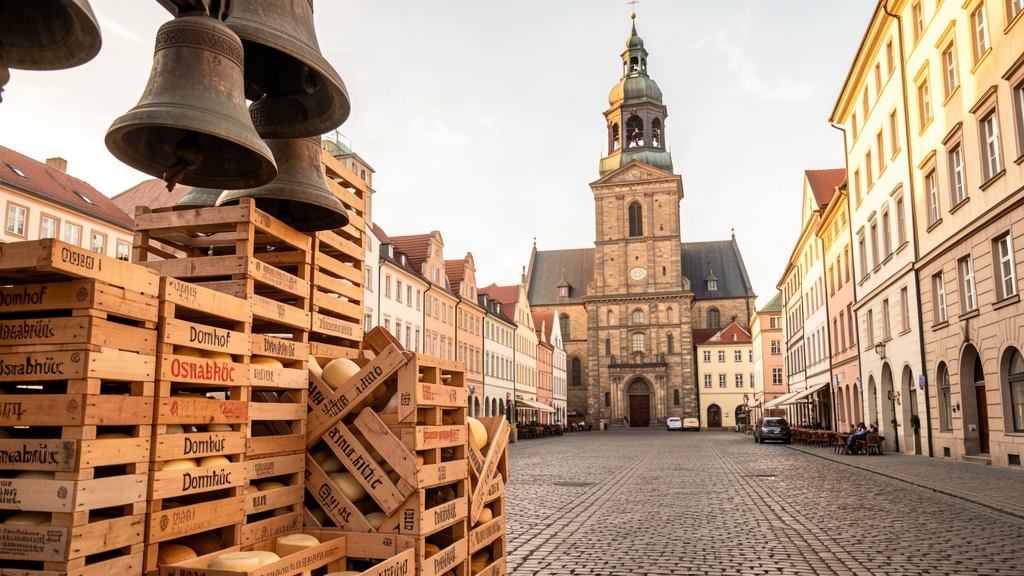
Saturday morning on Domhof is the honest hour. Roughly a hundred vendors fill the square in front of the cathedral — cheese, flowers, bread, farm crates, town and countryside in the same noise. Tour groups show up later; early you get locals doing the week’s shopping. Stand under Dom St. Peter’s towers long enough to hear how the square works, then buy something you can eat while walking. The market runs roughly 8:00–14:00. From Altstadt station (Hasetor) through Hasestraße it is about five minutes if you do not stop for every window.
Inside the Dom, stone cools the street heat. The diocesan museum next door is optional unless rain wins. Domhof is not a chapel checklist. It is the weekly rhythm that still treats the cathedral square as a working room.
From here the city opens two ways. South and west, lanes lean toward Heger Tor and the Altstadt pubs. North and east, the Hase cuts through with footbridges and willows. I take the river first while the market smell is still on my hands.
Hase footbridges, Öwer de Hase, and the wall that became a walk
The Hase is not a postcard Rhine. It is a northern river that once powered mills, carried goods, and doubled as a ditch. Later it turned into an urban sewer; cholera in 1859 made the stink impossible to ignore. The cleaned center stretch is recreation again — paths along Herrenteichswall, low bridges, and the pedestrian seam people still call Öwer de Hase, “over the Hase.” Walk it mid-morning when delivery vans thin out, and bike bells take over.
Herrenteichswall is the soft outdoor hour if rain holds. Trees, water, benches locals actually use. You do not need a boat fantasy; the path is enough. Keep the river on one side and old-town grain on the other, and the city’s scale makes sense — large enough for a university and industry, small enough that a river loop still orients you.
Cross back toward Hasestraße and the Altstadt tightens: half-timber faces, owner-run shops, coffee windows. Heger Straße is the corridor between cathedral side and market side — cobbles, cafés, evening noise without demanding a pub crawl. Heger Tor, the early-nineteenth-century Waterloo memorial gate, marks the western hinge. Brass and stone for Hanoverian soldiers; for a visitor it is a doorway between Wall Green and denser Altstadt.
Markt holds the civic weight. Rathaus Osnabrück keeps the Friedenssaal upstairs — carved oak, forty-two portraits of the delegates who sat in the Westphalian talks from 1643 to 1648 while Catholic counterparts worked in Münster. You can sit where diplomats ended thirty years of wreckage. Go once. Thirty quiet minutes beat a second loop of the same plaques. Marienkirche and the market facades do the outdoor work. Stand long enough to feel why two power centers needed two rooms, then keep walking.
Culture without a forced itinerary: Felix-Nussbaum-Haus for the painter’s fractured rooms; Erich Maria Remarque Peace Center if the war-and-exile thread pulls you; Museumsquartier MQ4 for several collections in one pocket. Rain days belong to Nussbaum or a long coffee, not outdoor heroics on wet cobbles.
Westerberg edges, green fingers, and how Osnabrück actually moves
West of the core, neighborhoods climb toward Westerberg and the university hills — students, quieter evenings, parkland pushing deep into residential fabric. Botanical Garden paths work if you have a third afternoon. Do not let the hinterland steal your only full day. Domhof, Hase, and Heger-Tor Altstadt are the point.
Teutoburg Forest and TERRA.vita trails start close for a longer stay. Hauptbahnhof is a bus hop or solid walk from the Altstadt; Altstadt/Hasetor is the better drop for Domhof. Trains connect Münster, Bremen, Hannover, and the Ruhr. Münster/Osnabrück Airport (FMO) is the usual air door. Inside the core, feet and a simple bike beat parking puzzles. Confirm Friedenssaal hours, museum Mondays, and kitchen rest days before you design a perfect arc onto closed doors. Two or three nights beat a single Peace Hall selfie between Münster connections.
If I had two nights I would do it like this: early coffee near Krahnstraße or Domhof, Saturday market crates if the calendar lines up, Dom exterior and a short interior pause, Hase path along Herrenteichswall and Öwer de Hase, lunch that is not a mall court, afternoon Heger-Tor lanes and Markt with a Friedenssaal visit, early evening river light or a museum hour if rain wins, dinner that still tastes local. Sleep close enough that Markt is optional at dawn. Summer puts bodies on the wall paths. Autumn clears the bridges. Winter lights hold the Christmas market without erasing the Hase.
Places to Stay
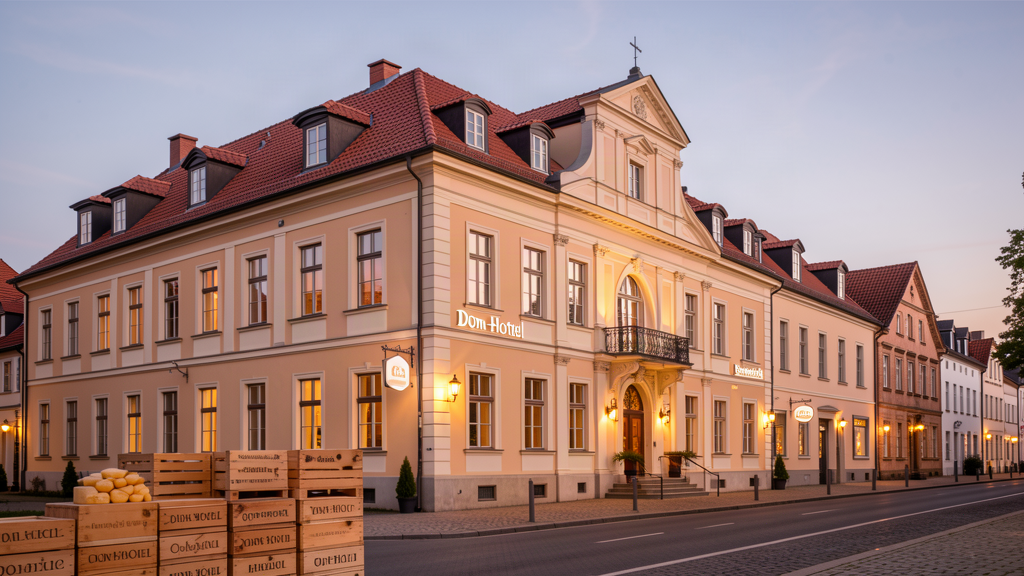
Dom-Hotel (value, cathedral-side practical) Kleine Domsfreiheit 5, 49074 Osnabrück. Small city hotel on the Domhof edge — nonsmoking rooms, breakfast buffet, and a walk-out into the cathedral square and Hasestraße without design rates. Book when you want market mornings without a long commute. Station is a short hop; the trade is simple comfort over spa theater.
Hotel Remarque (mid, wall-side four-star near Heger Tor) Natruper-Tor-Wall 1, 49076 Osnabrück. Larger modern house on the western wall line — restaurant, bar, reliable rooms, and a short walk toward Heger Tor, Felix-Nussbaum-Haus, and the Altstadt lanes. Named for the city’s famous son without turning the lobby into a museum. Choose it for a proper front desk and easy access to both the river and Markt. Parking garage helps by car; book ahead around congress and theater dates.
Romantik Hotel Walhalla (upper, timber Altstadt since 1690) Bierstraße 24, 49074 Osnabrück Family run house in baroque half-timber opposite the market grain — rooms in linked old buildings, restaurant rooms, and a small roof wellness corner with Rathaus views. Oldest continuously running guesthouse story in town, still a hotel rather than a theme set. Pick it when the doorstep should be Markt, Friedenssaal, and Heger Straße after dark. Garage parking costs extra; weekend rates climb with the Christmas market.
Restaurants and food
Café Läer (bakery-café calm on Krahnstraße) Krahnstraße 4, 49074 Osnabrück Traditional bakery café in one of the city’s oldest civic houses — breakfast plates, cakes, coffee, and a gallery room when the front fills. Good before Domhof market or after Friedenssaal when you want something quieter than a brauhaus bench. Come earlier on Saturdays; the lane fills when market bags start swinging.
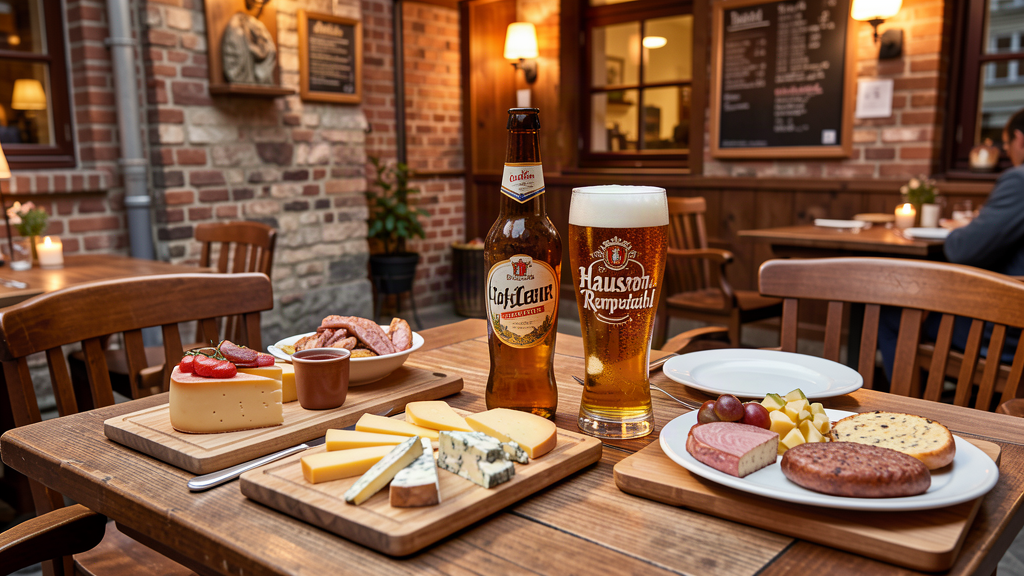
Hausbrauerei Rampendahl (mid, house beer on Hasestraße) Hasestraße 35, 49074 Osnabrück Small brewery restaurant in an old Bürgerhaus across from the bishop’s offices — three house beers, hearty German plates, Treberbrot with schmalz as the welcome habit, and a room locals still use. Named for a 1430 citizens’ uprising that met over drink and ended badly for its leaders. Come after a Hase walk or before Altstadt dusk. Reserve on weekends.
Wilde Triebe (upper-casual seasonal kitchen at Sutthausen station) Am Sutthauser Bahnhof 5, 49082 Osnabrück. Regional seasonal cooking in refurbished railway buildings on the southern edge — clear plates, garden seating when weather holds, Wednesday–Saturday dinners from 18:00. A short train or bus hop from the core, worth it as a counterweight to brauhaus nights. Book ahead; check rest days before you lock a Domhof-to-dinner arc that ends out here.
Regional food stays honest: market cheese and bread for a walking lunch, Westphalian and Lower Saxony plates when menus bother, brewery malt on Hasestraße, and international kitchens that thrive because students need them. Walk the Hase once in low light if you can. Let Domhof crates set a Saturday morning. Sit under Friedenssaal oak without turning the trip into a textbook. Osnabrück is better as market-to-river-to-gate than as another interchangeable Peace City stop.
