
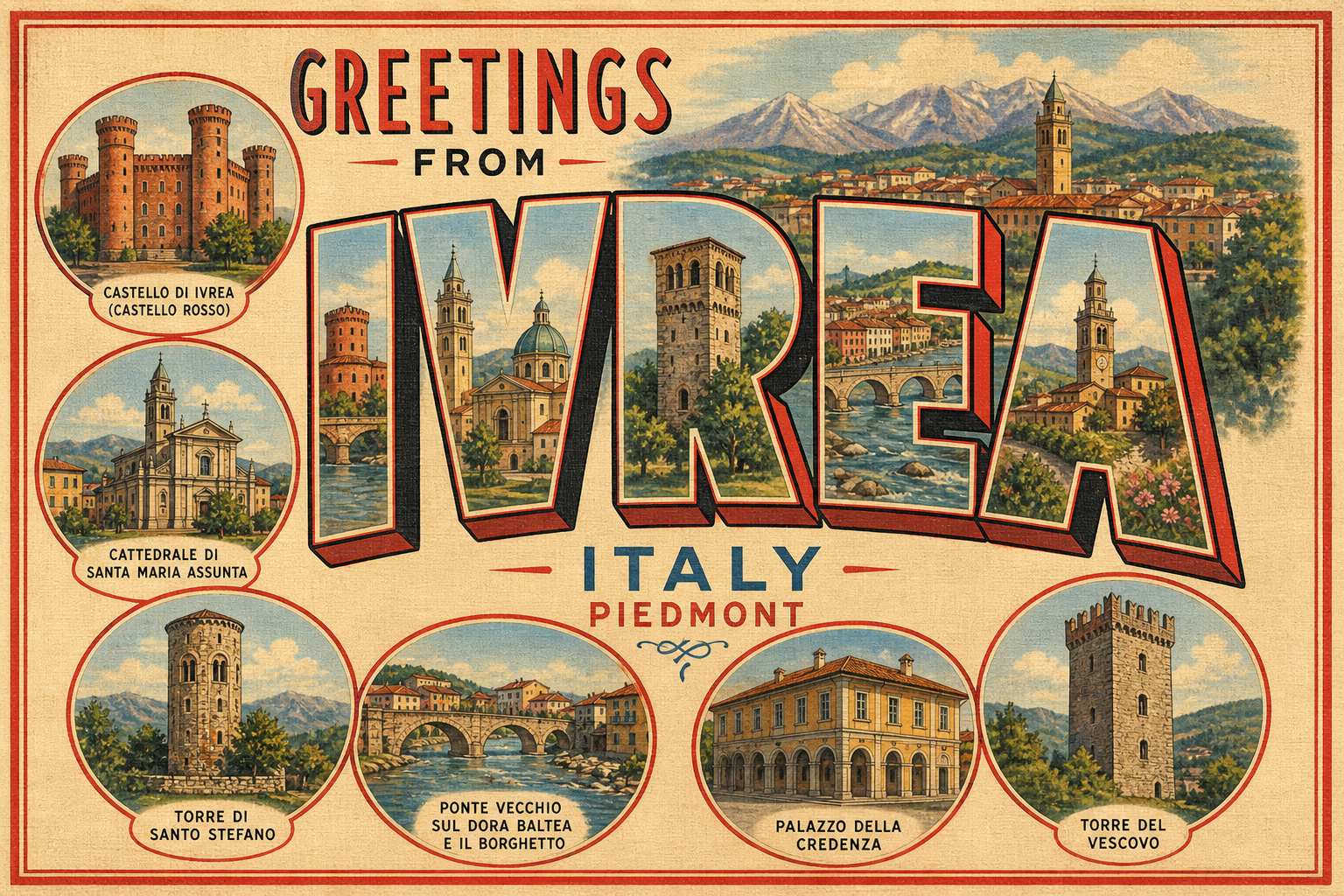
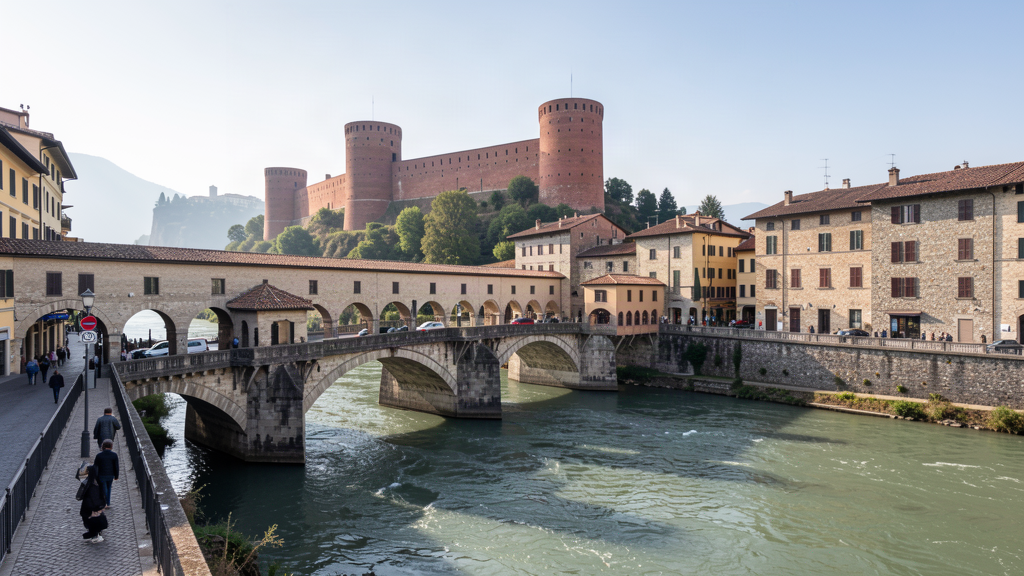
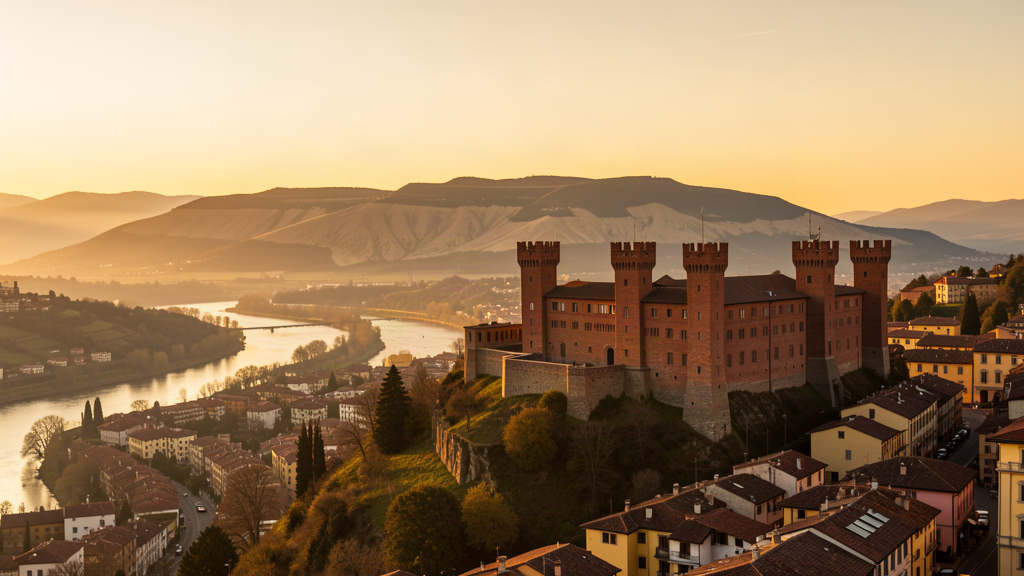
Ivrea sits where the Dora Baltea leaves the Alpine valleys and starts behaving like a lowland river. Red brick castle towers watch from the hill. Below them, the old streets tip toward the water, and a short Roman bridge still carries ordinary traffic into Borghetto, a quarter used to stone, current, and factory history at once.
Turin is an easy train ride south. Most people know Ivrea for the Carnival battle of oranges or for Olivetti typewriters and early computers. I usually skip both as openers. I cross the Ponte Vecchio on foot, stand over the green-gray water, and let the town arrange itself around the river instead of a checklist.
Ponte Vecchio and the far bank
This Ponte Vecchio is not Florence’s. It is quieter in fame: Roman stone, rebuilt and patched for centuries, still doing daily work. Cars use it. Pedestrians share the deck. On one side the upper town climbs toward the Duomo and the castle. On the other, Borghetto gathers low houses, workshops, and lanes that turn quickly away from the main flow.
I like midmorning, when deliveries are finishing. Look downstream toward the modern bridges and the canoe stadium stretch of river. Look up and the castle’s cylindrical towers break the skyline in brick the color of dried clay. The town wears several centuries at once and does not apologize for the mix.
Borghetto rewards slow walking. Facades sit close. Shutters open onto water. You hear traffic, then lose it around a corner. Villa Chiampo and the slopes above remind you a citadel once commanded this bank. Today it is quieter: a dog on a leash, a café table only when weather allows, the river arguing with stone.
Upper streets, cathedral, and the red castle
Cross back and climb. Via Arduino and the lanes around Piazza di Città still feel like a working provincial capital. Shops sell what people need. Bar counters fill with short conversations. The Duomo, Romanesque under later rework, is cool and dim if you catch an open door. Nearby, the bishop’s complex and the Torrione del Vescovo hold the skyline without a ticket queue.
The Castello di Ivrea, raised for the Savoy in the fourteenth and fifteenth centuries, is the silhouette everyone photographs. Four corner towers, red brick, a fortress that later held prisoners and now opens for exhibitions when works allow. Even if interiors are limited, the exterior walk is worth the hill. River ford below, roads north, a plain that needed watching.
I do not treat the castle as the whole story. From here the eye drops to rooftops, then the Dora, then the Serra d’Ivrea, the long moraine ridge that scars the landscape. Clear days feel Alpine. Gray ones deepen the brick and turn the town inward, which suits it.
Olivetti streets without the brochure voice
Ivrea’s UNESCO listing for the twentieth-century industrial city is earned. Camillo Olivetti founded the company here in 1908. Adriano Olivetti later pushed an idea of work, housing, and culture that still feels bold: factories with light, ambitious residential units, libraries treated as infrastructure. Walk between red-brick production buildings and later modern complexes, and you feel a company town that tried to be more than dormitories beside a plant.
La Serra on Corso Botta is the oddest piece for many visitors: dense, almost ship-like, once mixing hotel rooms, cultural spaces, and 1970s materials. Parts of it have lived complicated afterlives. Standing outside, then walking toward the older center, is enough to feel the jolt between medieval hill and industrial experiment.
If machines interest you, the Laboratorio-Museo Tecnologic@mente puts typewriters, calculators, and early computers under glass. I give it an hour when my feet want rest. Then I go back outside. The streets do as much work as the museum: factory roads, river paths, and hill lanes sharing the same map.
Lakes, carnival, and Canavese plates
North of the center, Lago Sirio and a chain of small lakes sit in moraine country. A half-day by bike or car is enough: water, reed edges, weekend walkers, a quieter temperature than the castle hill.
Carnival is the loud season. In February, the Battle of the Oranges fills streets with thrown fruit and costumes. See it once if you like ritual chaos. Know, too, that Ivrea on a plain Tuesday in May or October is another town: fewer costumes, more errands, better odds of hearing the Dora under the bridge without a drumline.
Food follows Canavese and wider Piedmont lines. Tajarin and other egg pastas, bagna cauda when cold justifies it, bollito and brasato, toma, peppers, hazelnuts, wines that do not always wear a Barolo price tag. Portions are serious. Lunch can end the day’s ambition in the best way. Dinner is better when you book.
Places to Stay
Lodging here is practical. Book early for Carnival and summer lake weekends. Midweek outside those peaks is usually simpler.
Aquila Nera da Tony — Corso Costantino Nigra 56, 10015 Ivrea TO. A small hotel-restaurant on the Borghetto side: real bed, short walk to the Ponte Vecchio, bill that leaves room for long meals. Rooms are simple. Personal welcome. Good budget base if stairs do not bother you.
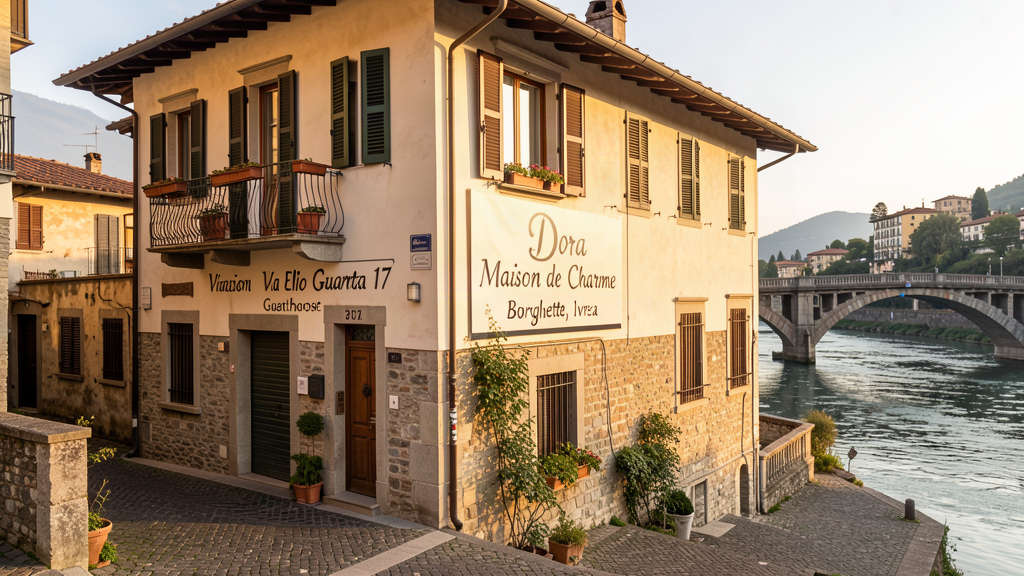
Dora Maison de Charme — Via Elio Guarnotta 17, 10015 Ivrea TO A compact residence almost at the bridge exit into Borghetto, close enough that the river becomes evening sound. More guesthouse than chain. Ideal if you want to walk the historic fabric without driving in from the outskirts. Book ahead; inventory is limited.
Hotel Sirio — Via Lago Sirio 85, 10015 Ivrea TO. Full service hotel by Lago Sirio when you want parking, lake air, and a quieter night after hill walking. You trade pure old-town romance for space. Sensible if you split time between the center and the lakes, or arrive by car.
Where to Eat
Reserve Friday and Saturday nights. Lunch is easier midweek, though popular rooms still fill on busy local days.
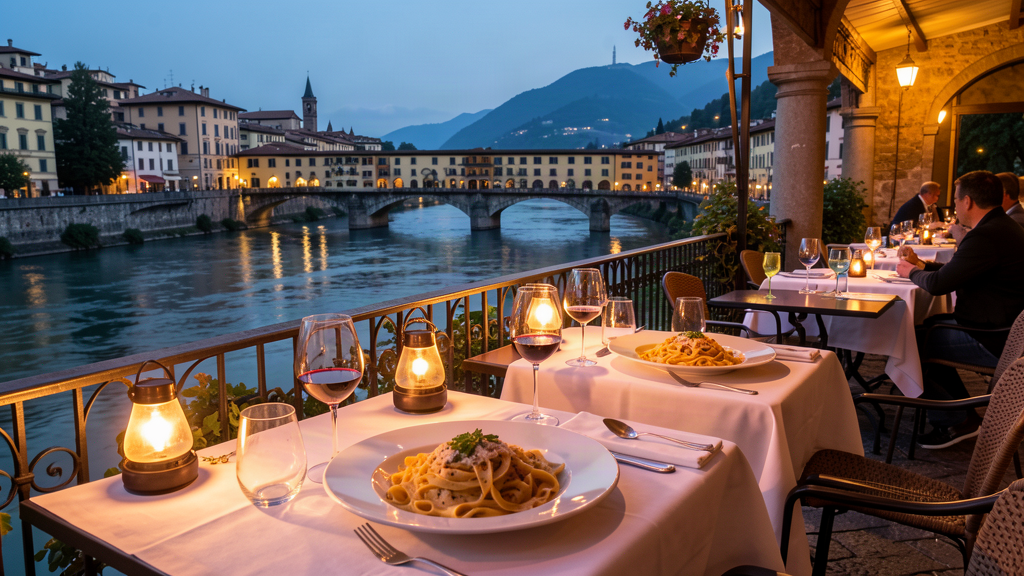
Osteria San Maurizio — Via Elio Guarnotta 1, 10015 Ivrea TO At the Borghetto end of the Ponte Vecchio, with a small terrace when weather allows. Piedmontese plates with weight, a wine list that does not lecture, and dinner where the river walk ends. I like it after a castle climb when I do not want to wander far.
Trattoria Monferrato — Via Gariglietti 1, 10015 Ivrea TO Classic cooking without performance. Pasta, braises, secondi that make sense after a cold walk along the Dora. The room is for eating, not for cameras. If there is a daily special tied to the market or season, take it.
Ristorante Pizzeria La Lucciola — Vicolo Cantarana 12, 10015 Ivrea TO A long-running address on a small lane in San Lorenzo. Useful when a group splits between pizza and fuller plates, or when you want a lively room without climbing back to the castle. Sometimes the correct meal is shared pizza after too many museums.
For a cheaper midday reset, any busy bar near Piazza di Città will do espresso and a panino. That is not failed planning.
A practical day without a parade schedule
Morning: coffee in the upper town, then a slow drop to the Dora and a crossing into Borghetto. Midday: climb back for the Duomo if open, the castle if accessible, and a sit with brick towers against whatever sky Piedmont offered. Lunch near the bridge or in the center. Afternoon: an Olivetti loop on foot, or a drive to Lago Sirio. Evening: early dinner, then a second pass over the bridge when day traffic has thinned.
Regional trains from Turin put you here without drama (check current Aosta-line stops for Ivrea). The station is a walk or short bus ride from the core. By car, the A5 works; center parking wants a plan. Inside the old streets, walk. Wear shoes that forgive uneven stone. Spring and autumn are the best seasons if you care more about pace than spectacle.
Carnival weeks need another mindset: book everything, expect crowds, and decide whether you want the orange battle or the quieter town that exists the other fifty weeks.
What stays with you
I leave Ivrea remembering the deck of the Ponte Vecchio more than any museum label. River color under Roman stone. Borghetto’s low houses. Red towers on the hill. A factory building with more glass than you expect. A plate of tajarin when the afternoon had already gone soft.
Come for Piedmont between Turin’s grid and the high Aosta valleys. Cross the Roman bridge without rushing. Walk Borghetto until the map simplifies. Then cross again after dinner, when the Dora sounds louder, and the towers go dark. That second crossing is usually when Ivrea stops feeling like a stopover.
